Endangered
Conus henckesi
Conus henckesi
Conus henckesi, now often listed as Conasprella henckesi, is a thumbnail-sized cone snail known only from shallow reefs in Bahia state, northeastern Brazil. The IUCN Red List rated it Endangered in 2025, raised from Vulnerable in 2013, because its range is tiny and the area it occupies is shrinking.
How to recognise it
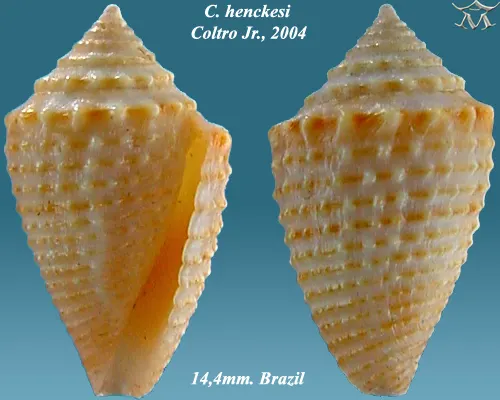
It is a small shell, 15 to 18 mm long, shaped like two cones set base to base, with slightly concave sides and a stepped spire that makes up about a quarter of the length. The spire has 6 to 7 whorls, and the angled shoulder carries a ring of 14 to 18 small nodules.
The body whorl is covered in heavy granules arranged on 16 to 18 broad spiral cords. Colour runs from yellow-orange to red-orange, strongest in live animals, sometimes with pale brown marks, and the opening is light yellow-orange. The largest of the shells in the original description measured 17.3 mm.
Where it lives
The species was described by Coltro in 2004 from Mar Grande, off Itaparica Island in Bahia. He recorded it on coral sand at 1 to 2 metres depth on the outer reefs facing the open sea, and called it endemic to that island.
The Red List gives a wider picture. It records the snail in Bahia only, at 2 locations, over depths of about 1 to 20 metres, on sandy bottoms, coral reef and rubble between reefs. Its extent of occurrence is estimated at 612 square kilometres and its area of occupancy at 232 square kilometres.
Pins are Wikidata “endemic to” fields. Orange dots, when present, are GBIF occurrence tiles — survey bias included.
A shell once mistaken for another
For years collectors filed these snails as a knobbly form of Conus selenae, a species from further north. Coltro separated them on shape and detail: selenae has a flatter apex with fewer whorls, a smoother body, an oval outline and a white opening, while henckesi has the stepped, nodular look described above.
Why it is in trouble
The assessment names two pressures: tourism and recreation areas, and small-scale harvesting. It also records a continuing decline in the area the snail occupies. Whether the number of animals is rising or falling is listed as unknown, and no population count exists.
Coltro warned in 2004 that so restricted a range could make the snail endangered as people occupy the island. The assessment records no recovery plan or monitoring scheme. Like other cone snails it is venomous and can sting people, so live ones are best left alone.
Sources
Written for this catalog in our own words from the sources below, checked against them on 12 November 2026. Population figures are estimates and carry the year they were made. Status and assessment year: IUCN. 2026. The IUCN Red List of Threatened Species. Version 2026-1. iucnredlist.org.