Critically Endangered
Conus salreiensis
Conus salreiensis
Conus salreiensis is a small cone snail known only from shallow rocky water on the northwest coast of Boa Vista, one of the Cape Verde islands. The IUCN rated it Critically Endangered in its 2012 assessment, with a decreasing population confined to a single location and a tiny range.
How to recognise it
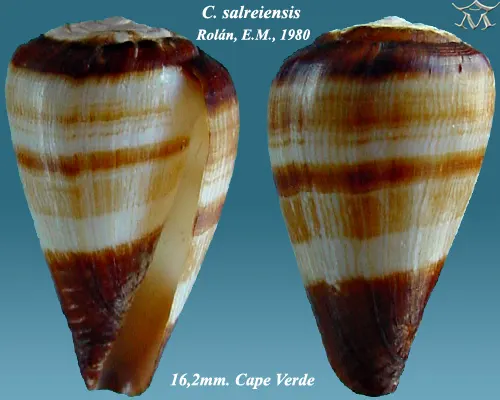
This is a sea snail with a conical shell that reaches about 25 mm, with a rounded shoulder and a short spire. The spire and the base are dark brown. Between them, the last whorl carries several spiral bands that run from light brown to yellowish, and a hand lens shows many fine brown lines running across the bands.
Rolán described it in 1980. Like every cone snail, it is a venomous predator.
Where it lives
Everything known about this species places it in Cabo Verde, on the northwest side of Boa Vista. The IUCN assessment records a single location and a very small footprint: an area of occupancy of 9 and an extent of occurrence of 12, presumably in square kilometres, though the assessment does not state the unit. The snails live on subtidal rocky reefs at depths of about 1 to 15 m.
Cape Verde's cone snails are unusually local. A 2016 study in Global Change Biology by Peters and colleagues reported that 53 of the archipelago's 56 cone species occur nowhere else, and that most are restricted to a single island, often a single bay.
Pins are Wikidata “endemic to” fields. Orange dots, when present, are GBIF occurrence tiles — survey bias included.
Why it is in trouble
A range this small leaves very little margin. The assessment lists two ongoing threats that affect the whole population: small-scale harvest, and recreational activities along the shore. It records specimen collecting as a use, and it notes continuing decline in the area the species occupies. It rates the recreational pressure as capable of causing very rapid declines, although the effect of the harvest is listed as unknown.
The same 2016 study points to Cape Verde's shift to a tourism-based economy, because the building boom that follows often overlaps the shallow habitat of range-restricted cone snails. It found 45.3 percent of the archipelago's assessed cone species threatened or near-threatened, compared with 7.4 percent of 579 species elsewhere, and reported that three cone snails are rated Critically Endangered, all of them endemic to Cape Verde.
What is being done
The 2012 assessment lists no conservation actions in place for this species. Research needs recorded there are population size, distribution and trends, the effects of harvest and use, and the threats themselves.
Its taxonomy is also unsettled. The World Register of Marine Species currently treats Conus salreiensis as a synonym of Conus crotchii (named by Reeve in 1849), as do other references. The Red List assessed salreiensis as a separate species in 2012, so it appears here under that name.
Sources
Written for this catalog in our own words from the sources below, checked against them on 12 November 2026. Population figures are estimates and carry the year they were made. Status and assessment year: IUCN. 2026. The IUCN Red List of Threatened Species. Version 2026-1. iucnredlist.org.