Endangered
Conus aemulus
Conus aemulus
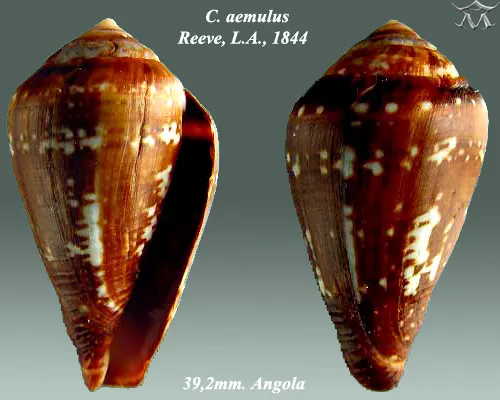
Conus aemulus, the amber marbled cone snail, is a small venomous sea snail known only from shallow waters off Angola. The IUCN Red List assessed it as Endangered in 2025, replacing a Least Concern listing from 2012. Its range is tiny, and pollution and collecting both put it at risk.
How to recognise it
Lovell Reeve described this species in 1844. Its shell is conical, between about 20 and 58 mm long, and it belongs to the subgenus Lautoconus.
Like other cone snails it is a predator that hunts with venom, and it can sting people, so live ones should be left alone.
Where it lives
The IUCN records it as endemic to Angola, in the south-east Atlantic. It lives in shallow water, from about 1 to 5 m deep, on sandy bottoms and on rocky reefs. It is not migratory.
The Red List gives an extent of occurrence of 464 square kilometres and an area of occupancy of 308 square kilometres, with two to five locations. One published description puts the habitat at a strip of coast about 40 km long.
Pins are Wikidata “endemic to” fields. Orange dots, when present, are GBIF occurrence tiles — survey bias included.
Why it is in trouble
The 2025 assessment says the population is declining, and it classes the species as Endangered under criteria B1ab(iii,v)+2ab(iii,v), which cover a small range with continuing decline. The ongoing threats it lists are sewage, run-off, and garbage and solid waste. Each affects the majority of the population and is causing slow, significant declines. A possible future oil spill is also listed. Pollution from the nearby city of Luanda is reportedly a worry.
Small-scale harvesting affects a minority of the population and is thought to cause fluctuations. The IUCN also records international use of the species for specimen collecting.
Older references still call the species Least Concern. That reflects a 2012 assessment, which has since been replaced.
What is being done
Little has been recorded. The assessment says there is no recovery plan, and it is unknown whether any monitoring scheme or protected site covers the species. Research on population size, distribution and threats is listed as a need.
Sources
Written for this catalog in our own words from the sources below, checked against them on 12 November 2026. Population figures are estimates and carry the year they were made. Status and assessment year: IUCN. 2026. The IUCN Red List of Threatened Species. Version 2026-1. iucnredlist.org.