Endangered
Conus ateralbus
Conus ateralbus
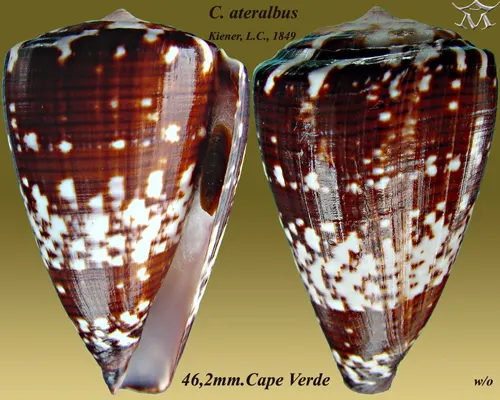
Conus ateralbus, now often called Kalloconus ateralbus, is a venomous cone snail found only on the island of Sal in Cabo Verde. Its shell has white triangles on a black background. The IUCN Red List assessed it as Endangered in 2012, and later genetic work has shrunk its known range to part of one coast.
How to recognise it
Adult shells reportedly measure roughly 29 to 48 mm. A 2020 taxonomic revision describes white triangular or tessellate markings on a black background that seem fairly constant between shells, and it measured one specimen from Calheta Funda, Sal, at 40.1 mm.
Like all cone snails it is a predatory marine gastropod armed with venom. Cone snails can sting people, so live ones should be handled carefully or not at all.
Where it lives
It is endemic to Sal Island, Cabo Verde. The IUCN assessment records it in shallow water, 2 to 15 m deep, on sandy bottoms and rubble between reefs, and occasionally on coral reef. It counts 2 to 5 locations and puts both the extent of occurrence and the area of occupancy at 60 square kilometres. Those figures date from before the species was split.
A 2020 revision of West African cone snails by Tenorio and colleagues, based on mitochondrial genomes, treats what looked like one species on Sal as two cryptic sister species: this one and Kalloconus marimaris. With the two separated, this species is known only from the southwest coast of the island, at places including Calheta Funda and Algodoeiro. The revision places it in the genus Kalloconus and credits the name to Kiener, 1850.
Pins are Wikidata “endemic to” fields. Orange dots, when present, are GBIF occurrence tiles — survey bias included.
Why it is in trouble
The 2012 assessment lists small-scale harvesting for subsistence and recreational activities as ongoing threats across the whole range. Their severity was marked unknown. It also records continuing decline in habitat and that the population is not severely fragmented, with a stable population trend and no population estimate.
The 2020 revision adds that the southwest coast of Sal has seen large tourism development in recent years, putting pressure on marine habitats. It says the species is fairly common inside its small range, yet concludes that its risk status probably needs to be raised.
What is being done
The assessment records no conservation actions in place. The 2020 revision flags the Red List entry as needing revision because the range is now so small, but it reports no specific protection measures.
Sources
Written for this catalog in our own words from the sources below, checked against them on 12 November 2026. Population figures are estimates and carry the year they were made. Status and assessment year: IUCN. 2026. The IUCN Red List of Threatened Species. Version 2026-1. iucnredlist.org.