Critically Endangered
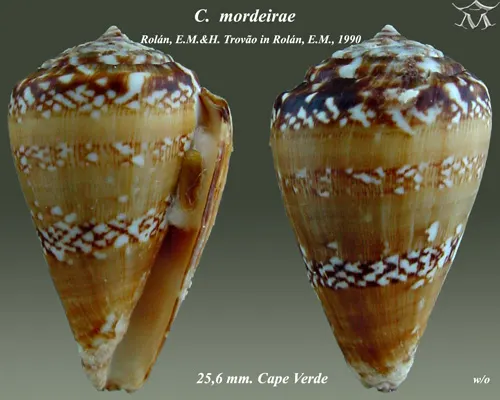
Conus mordeirae
Conus mordeirae
Conus mordeirae is a small cone snail known from a single bay on the west coast of Sal island in Cape Verde. The IUCN Red List assessed it as Critically Endangered in 2012, citing tourism development and small-scale harvesting of shells. Some databases now treat the name as a synonym of Conus cuneolus.
What it is
Cone snails (genus Conus) are predatory, venomous sea snails. Live ones can sting people, so they should not be picked up. The IUCN lists this one at about 35 mm long as an adult.
It was described in 1990 by Rolán and Trovão from Cape Verde. The IUCN assessment and a 2016 study of Cape Verde's cone snails both treat it as a species in its own right. MolluscaBase and GBIF list it as a synonym of Conus cuneolus Reeve, 1843, a species the Red List ranks as Endangered. Which name applies depends on the source, so check the name before looking up its status.
Where it lives
It is endemic to Cape Verde, in the eastern central Atlantic. The IUCN assessment places it only in the Baía da Murdeira on Sal's west coast, a bay with about 11 km of coast, and lists a single location with an area of 18 square kilometres. It lives on shallow subtidal rocky reef about 1 to 5 metres deep.
That is snorkelling depth. Of the twelve cone snails endemic to Sal, six are threatened, and this is the only one ranked Critically Endangered.
Pins are Wikidata “endemic to” fields. Orange dots, when present, are GBIF occurrence tiles — survey bias included.
Why it is in trouble
A 2016 study in Global Ecology and Conservation, led by Howard Peters, found the population in decline, with the snails densest next to resort developments. It names tourism infrastructure as the pressure that pushed this species to Critically Endangered. The IUCN assessment lists tourism and recreation areas as an ongoing threat across the whole range, with very rapid declines, and points to a large resort project planned at the bay itself. It also lists small-scale harvest. It describes the species as once among the most abundant in the region but now rare.
The study adds that Cape Verde's cone snails are easy to collect. They live in the shallows, many have attractive patterns, and they can be picked up by tourists or sold by shell traders. Only live animals give the shell quality that serious collectors want.
Collecting is not believed to have hurt most species so far, the study says, but rare ones already under pressure could be pushed further by irresponsible gathering. Biology adds to the risk. Cape Verde's endemic cone snails have larvae that draw nourishment from an egg sac instead of feeding, so they disperse poorly. That helped create many species confined to one island or even one bay, and leaves each with little room to recover.
What is being done
The IUCN assessment lists no conservation measures in place and says more research on abundance and threats is needed. Baía da Murdeira is the one exclusively marine protected area among the 27 coastal areas Cape Verde has scheduled, but the 2016 study describes the protected area network as short on management and monitoring. It recommends an export ban on all Cape Verde cone snails and shells, apart from licensed research, along with ongoing population monitoring.
Sources
Written for this catalog in our own words from the sources below, checked against them on 12 November 2026. Population figures are estimates and carry the year they were made. Status and assessment year: IUCN. 2026. The IUCN Red List of Threatened Species. Version 2026-1. iucnredlist.org.