Endangered
Brookesia tristis
Brookesia tristis
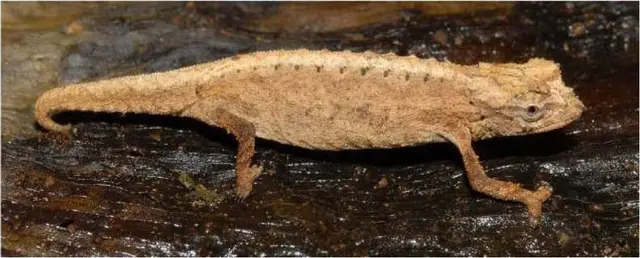
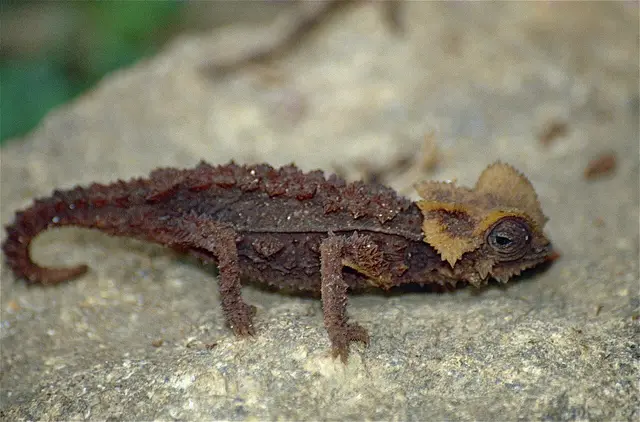
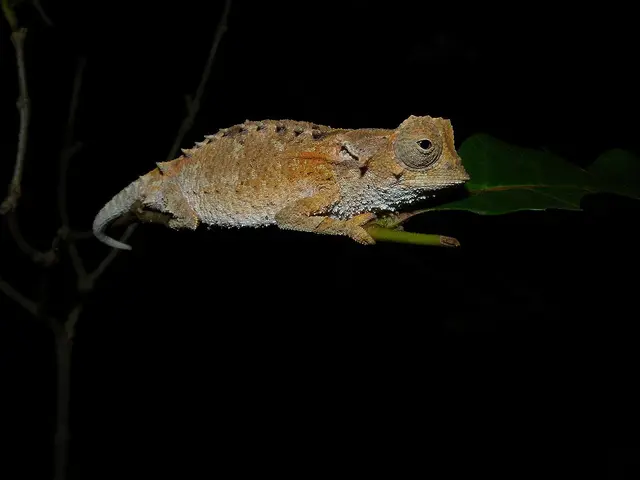
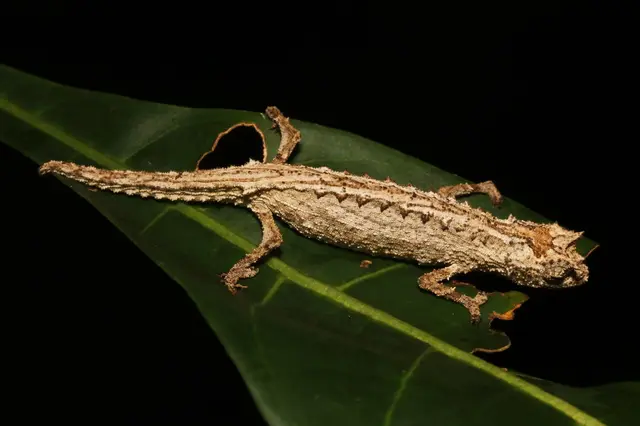
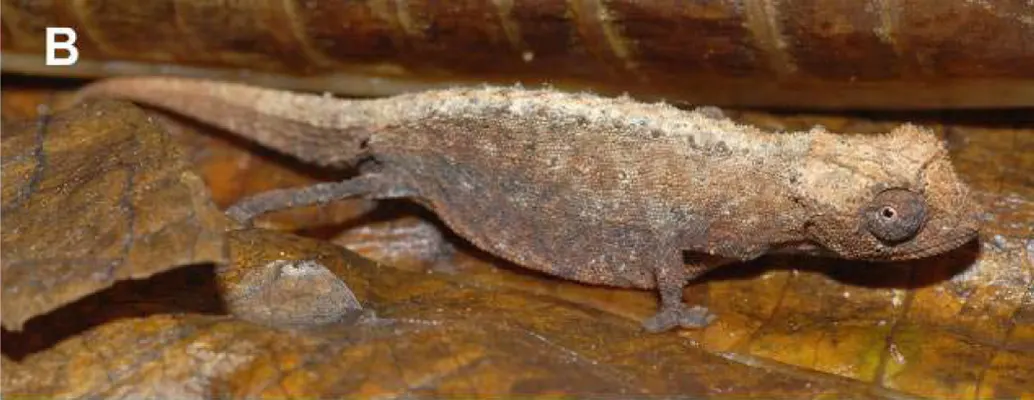
Brookesia tristis is a tiny leaf chameleon known only from one limestone massif, Montagne des Français, in northern Madagascar. It was formally described in 2012 and listed as Endangered by the IUCN Red List in 2014. Its name means sad, a nod to the forest loss at its only home.
How to recognise it
It is one of the miniature leaf chameleons. In the original description, adult males measured 18.0 to 18.2 mm from snout to vent, and females were listed at 18.0 to 23.8 mm. Two hatchlings were about 14 mm in total length.
In life it is brown to beige, with faint brown bars radiating from the eye and a brown chin and throat. Several specimens kept together in a bag developed a light grey stripe down the back, which the describers took to be a stress response.
Where it lives
It has been found only on Montagne des Français, a limestone massif in the far north of Madagascar. The IUCN gives its extent of occurrence as just 63 square kilometres, treats the whole range as a single location, and records it at 140 to 300 m above sea level in dry forest.
Pins are Wikidata “endemic to” fields. Orange dots, when present, are GBIF occurrence tiles — survey bias included.
How it lives
Researchers found most individuals sleeping at night on small branches 5 to 50 cm above the leaf litter. The animals were abundant in a few small patches and scarce in other forest that looked similar.
One female laid two large eggs in February. The young hatched after 64 and 69 days at 20 to 26 degrees C.
Why it is in trouble
The scientists who described it reported severe deforestation across its entire known range, even though the massif had recently been declared a nature reserve. They named the species tristis, Latin for doleful or sorrowful, because of that destruction. A 2012 news report on the discovery said habitat destruction was continuing there.
The IUCN lists shifting agriculture as the threat, with the species' extent continuing to shrink. The assessment gives no population count.
What is being done
The 2014 assessment records that the species occurs in a protected area covering nearly all of its range, that an area management plan exists, and that it falls under international trade controls. It also records no recovery plan, no monitoring scheme and no captive population.
Sources
Written for this catalog in our own words from the sources below, checked against them on 12 November 2026. Population figures are estimates and carry the year they were made. Status and assessment year: IUCN. 2026. The IUCN Red List of Threatened Species. Version 2026-1. iucnredlist.org.