Endangered
Brookesia decaryi
Brookesia decaryi
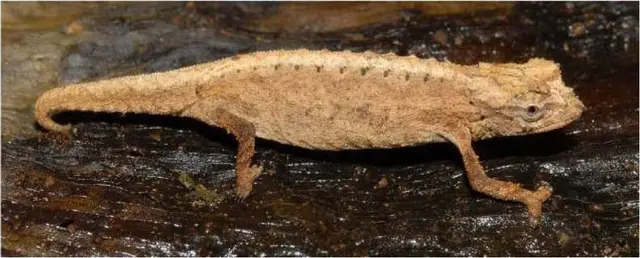
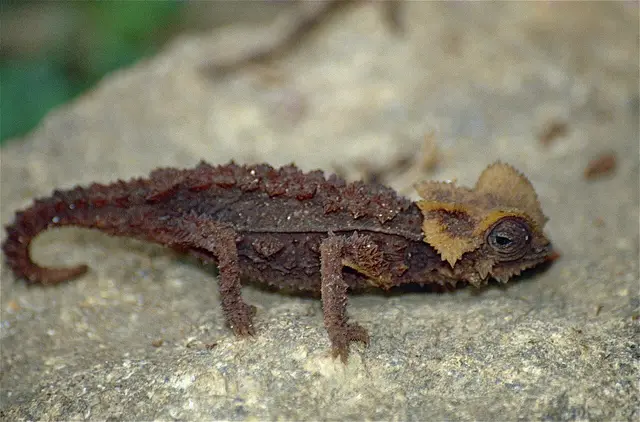
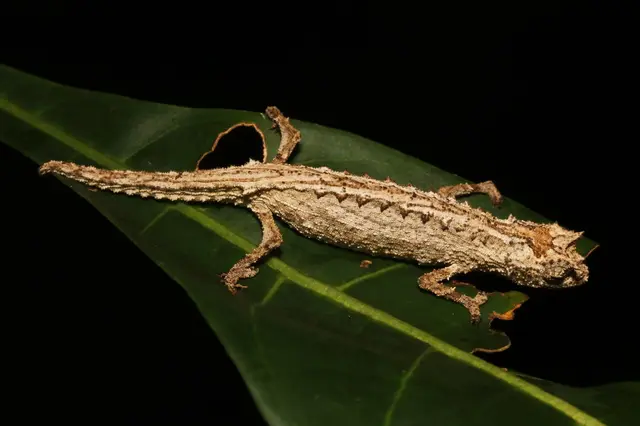
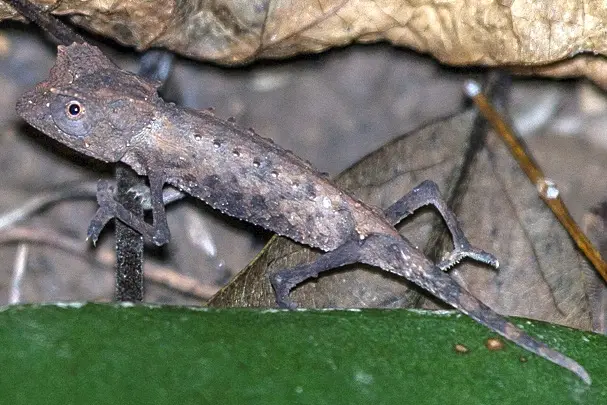
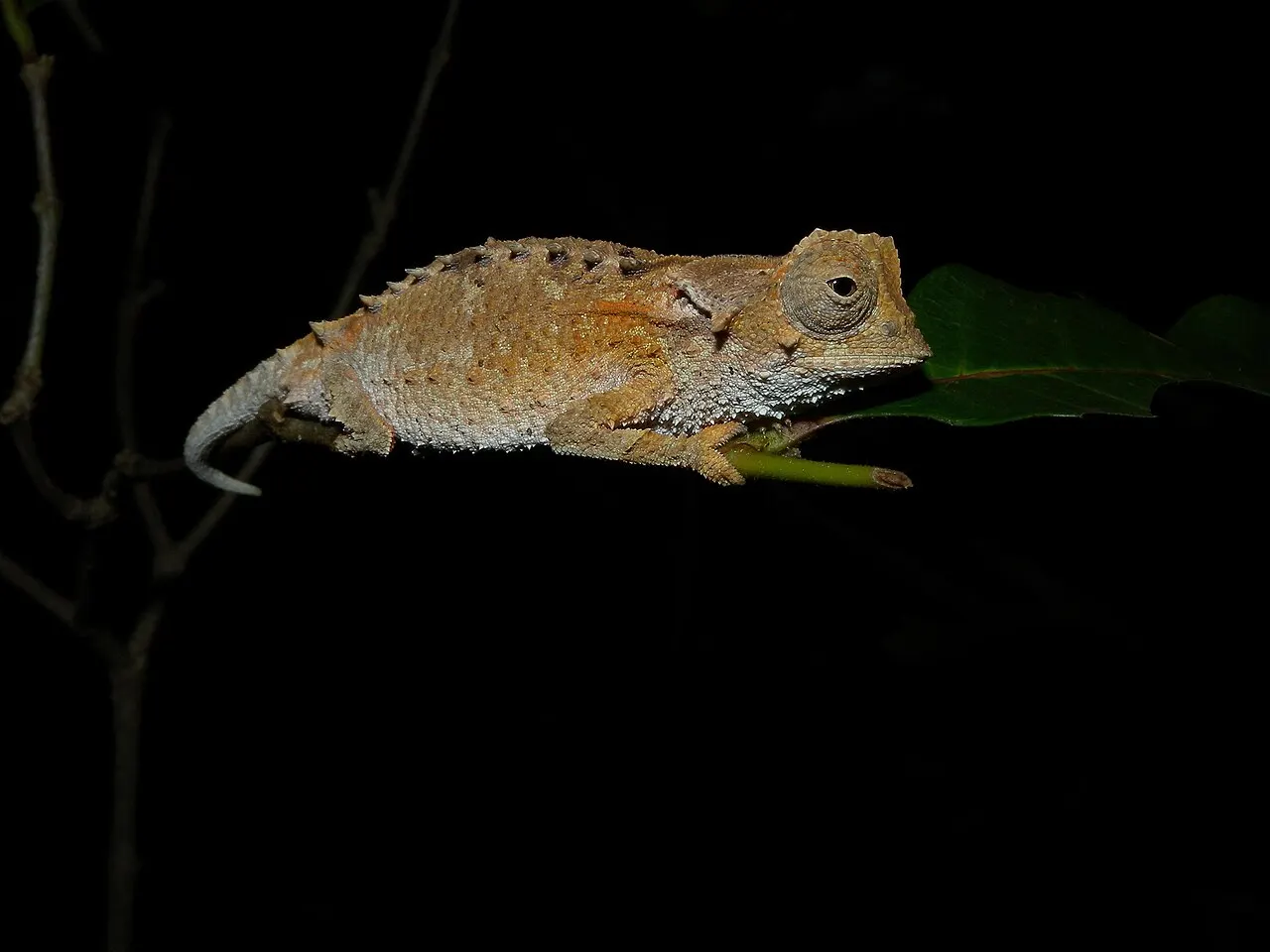
Decary's leaf chameleon (Brookesia decaryi), also called the spiny leaf chameleon, is a small, short-tailed chameleon found only in the dry forests of northwest Madagascar, mainly in Ankarafantsika National Park. The IUCN Red List lists it as Endangered (assessed 2011), with a decreasing population.
How to recognise it
This is one of the larger leaf chameleons, though that still means only about 8 cm from nose to tail tip. The tail is short and starts behind a well-developed pelvic shield. A row of ten spiny scales runs down each side of the back and carries on along half of the tail.
Most animals are light beige on the upper body, with a dark belly, throat, eyes and legs. Some have a dark line down the back. In males the back often looks divided into a front and a rear part. They hide so well among leaves and twigs that they are hard to spot in daytime.
Where it lives
Fernand Angel described the species in 1939, and its name honours the French botanist Raymond Decary. It is endemic to Madagascar. The main population lives in the dry forest of Ankarafantsika National Park, in the northwest. A less-known population survives in a small patch of dry forest near Mahajanga on the west coast. Little intact forest remains between the two, so they are unlikely to meet.
The Red List counts one location, puts the species at elevations up to 200 m, and estimates the extent of occurrence at about 1,300 square kilometres, roughly the size of the park.
Pins are Wikidata “endemic to” fields. Orange dots, when present, are GBIF occurrence tiles — survey bias included.
How it lives
Ankarafantsika is hot and dry for most of the year, with a short rainy season from about November to March. Green plants appear only in the rains. For the rest of the year the forest floor is a mix of bark, dead wood, twigs and many termite nests, under low, tangled shrubs.
Decary's leaf chameleon is active by day. At night it reportedly sleeps close to the ground, at a mean height of about 17 cm, mostly on small plants, fallen logs and small trees. It lays eggs, and clutches of two to five eggs have been recorded. Much else about its breeding is unknown.
Why it is in trouble
The Red List ties its decline to the loss and degradation of its dry forest. Threats listed are small-holder grazing and farming, more frequent or intense fires, and small-scale harvesting. Both known areas are small, and little intact forest remains between them.
Its tiny range is what makes it so exposed. It was listed under criterion B1ab(iii), which covers a small extent of occurrence, very few locations and continuing habitat decline.
What is being done
Part of its range lies inside Ankarafantsika National Park, where collecting is not permitted. The Red List records protected sites over part of its range and lists site management as the conservation action, but notes no recovery plan and no systematic monitoring scheme in place at the time of the 2011 assessment.
International trade is also shut off for now. A keeper reference lists the legal export quota as none.
Sources
Written for this catalog in our own words from the sources below, checked against them on 12 November 2026. Population figures are estimates and carry the year they were made. Status and assessment year: IUCN. 2026. The IUCN Red List of Threatened Species. Version 2026-1. iucnredlist.org.