Endangered
Antsingy leaf chameleon
Brookesia perarmata
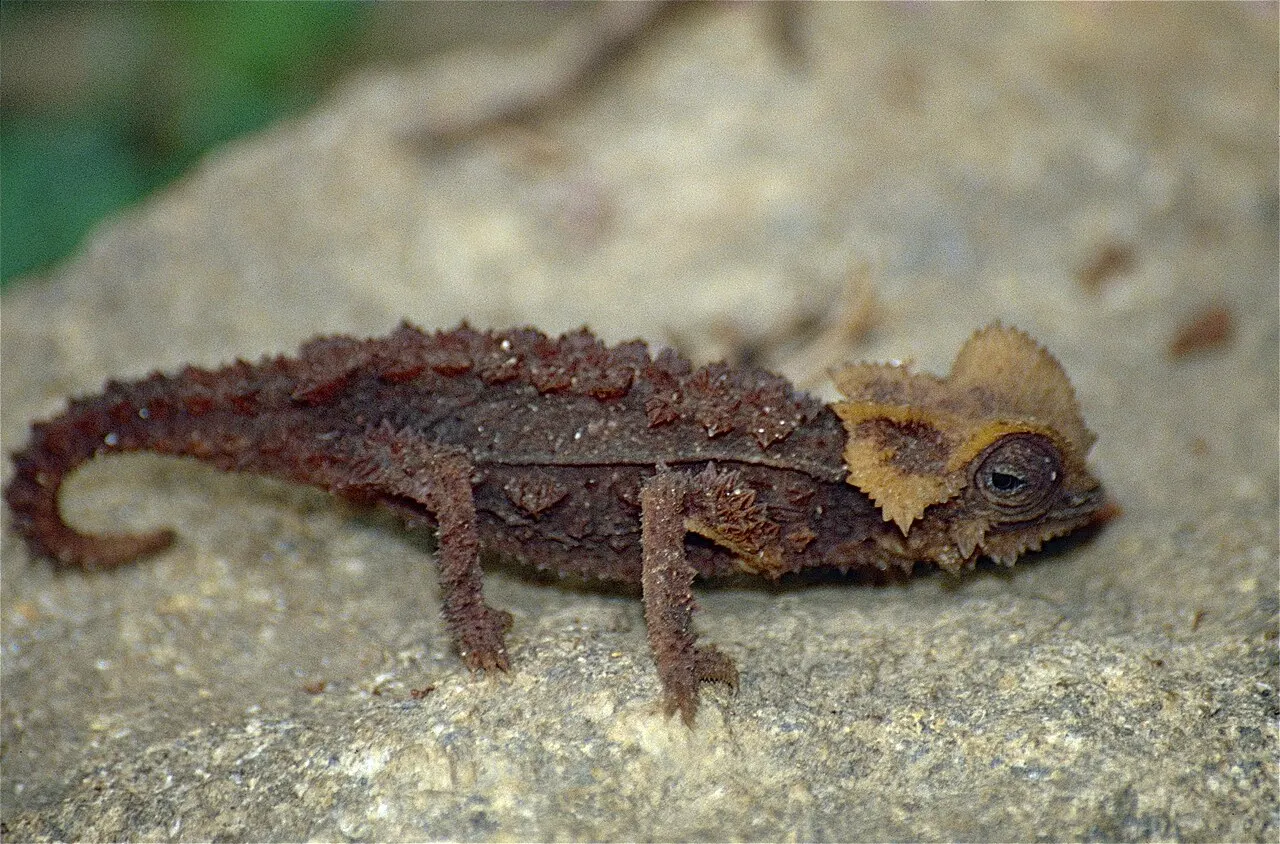
The antsingy leaf chameleon (Brookesia perarmata) is a small, spiny, brown chameleon found only in the dry forest of Tsingy de Bemaraha National Park in western Madagascar. The IUCN rated it Endangered in 2020. Heavy collecting for the pet trade hit it in the 1990s, and forest damage and fire are further threats.
How to recognise it
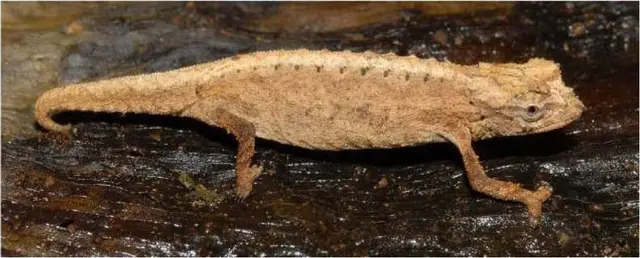
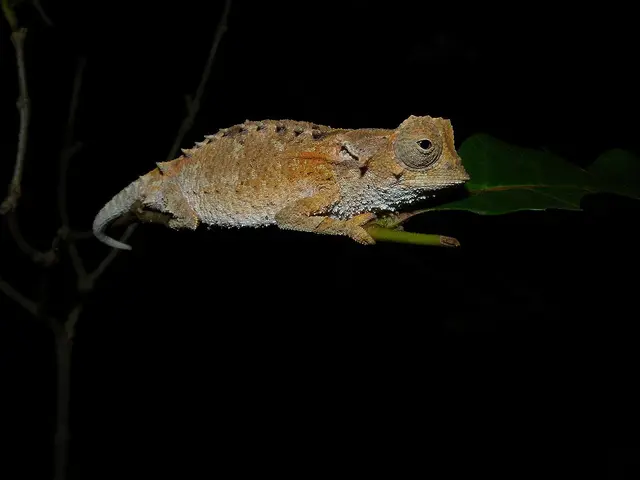
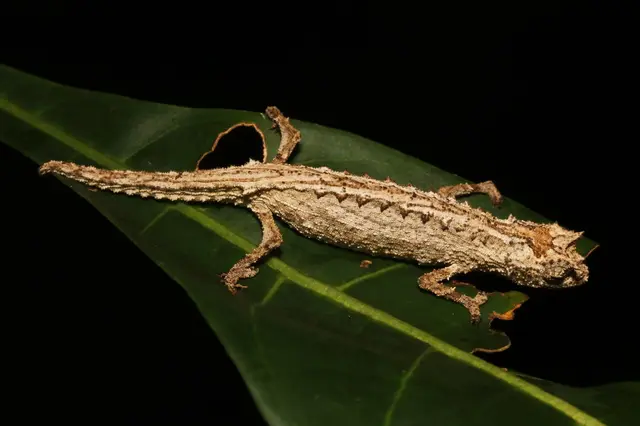
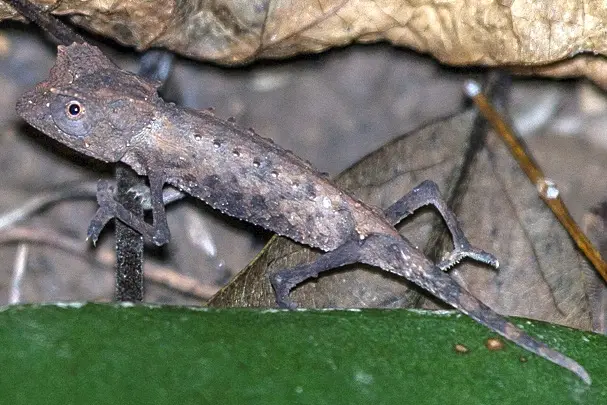
Adults reach about 11 cm, which makes this one of the larger dwarf leaf chameleons. The body is brown and the head runs from brown to tan. Rows of thorny spines run along the back, and more spines on the head crests give the outline a jagged, armoured look. Its short tail isn't used for gripping and helps it move through leaf litter.
Where it lives
It is known only from the northern part of Tsingy de Bemaraha National Park in Madagascar's Melaky region, where dry deciduous forest grows between the park's stone pinnacles. The IUCN counts it as a single location, recorded between 100 and 430 metres above sea level.
A night survey at five sites, published in the journal Oryx in 2008, found it abundant at three of the five. It was absent from Ankazomanga, a degraded forest about 10 km outside the park boundary, and most common at Bendrao, the most intact forest surveyed. The estimated density across sites was about 29 animals per hectare, lower than the neighbouring Brookesia brygooi (about 53) and higher than Brookesia exarmata (about 19). Roosting animals favoured areas with thick leaf litter and understorey and few bare rock outcrops.
Pins are Wikidata “endemic to” fields. Orange dots, when present, are GBIF occurrence tiles — survey bias included.
How it lives
This is a forest-floor animal that moves through leaf litter, where its brown colouring blends in. At night it climbs onto low plants to sleep, and dwarf chameleons of this genus mostly roost less than a metre off the ground. It lays eggs, and captive eggs have hatched after incubation as short as two months.
Beyond that, little has been recorded about its diet, lifespan or breeding in the wild.
Why it is in trouble
The IUCN lists the population as decreasing. Threats it records include shifting agriculture, small-holder farming and grazing, more frequent fires, and collection of animals. The 2008 Oryx survey also pointed to cattle grazing and bushfires damaging the leaf litter and understorey the species depends on.
Collection for the pet trade was the sharpest blow. A 2005 review in Oryx put recorded imports into the United States between 1996 and 2001 at about 2,215 animals, the most of any Brookesia species in that data. Madagascar's forestry ministry does not permit collection of this species, yet consignments were still intercepted at Antsalova in 1998 and 2000, one of them holding 250 live chameleons hidden in a radio cassette player.
What is being done
The species was moved onto CITES Appendix I in 2002, which allows international commercial trade only in exceptional circumstances. Recorded exports from Madagascar then fell sharply, to 24 animals in 2002 and 3 in 2003. The 2005 review took this as a sign that CITES can work for a threatened species.
The 2020 IUCN assessment records a recovery plan, conservation sites covering the whole known range and at least one protected area, but no systematic monitoring scheme. Captive breeding is known only up to the second generation, according to one keepers' reference, and wild-caught animals reportedly carry heavy roundworm burdens.
Sources
Written for this catalog in our own words from the sources below, checked against them on 12 November 2026. Population figures are estimates and carry the year they were made. Status and assessment year: IUCN. 2026. The IUCN Red List of Threatened Species. Version 2026-1. iucnredlist.org.