Endangered
Naturelle leaf chameleon
Brookesia karchei
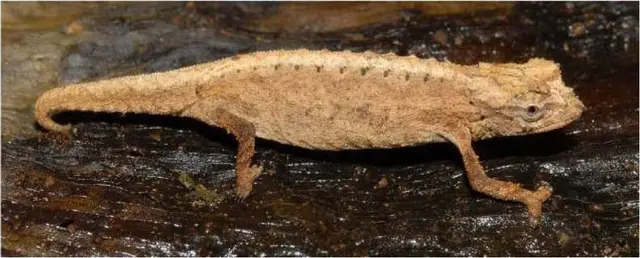
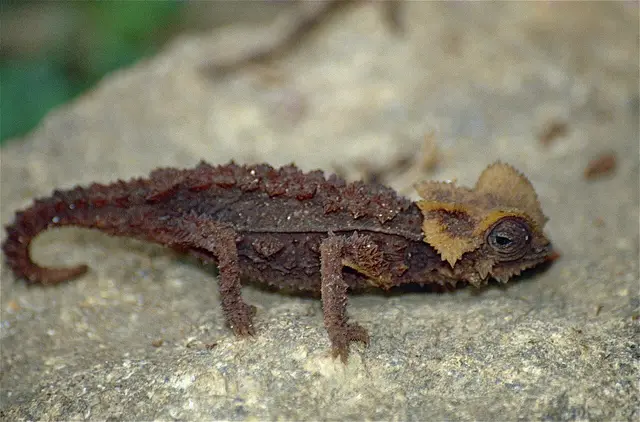
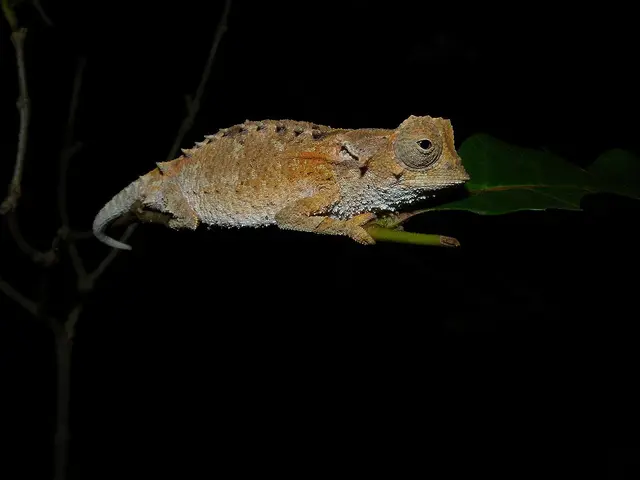
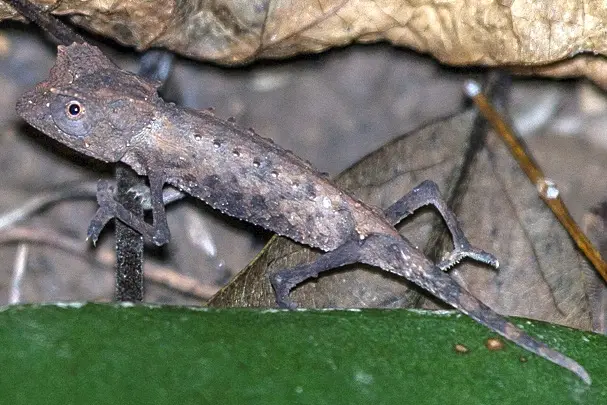
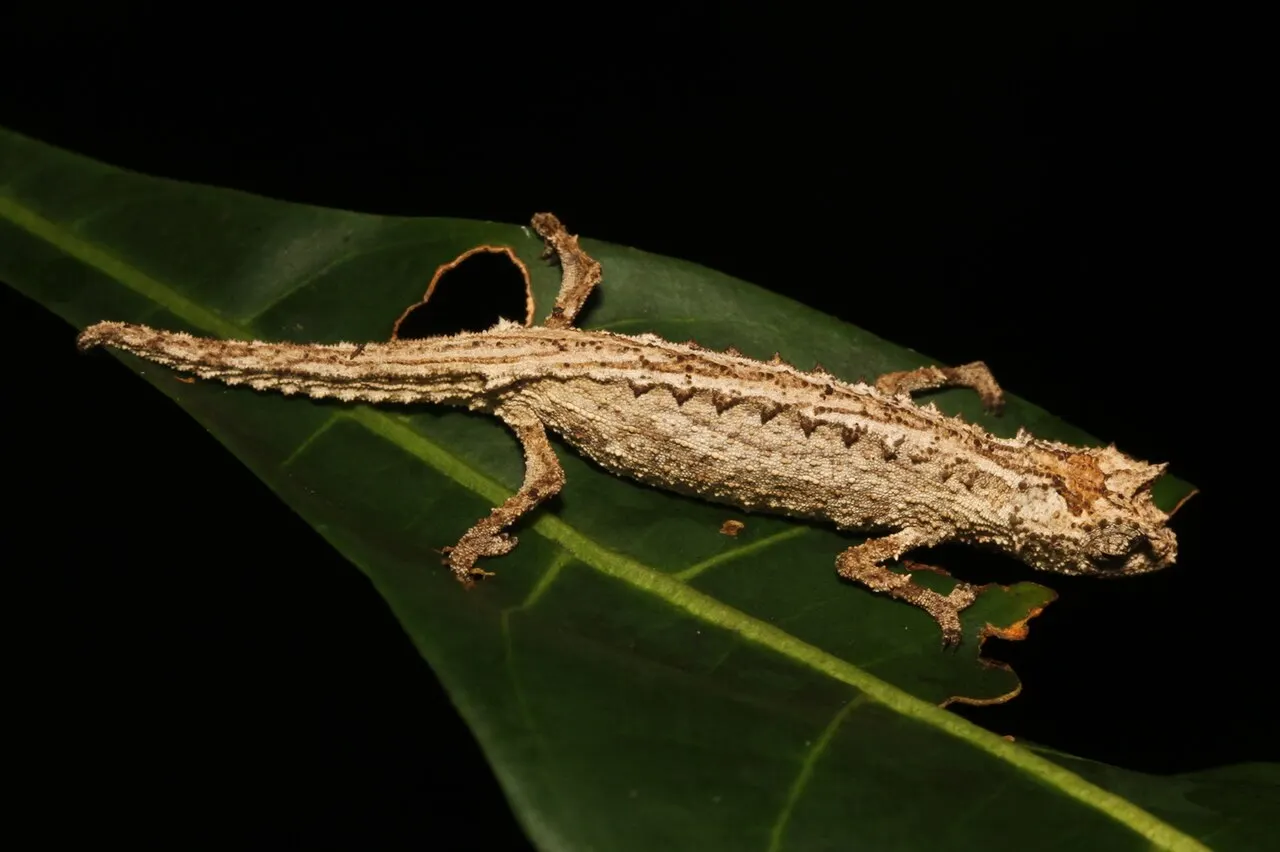
The naturelle leaf chameleon (Brookesia karchei) is a tiny, beige-brown chameleon of Madagascar's north-east, known only from the Marojejy massif. The IUCN Red List rated it Endangered in 2011. It lives in humid forest leaf litter, and its forest is reportedly being degraded by rosewood extraction.
How to recognise it
Like other leaf chameleons it is very small. A measured female was 30.7 mm from snout to vent and 51 mm in total with the tail, and a keeper's account gives about 50 mm as the full length, with females a little smaller. The body is beige to light brown, a small bony projection sits above the nose and eyes, and each side of the back carries a row of 12 to 13 enlarged, spiny scales that stops before the tail.
It belongs to the minima group of Brookesia, a set that includes some of the smallest chameleons in the world. The name honours Jean-Paul Karche, a French biogeologist and volcanologist who worked in Madagascar.
Where it lives
The species was described in 1970 from the Marojejy massif, at about 700 m above sea level. It is still known only from there, in Marojejy National Park. The IUCN records one location, between 380 and 850 m, with an extent of occurrence of about 597 square km.
The IUCN lists humid lowland forest as its habitat. A keeper's account describes it among damp leaf litter between rocks and moss, and also in dense foliage and on bark. Average monthly temperatures at Marojejy run from about 22 to 26 C. It lays eggs.
Pins are Wikidata “endemic to” fields. Orange dots, when present, are GBIF occurrence tiles — survey bias included.
Why it is in trouble
The 2011 assessment gives a decreasing population trend and lists small-scale harvesting of forest products as an ongoing threat. Extraction of rosewood timber is reportedly the main cause of falling forest quality. No population estimate exists, and the IUCN lists population size and distribution, habitat trends and life history as research needs.
What is being done
All of its known range lies in Marojejy National Park, where collecting any chameleon is illegal. The species falls under international trade controls, and a specialist keeper's site says no legal export is possible. As of the 2011 assessment there was no recovery plan, no monitoring scheme and no captive population, and site management was listed as a need.
Sources
Written for this catalog in our own words from the sources below, checked against them on 12 November 2026. Population figures are estimates and carry the year they were made. Status and assessment year: IUCN. 2026. The IUCN Red List of Threatened Species. Version 2026-1. iucnredlist.org.