Critically Endangered
Boophis ankarafensis
Boophis ankarafensis
The Ankarafa skeleton frog (Boophis ankarafensis) is a tiny green treefrog known from a single forest on Madagascar's northwest coast. The IUCN Red List classed it as Critically Endangered in 2016. It was only described to science in 2014, and its whole known range is a few square kilometres of stream-side forest.
How to recognise it
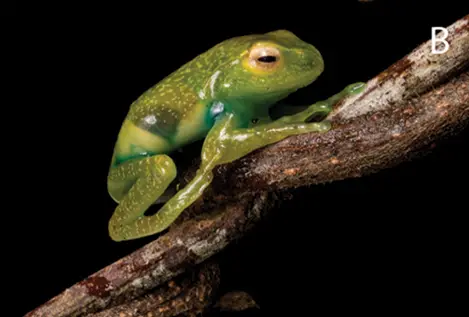
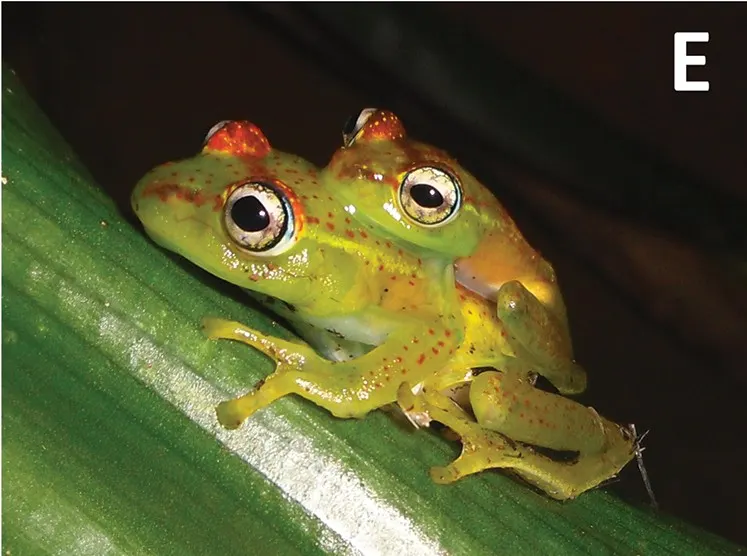
This is a small, slender frog. Males measure about 23 to 24 mm from snout to vent, and the single female measured in the original description was 28.5 mm. The back and limbs are light green, with reddish-brown and yellow speckles, a reddish-brown band between the eyes and thin yellow stripes running back from behind each eye. The webbing and the finger and toe discs are green-yellow.
Frogs of the genus Boophis are often called skeleton frogs because their skin is somewhat see-through. Sound is the easiest way to tell this species from its close relative Boophis bottae. Its trill has a faster pulse rate, and its short click notes usually have two pulses where B. bottae usually has three.
Where it lives
The species is known only from Ankarafa Forest, a forest fragment inside Sahamalaza-Iles Radama National Park on the Sahamalaza Peninsula. The IUCN lists one location, at roughly 100 to 150 m above sea level, and an extent of occurrence of about 61 square kilometres. The describing team put the area it actually occupies at about 4 km², within an estimated forest patch of under 5 km².
Surveys elsewhere did not find it. The frog was absent from nearby Anabohazo Forest and from other forest sites across northwest Madagascar, although those surveys were not aimed at this species. Researchers suspect it is a true local endemic.
Pins are Wikidata “endemic to” fields. Orange dots, when present, are GBIF occurrence tiles — survey bias included.
How it lives
Males call at night from leaves and branches about 0.5 to 2 m above the ground, along fast-flowing streams, and they often sit close together. The frog was not found along open, unvegetated stretches of stream. All breeding the team saw happened in the wet season, mostly from October to December, and eggs are thought to be laid in or beside flowing water. Tadpoles have not been described.
Between October 2011 and January 2012 the team encountered 54 frogs, most of them males. Calls were picked up at 8 of 37 listening points.
Why it is in trouble
Loss of forest is the main problem. The IUCN names small-holder farming, shifting agriculture and small-scale grazing as threats, and records the population as decreasing. The describing team pointed to slash-and-burn clearing (known locally as tavy), small-scale logging and uncontrolled fires, with clearing concentrated in the stream-side forest the frog depends on.
The team warned that a single large fire could wipe out the species. Being inside a national park has not stopped the deforestation.
What is being done
The frog occurs in a protected area, and the IUCN assessment lists site protection and management, awareness work, training, habitat restoration and alternative livelihoods as conservation actions. The describing team called for an immediate halt to forest destruction and to agricultural practices inside the park.
Sources
Written for this catalog in our own words from the sources below, checked against them on 12 November 2026. Population figures are estimates and carry the year they were made. Status and assessment year: IUCN. 2026. The IUCN Red List of Threatened Species. Version 2026-1. iucnredlist.org.