Endangered
Amami tip-nosed frog
Odorrana amamiensis
The Amami tip-nosed frog (Odorrana amamiensis) is a large brown-to-green stream frog found only on two islands in Japan's Ryukyu chain, Amami-Oshima and Tokunoshima. The IUCN Red List lists it as Endangered (2021 assessment), with logging, roads, pesticides and introduced mongooses behind its decline.
How to recognise it
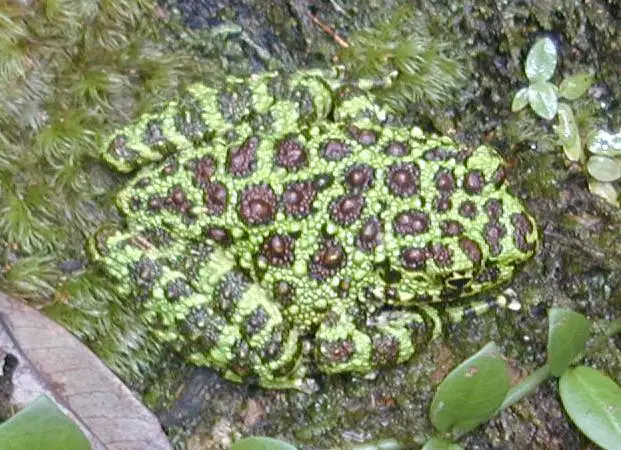
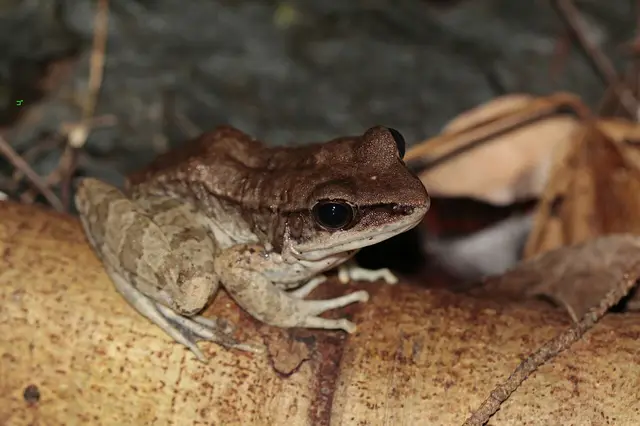
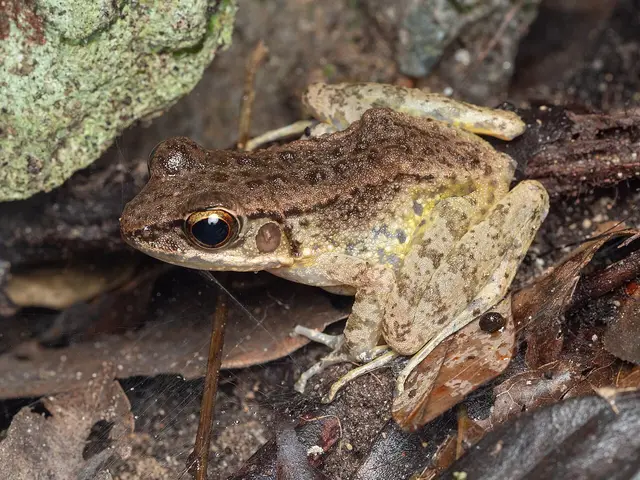
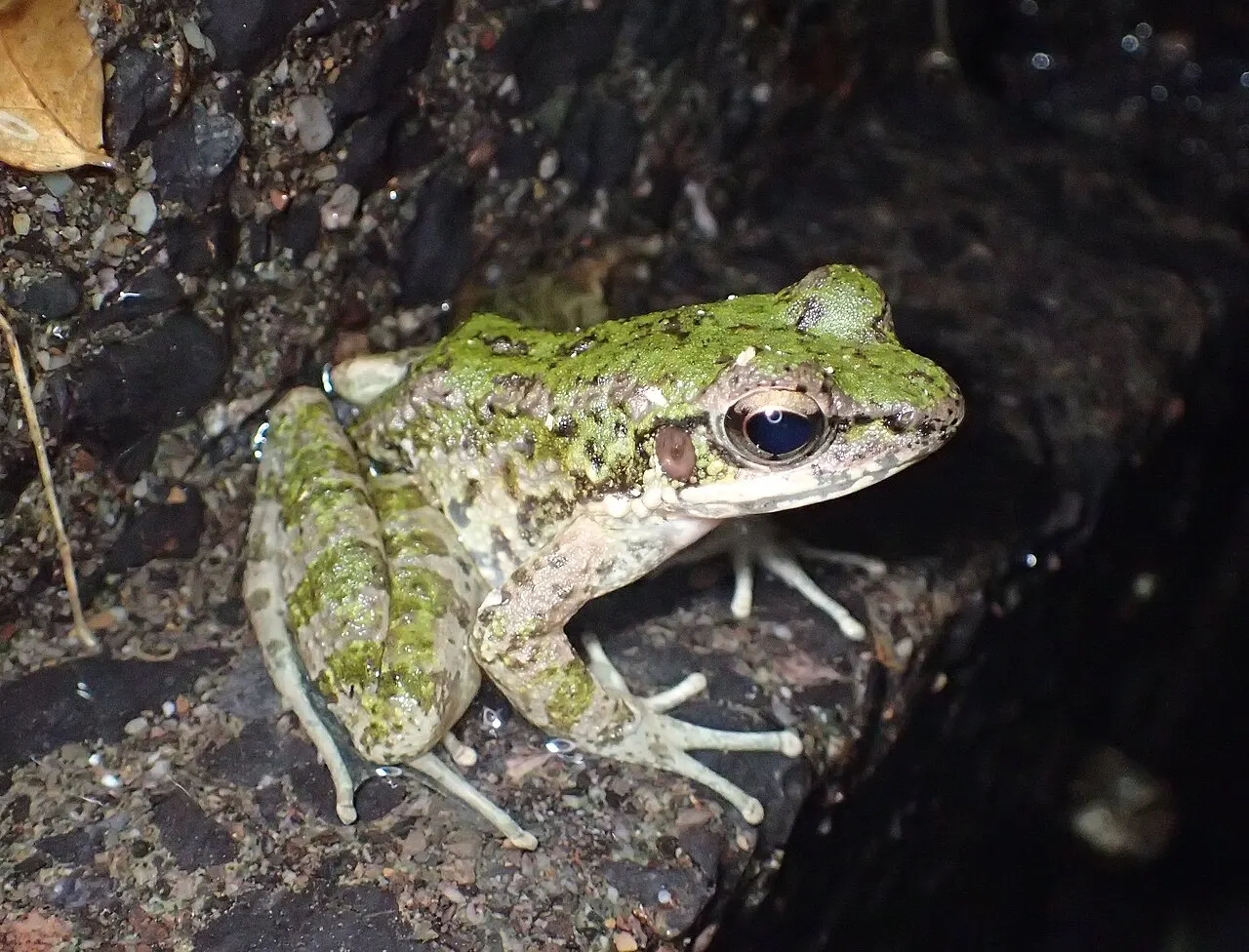
It's a fairly slender frog with a triangular head, a pointed snout and a clear eardrum. Females are the larger sex, reaching 76 to 101 mm from snout to vent against 57 to 69 mm for males. The back runs from light brown to green, often with big black blotches and small dark dots, though some animals have none.
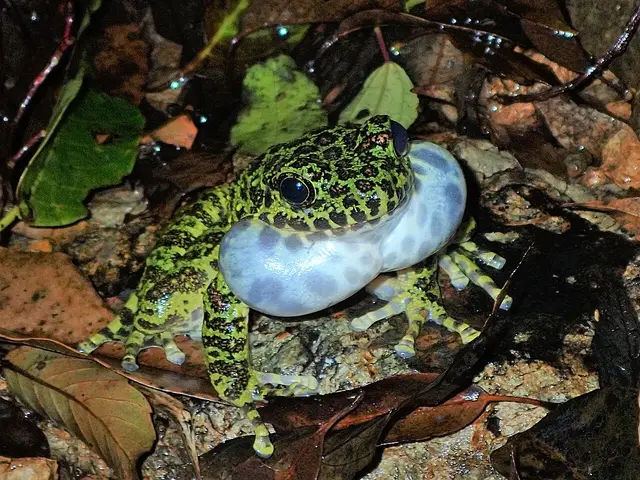
Dark marks sit beneath the eye ridge, around the eardrum and along the back edges, and the limbs are crossed by dark bars. Toes are well webbed, while the fingers are free with small discs. Males have paired throat sacs for calling.
Where it lives
The species is endemic to the Amami Islands and is known only from Amami-Oshima and Tokunoshima. It lives along streams in broad-leaved evergreen forest, mainly between 250 and 650 m. It's common beside mountain streams and rare in the lowlands.
The IUCN puts its extent of occurrence at about 2,653 square kilometres, counts two locations and describes the population as severely fragmented, with the trend currently listed as stable.
Pins are Wikidata “endemic to” fields. Orange dots, when present, are GBIF occurrence tiles — survey bias included.
How it lives
The frog breeds in the cooler months. The season runs from mid-October to early May and peaks from late December to early January, and egg masses have been found at the foot of waterfalls. A 2020 study in Current Herpetology by Hirotaka Komine and Bruna Trentin counted frogs along a 20 m stretch of one Amami-Oshima stream from 28 November to 5 December 2015. They tallied over 200 frogs, many calling and mating at night for three days before numbers fell quickly.
The frog is mostly active at night, though some were seen at breeding sites in daylight.
Why it is in trouble
The IUCN lists herbicides and pesticides, roads and railways, and forestry harvest among the threats. Logging and road building destroy forest, rivers have been altered, and pesticides pollute streams. Predation by invasive mongooses is also named as a threat.
Mongooses were brought to Amami Island in 1979. A 2021 study in Biological Invasions led by Hirotaka Komine, summarised in a Tokyo University of Agriculture and Technology release, found that native frogs facing stronger mongoose predation had longer hind legs and more endurance. After a Ministry of the Environment eradication project removed most of the mongooses, the native frog population reportedly recovered.
What is being done
The IUCN lists site protection and management, habitat restoration and control of invasive species as actions needed or underway. The mongoose removal programme is the clearest success so far, although the assessment still records a continuing decline in habitat area.
Sources
Written for this catalog in our own words from the sources below, checked against them on 12 November 2026. Population figures are estimates and carry the year they were made. Status and assessment year: IUCN. 2026. The IUCN Red List of Threatened Species. Version 2026-1. iucnredlist.org.