Endangered
Ishikawa's frog
Odorrana ishikawae
Ishikawa's frog (Odorrana ishikawae) is a large, moss-patterned frog that lives only in the forested mountain streams of northern Okinawa Island, Japan. The IUCN Red List assessed it as Endangered in 2021. It has a tiny range and is threatened by habitat change.
How to recognise it
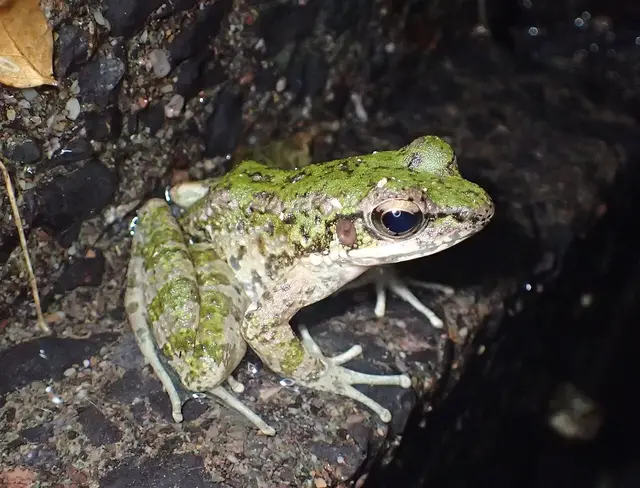
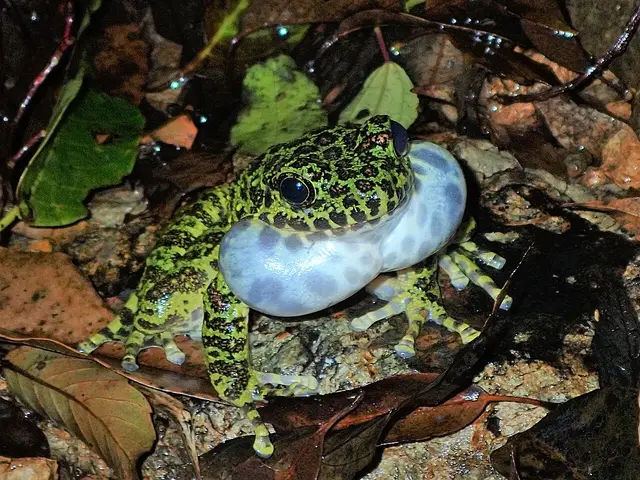
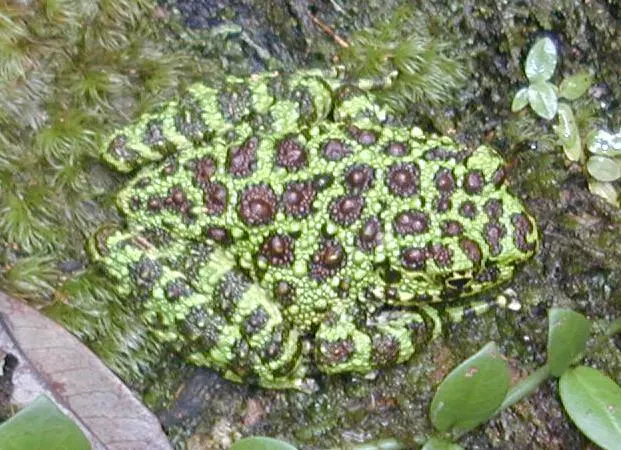
This is a big frog, up to about 10 cm by one account, though another naturalist gives a typical length of 90 to 120 mm. The skin is mottled emerald green and black, which blends in with moss and wet rock. A rare blue form turns up now and then. It is often called Japan's most beautiful frog, though that is a popular opinion.
Where it lives
The species is endemic to Okinawa Island in the Ryukyus, mostly in the northern forest known as Yambaru. It lives along mountain torrents and upper streams, both permanent and seasonal, inside temperate forest, from sea level to about 503 m.
The IUCN estimates its extent of occurrence at 360 square kilometres and its area of occupancy at 208, and treats it as a single location. Frogs were seen near Nago and Motobu in the middle of the island until 1993, but those populations are believed to be gone.
Pins are Wikidata “endemic to” fields. Orange dots, when present, are GBIF occurrence tiles — survey bias included.
How it lives
Ishikawa's frog is nocturnal. It hides in rock cracks by day and comes out at night to hunt insects, worms and millipedes. One nature writer reports breeding in the cooler months, roughly December to March. A 2012 study describes eggs laid in water in holes along rocky stream slopes near the head of a stream.
Why it is in trouble
Because the frog depends on small forest streams, changes to them hit it hard. The IUCN lists dams, roads and railways, and a named species as threats, with forest and stream habitat being converted or degraded. Road deaths have been photographed on Okinawa. A 2012 genetics study in Heredity also names over-collection for the pet trade and predation by the small Indian mongoose, though the mongoose evidence it cites comes from Amami-Oshima, not Okinawa.
The IUCN trend is stable, but the occupied area and range are still declining. The category was Endangered in 2015 as well.
What is being done
The IUCN notes a systematic monitoring scheme, invasive species control or prevention, and captive (ex situ) breeding. Okinawa and Kagoshima prefectures designate the frog a natural asset. A 2011 Zoological Science paper reported artificial insemination of field-caught pairs from Okinawa and Amami island populations in 2004, 2006 and 2008. Fewer than half of the eggs reached metamorphosis, and about 500, 300 and 250 young were being raised from the three trials. Second-generation frogs followed from natural mating in 2009 and 2010. The IUCN says the frog does not occur in any protected area.
Sources
Written for this catalog in our own words from the sources below, checked against them on 12 November 2026. Population figures are estimates and carry the year they were made. Status and assessment year: IUCN. 2026. The IUCN Red List of Threatened Species. Version 2026-1. iucnredlist.org.