Endangered
Tylomelania patriarchalis
Tylomelania patriarchalis
Tylomelania patriarchalis is a large freshwater snail found only on the Indonesian island of Sulawesi, in the ancient Malili lakes, and described from Lake Matano. The IUCN Red List rated it Endangered in 2019. Its range is tiny, and invasive cichlid fish are the main danger.
How to recognise it
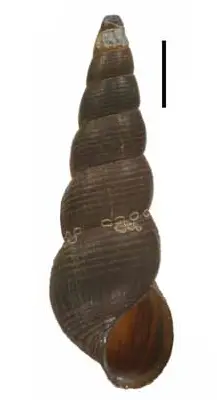
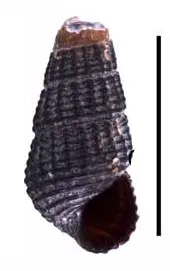
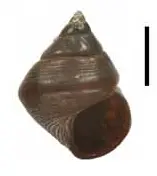
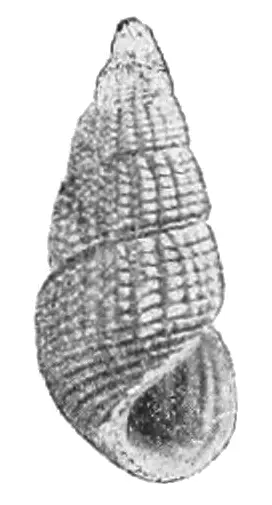
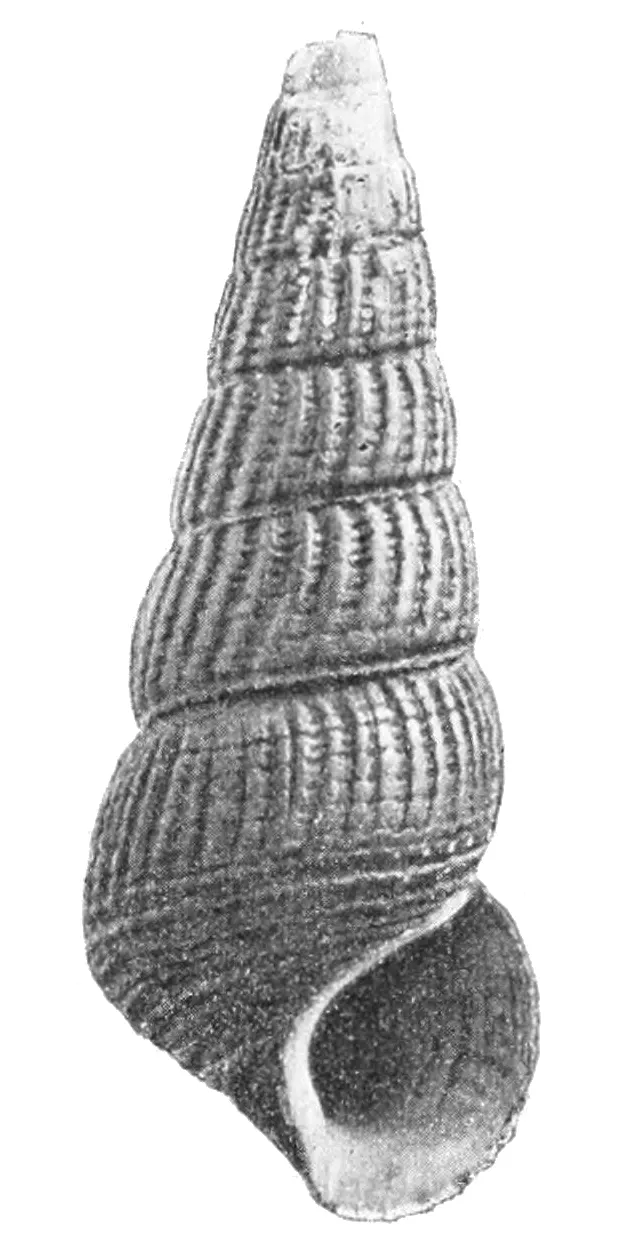
This is a big snail with a shell of 6 to 9 whorls. One published description gives a shell about 82 millimetres high and 26 millimetres wide, with an opening about 22 millimetres high. The plate that seals the shell, the operculum, shows 6 or 7 concentric lines. The species belongs to the family Pachychilidae and was described in 1897 by P. Sarasin and F. Sarasin.
Where it lives
The species is endemic to Indonesia, and the IUCN records it from a single location on Sulawesi. The type locality is Lake Matano, one of the Malili lakes. The IUCN estimates its area of occupancy at 80 square kilometres and its extent of occurrence at 184. It is listed from both permanent lakes and rivers or streams.
The Malili system (lakes Matano, Towuti, Mahalona, Masapi and Wawontoa) holds a large radiation of Tylomelania snails, with roughly 40 species in the genus across these lakes according to one genus overview.
Pins are Wikidata “endemic to” fields. Orange dots, when present, are GBIF occurrence tiles — survey bias included.
How it lives
Little has been written about this particular species, so what follows comes from the genus. Tylomelania snails graze on rocks and soft bottoms, eating plant material and detritus. They bear live young, and a female carries a single fully developed juvenile at a time. That slow rate of reproduction matters when a population starts to fall. The IUCN gives a generation length of 2 years and describes the species as not migratory.
Why it is in trouble
The IUCN's highest-scoring threat is an introduced species, affecting more than 90 percent of the population, with nutrient pollution second. The invader described in Lake Matano is a cichlid fish. Dams and mining are also listed, with unknown impact. Large-scale harvest is recorded at low impact, and collection for the aquarium trade is flagged as a possible threat to the genus.
The cichlid problem is well documented in Lake Matano. Flowerhorns, an artificial hybrid of several Neotropical cichlids, were first recorded there in 2010, probably released by an aquarist or pet shop owner. An Oryx conservation news report said smaller Tylomelania species and juveniles of larger ones had disappeared as the fish spread. Lake Matano has six endemic Tylomelania species, nearly all Critically Endangered, though that report doesn't name T. patriarchalis. For this species the IUCN estimated a past decline of about 50 percent and projects a further 50 percent, both tied to introduced species.
What is being done
The assessment lists harvest management and control of invasive species as the actions needed, and records no conservation actions in place. For another Matano snail, T. zeamais, a community project surveyed 32 sites, found the snail at 20, bred it in captivity for release, and ran school outreach alongside an invasive-species removal programme. No action specific to T. patriarchalis was found.
Sources
Written for this catalog in our own words from the sources below, checked against them on 12 November 2026. Population figures are estimates and carry the year they were made. Status and assessment year: IUCN. 2026. The IUCN Red List of Threatened Species. Version 2026-1. iucnredlist.org.