Critically Endangered
Tylomelania hannelorae
Tylomelania hannelorae
Tylomelania hannelorae is a very small freshwater snail found only in Lake Mahalona on the Indonesian island of Sulawesi. It is the smallest snail in the Malili lakes group. The IUCN Red List rated it Critically Endangered in 2019, because it lives on one small stretch of shore and a steep decline is predicted.
How to recognise it
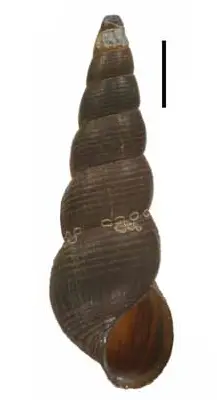
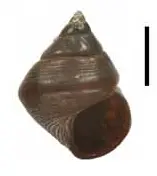
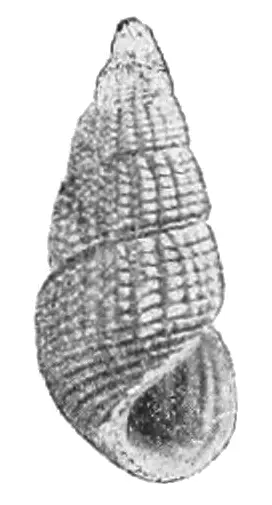
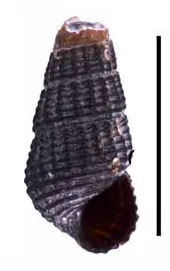
This is a small, dark brown snail with a long, cone-shaped shell. The shell of the first specimen used to describe the species, the holotype, measured 11.8 mm by 5.5 mm. The largest adults can reach about 13.9 mm. Among the Tylomelania snails of the Malili lakes it is the smallest.
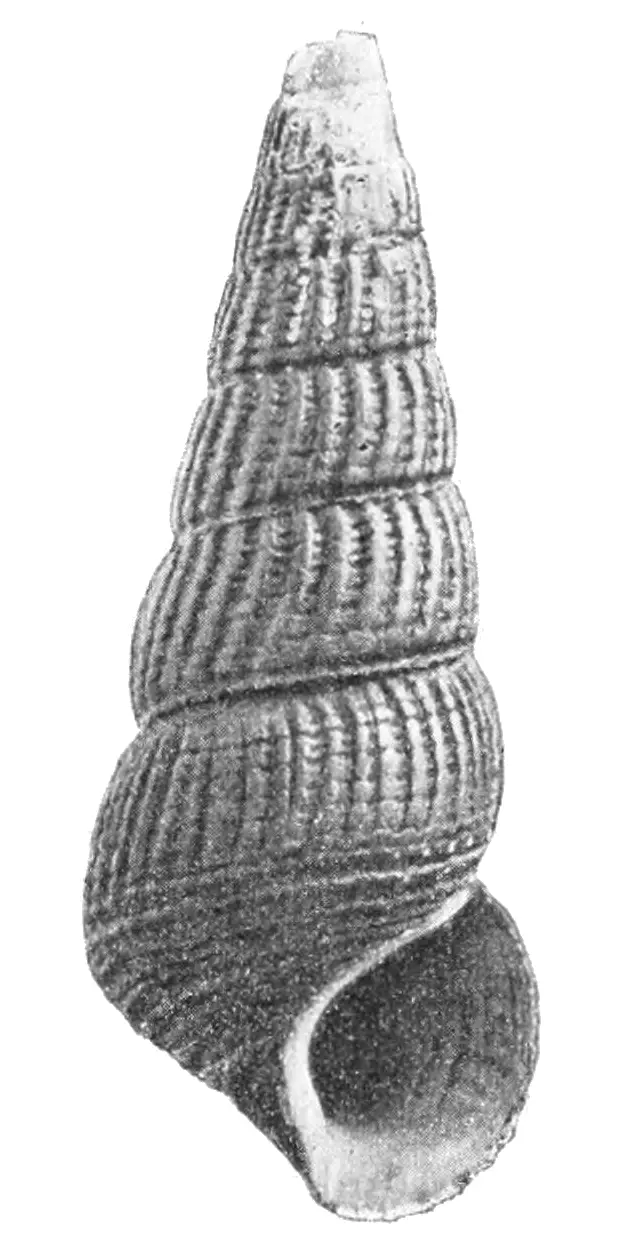
The shell surface has axial ribs (running along the whorls) and spiral ribs (running around them), which together form a net-like pattern. The tip of the spire is worn away in adults, leaving three to five whorls. That wear helps tell a full-grown adult from a young snail of a larger, similar species.
Where it lives
Lake Mahalona is one of the Malili lakes in the south of Sulawesi, and it is the only place the species is known. The original collectors found it on rocks in water less than half a metre deep, at a cape on the north-west shore.
The IUCN counts a single location. Both its extent of occurrence and its area of occupancy are given as 4 square kilometres, within a lake of about 24 square kilometres.
Pins are Wikidata “endemic to” fields. Orange dots, when present, are GBIF occurrence tiles — survey bias included.
How it lives
Very little has been published about its day-to-day behaviour. The species description reports that females carry one or two embryos in a brood pouch, and the embryos can reach a shell height of about 3.1 mm.
The IUCN gives a generation length of 1 to 2 years and lists the snail as not migratory. The population trend is recorded as unknown, and no population estimate exists.
Why it is in trouble
The species qualifies as Critically Endangered under criteria A3e and B1ab(iii)+2ab(iii). In plain terms, that means a tiny range, continuing habitat decline and a projected population fall of more than 90 percent over the next 10 years.
The projection rests on an invasive fish, the flowerhorn cichlid, which the IUCN says was confirmed in Lake Mahalona in 2018. In Lake Matano, next door, the same fish spread through the whole lake in under 10 years and is thought to have helped drive declines of some Tylomelania snails by eating small adults and juveniles. Adults of this species are probably small enough to be eaten too.
Other threats listed as ongoing are nutrient loads reaching the lake, dams of unknown size, and mining and quarrying. The IUCN text points to nickel mining, hydroelectric installations on the Matano outlet that alter water levels across the lake system, and erosion and sewage from a growing human population.
What is being done
The IUCN knows of no conservation actions in place for this snail. Its research needs are better data on population size, distribution and trends, and a clearer picture of the threats.
A conservation grant report on a related snail, Tylomelania zeamais, shows what the lake system is going through. It describes thick algae smothering the rocks where snails live and invasive cichlids eating juveniles in Lake Matano, and surveys in 2017 and 2018 that failed to find that snail where it had been abundant two decades earlier.
Sources
Written for this catalog in our own words from the sources below, checked against them on 12 November 2026. Population figures are estimates and carry the year they were made. Status and assessment year: IUCN. 2026. The IUCN Red List of Threatened Species. Version 2026-1. iucnredlist.org.