Endangered
Salmo platycephalus
Salmo platycephalus
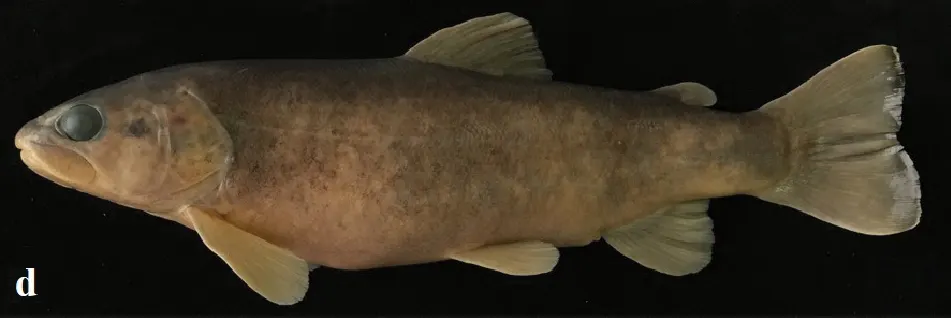
The flathead trout (Salmo platycephalus) is a stream trout found only in a few mountain tributaries of the Zamantı River in southeastern Turkey. The IUCN Red List assessed it as Endangered in 2019. Its tiny range is its weakness, and scientists still debate whether it is a true species.
How to recognise it
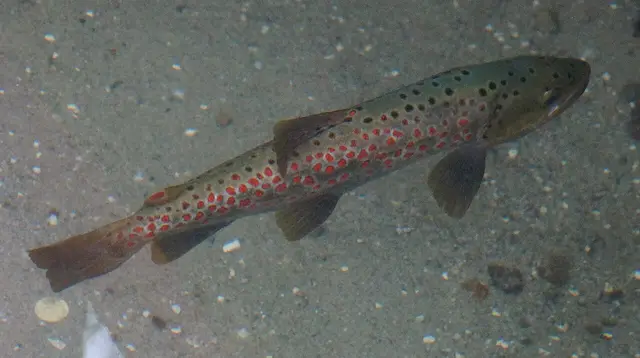
At a glance it looks like a plain brown trout, and that is part of the puzzle. The difference shows up in the spotting. Brown trout in neighbouring river basins carry red spots ringed in pale colour, and red and black spots on the dorsal fin. Flathead trout from the Seyhan basin lack the dorsal spots, and a 2011 study of fish caught by electrofishing found no red body spots in fish longer than about 70 mm and no black spots beyond roughly 170 mm.
Counts and measurements also set it apart. The same study found that Zamantı fish differed from brown trout in the number of pyloric caeca (small pouches off the gut) and gill rakers, and in head depth and the distance from the snout to the dorsal fin. They also had greater standard lengths than trout from the Ceyhan and Euphrates streams, a difference the researchers suggested could reflect heavier fishing pressure there.
Where it lives
Robert Behnke described the species in 1968. The original localities were Söğüksu and Karagöz, streams near the town of Pınarbaşı in the upper Zamantı system, a tributary of the Seyhan River. Later surveys also found it at Uzunyayla and in the Sarız and Kala streams, at about 1,500 to 1,800 m above sea level. Karagöz produced no flathead trout in the 2011 study's sampling between 2000 and 2006, and the fish was most numerous around Uzunyayla.
The IUCN lists four locations and an area of occupancy of about 200 square kilometres. It lives in permanent rivers and streams and does not migrate. Its diet reportedly includes mayflies, caddisflies and small crustaceans called scuds.
Pins are Wikidata “endemic to” fields. Orange dots, when present, are GBIF occurrence tiles — survey bias included.
A species or a local brown trout
Its standing is unsettled. Genetic evidence reportedly suggests the flathead trout may descend from introduced brown trout (Salmo trutta), which would make it a distinctive local form rather than a separate species. The IUCN Red List assesses it as a species in its own right, but its 2006 summary already called for the taxonomy to be checked with genetic work. GBIF also treats it as an accepted species.
Why it is in trouble
Because the whole population sits in a handful of streams, almost any local change matters. The 2019 assessment, under criterion B2ab(ii,iii,v), records a continuing decline in area, habitat and numbers of mature fish, and lists the overall trend as decreasing. The threats named are drought, water drawn from rivers and from groundwater for farming, small dams, and small-scale harvest for food. Hybridisation is listed as a stress.
Introduced trout are a long-standing worry. The 2006 summary named illegal netting and released rainbow trout, which prey on larvae and compete with young fish, as the main threats. It described the population as large but restricted. The category has moved over time: Critically Endangered in 1996 and 2006, Endangered in 2019.
What is being done
Little is on record. The 2019 assessment lists no conservation actions in place. It calls for invasive species control, site and area management, habitat protection and awareness raising, at national and sub-national level. The 2006 summary likewise knew of no measures in place.
Sources
Written for this catalog in our own words from the sources below, checked against them on 12 November 2026. Population figures are estimates and carry the year they were made. Status and assessment year: IUCN. 2026. The IUCN Red List of Threatened Species. Version 2026-1. iucnredlist.org.