Endangered
Salmo carpio
Salmo carpio
The carpione (Salmo carpio) is a silvery, trout-like fish found only in Lake Garda, Italy. The IUCN Red List assessed it as Endangered in 2024, after rating it Critically Endangered in 2006. Catches have collapsed since the 1950s, and fishing for it is now banned.
How to recognise it
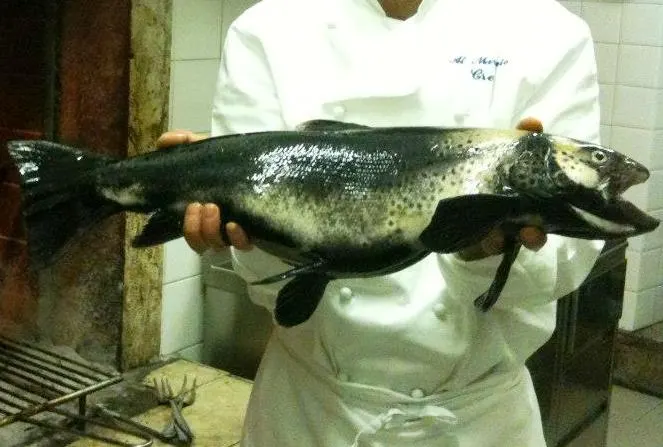
The carpione looks like a slimmer, silvery cousin of the lake trout, with larger scales. Its back and flanks are silvery with a few irregular black spots, the belly is white, and the dorsal and tail fins are dark. Outside the breeding season fish are silvery, and some males turn dark and mottled when spawning.
Adults are usually under about 40 cm and 500 g, though fish of around 3 kg have been caught. A press report from 2019 described a fisherman landing a 5 kg female ready to spawn.
Where it lives
The whole life cycle takes place in Lake Garda, a single deep lake in northern Italy, which is why the Red List counts it as occurring at one location. Fish live in open water, mostly at depths down to about 200 m. Attempts to establish it in other lakes in Italy and elsewhere have failed every time.
Pins are Wikidata “endemic to” fields. Orange dots, when present, are GBIF occurrence tiles — survey bias included.
How it lives
It feeds on small planktonic crustaceans and bottom-dwelling crustaceans, mainly in summer. Fish mature at two or three years and rarely live beyond five.
Unlike other Italian salmonids, it is described as spawning twice a year, in winter and in summer, though some biologists think it is one long season. Spawning takes place over loose bottom in the northern part of the lake, at depths of about 80 to 300 m, near underwater springs. In 2016 a female was documented spawning in the Toscolano river, a behaviour not recorded before.
Why it is in trouble
Its flesh has been prized since Roman times, and demand and prices rose with the tourism boom. A 2010 study in Studi Trentini di Scienze Naturali showed professional catches falling from roughly 20 tonnes a year in the 1950s and 1960s to a few tonnes at most from the 1970s onward. Numbers also reportedly fell by about 80% in the ten years to 2006.
Researchers don't fully agree on the causes. Overfishing is the leading suspect. The fish can fetch up to 70 euros a kilo, and in 2019 conservation groups alleged that some markets and restaurants sold carpione of doubtful origin. Sewage, nutrient loading, silt, large dams, changes to the lake's habitat and a warming climate are also blamed, along with other fish that compete with it or eat its eggs. The Red List records the population trend as unknown.
What is being done
Fishing for the carpione is banned. Veneto's 2024 rules for Lake Garda prohibit catching and holding it, by professional and recreational anglers alike, until 31 December 2026, under decisions of December 2023 and August 2024. A 2019 press report said fishing for it was banned across the basin, and a later news item said the ban now applies in Trentino waters too.
The Red List assessment records conservation sites over the whole range, with 91 to 100% of the population inside protected areas, and a recovery plan. Captive breeding has moved ahead since 2005. In 2006, wild adults with ripe eggs produced 1,100 eggs, and by 2008 a quarantine station at Riva del Garda held 80 fish from that spawning. Lombardy's Life Scipione project (about 2.2 million euros, half EU funded) aimed at restocking, though a local councillor has warned that released farmed fish could contaminate the native gene pool.
Sources
Written for this catalog in our own words from the sources below, checked against them on 12 November 2026. Population figures are estimates and carry the year they were made. Status and assessment year: IUCN. 2026. The IUCN Red List of Threatened Species. Version 2026-1. iucnredlist.org.