Critically Endangered
Nevada Grayling
Pseudochazara williamsi
The Nevada grayling (Pseudochazara williamsi) is a brown mountain butterfly found only in the high ranges of south-eastern Spain. Its Red List category was raised from Least Concern to Critically Endangered in 2025. Warming, dry summers and grazing have wiped it out of most of the sierras where it once flew.
How to recognise it
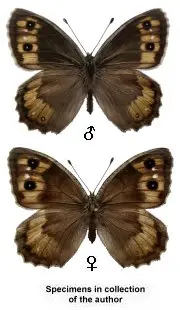
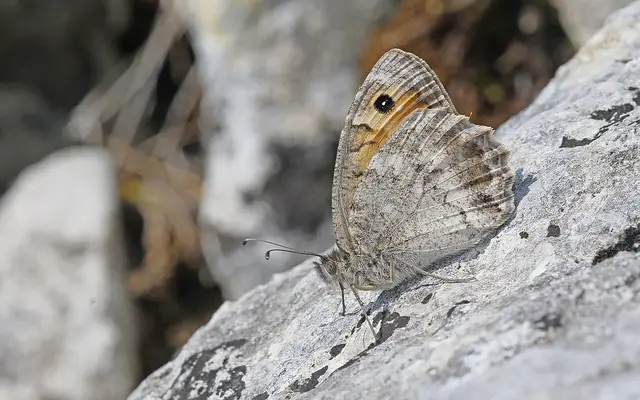
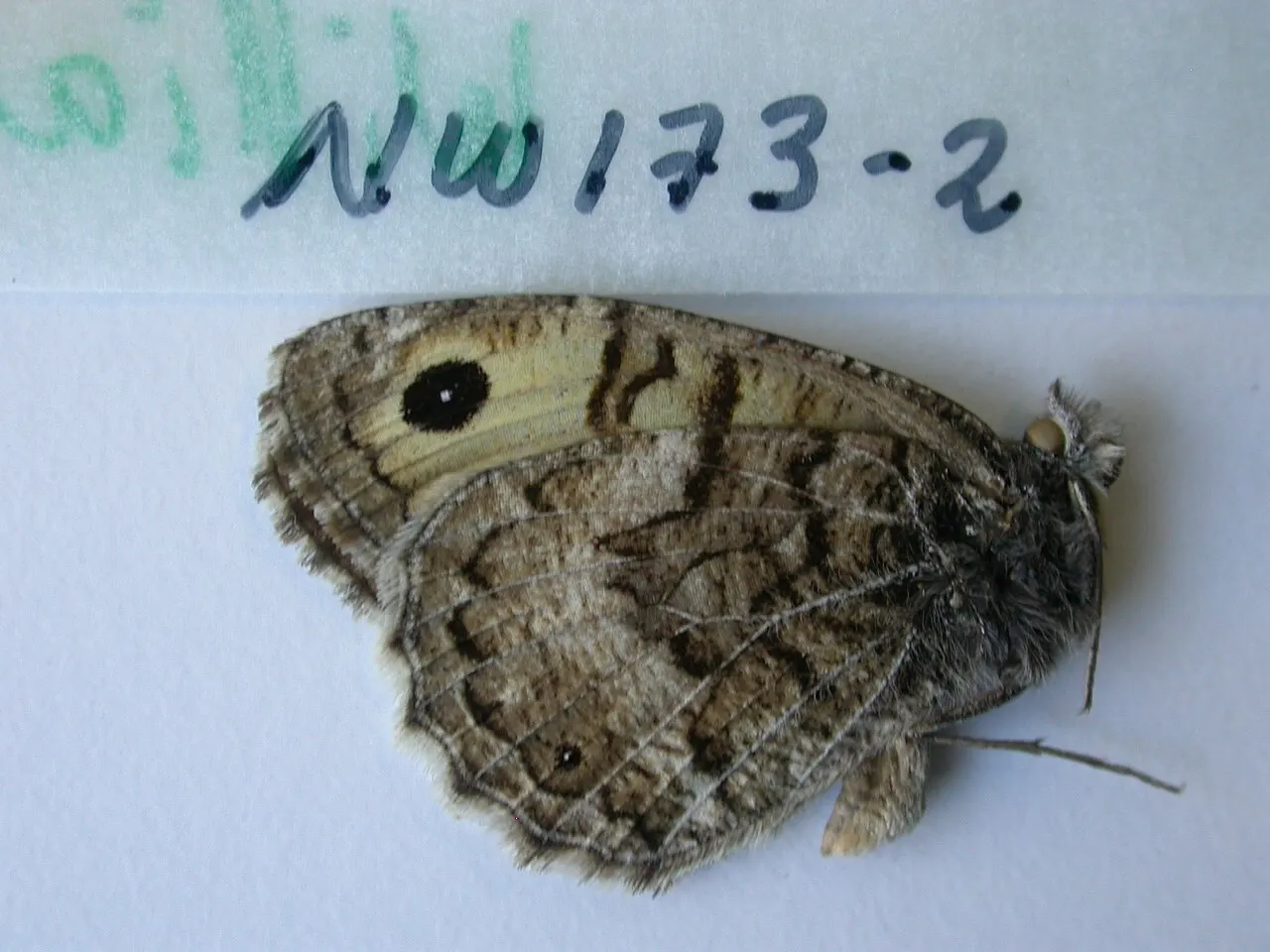
This is a medium-sized, well camouflaged butterfly. Males have a wingspan of 41 to 48 mm and females 42 to 51 mm. The upperside is light brown with a broad orange-yellow band and large black eyespots. The hindwing underside is beige, speckled with brown and crossed by wavy concentric lines.
Males are territorial. They make short, fast flights at ground level and perch on stones with the wings closed, and when disturbed they flash the two eyespots on the underside of the forewing. Females perch for much longer and fly only when nothing threatens them.
Where it lives
It is endemic to the mountains of Almería, Granada and Murcia. Records since 1925 come from eleven areas, among them Sierra Nevada, Sierra de Baza, Sierra de Gádor, Sierra Seca and Sierra de María. Since 2023 it has been confirmed in only four: Sierra Nevada, Baza, Gádor and Sierra Seca.
It lives on high, open ground. The IUCN gives an elevation range of 2,100 to 2,400 m, while a 2025 field study found the surviving populations between 1,903 m and 2,634 m. Occupied sites have moved uphill, with a median elevation of 2,103 m in the 20th century and 2,317 m since. The IUCN estimates the occupied area at 12 sq km and the extent of occurrence at 37 sq km.
Pins are Wikidata “endemic to” fields. Orange dots, when present, are GBIF occurrence tiles — survey bias included.
How it lives
There is one generation a year. Sources differ a little on the flight period. One account gives mid-June to early August, while the 2025 study compiled 277 dated records from 1925 to 2025 and found them running from 9 June to 26 August, with 81 percent in July and a mean date around 15 July.
Eggs are laid in June or July and the caterpillars hatch in July. They feed on grasses, probably fescue and Koeleria, although the exact host plants are still uncertain. They overwinter as caterpillars and pupate underground in May or June. Nectar is scarce in the habitat, which may help explain the small size of colonies.
Why it is in trouble
Heat is the root problem. Young caterpillars appear to be killed by high temperatures, and the species prefers cold, moderately dry conditions. The 2025 action plan reports that average temperature in Sierra Nevada has risen by 1.85 C since 1971 and annual rainfall has fallen. The IUCN lists habitat shifting, drought and temperature extremes as threats, and records a decreasing, severely fragmented population.
Since the 20th century, August sightings have dropped by 91 percent, and the 2023 to 2025 fieldwork found parched grass and few flowers at several sites. On mountains with no higher ground, populations cannot climb any further.
Local pressures add to it. Overgrazing is evident on Sierra Seca, where the remaining colony occupies at most about 15 hectares. Scrub is closing over open ground where grazing has stopped. Pine plantations and the Sol y Nieve ski resort took over habitat in the past, and spraying against pine processionary moth is blamed for the loss in Sierra de los Filabres.
Five sites (María, Orce, La Sagra, Guillimona and Revolcadores) have probably lost the butterfly. It is considered extinct in Sierra de los Filabres, where the last record is from 1994, and Sierra Espuña has had none since 1972. Even in Sierra Nevada it has vanished from classic sites such as Loma del Veleta. A 2015 butterfly Red List assessment had rated it Least Concern, a judgement based on expert opinion.
What is being done
All known populations lie inside the Natura 2000 network, and the Sierra Nevada colonies are within a national park. The butterfly is on the Andalusian list of species under special protection, though not in the stricter protected species catalogue. The IUCN notes that no formal recovery plan was in place when it assessed the species.
A species action plan published in 2025 by the Andalusian regional government, the European Butterflies Group and Butterfly Conservation Europe proposes measures for 2026 to 2031. They include livestock exclusion fences at the best sites, planted nectar patches, support for traditional mountain irrigation channels that keep flowers growing, an experimental captive rearing trial, and listing the butterfly as endangered in the regional catalogue.
Sources
Written for this catalog in our own words from the sources below, checked against them on 12 November 2026. Population figures are estimates and carry the year they were made. Status and assessment year: IUCN. 2026. The IUCN Red List of Threatened Species. Version 2026-1. iucnredlist.org.