Critically Endangered
Pseudochazara cingovskii
Pseudochazara cingovskii
The Macedonian grayling (Pseudochazara cingovskii) is a pale, rock-coloured butterfly found only on dry marble slopes around Pletvar in North Macedonia. Its range is tiny and partly quarried. The IUCN Red List rated it Critically Endangered in 2025, and a 2013 paper called it Europe's most endangered butterfly.
How to recognise it
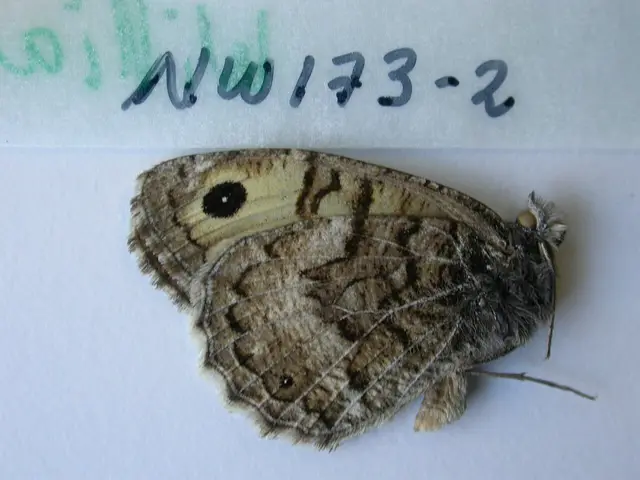
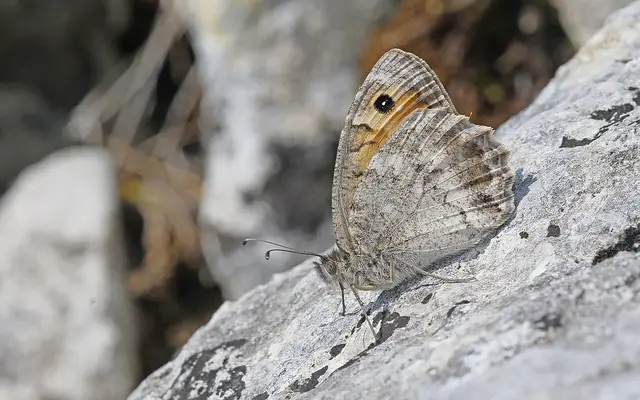
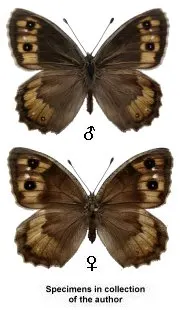
It's a grayling, a group of brownish butterflies in the family Nymphalidae that rest with wings closed. The upper side is greyish brown with paler bands, and the forewing carries two eyespots with white centres. Males span about 43 to 51 mm and have more pointed forewings, while females are bigger, about 53 to 56 mm, and rounder winged.
The underside is very pale, which makes a resting butterfly hard to spot against white limestone and marble.
Where it lives
It lives nowhere else on Earth. The main site is the Pletvar massif, with other populations on nearby mountains near Vitoliste. The habitat is arid, rocky slopes of pale metamorphic rock such as marble and gneiss, with sparse vegetation. Sources give different altitude ranges. The IUCN lists 800 to 900 m, while descriptions elsewhere run from about 700 to 1,700 m.
The Red List estimates an extent of occurrence of 274 and an area of occupancy of 92 (square kilometres, by IUCN convention). Fieldwork in 2012 put the suitable habitat at just under 10 square kilometres, so the figures measure different things.
Pins are Wikidata “endemic to” fields. Orange dots, when present, are GBIF occurrence tiles — survey bias included.
How it lives
There is one generation a year, and the butterflies fly in July and August. The caterpillars feed on grasses (Poaceae), though accounts name different species, including a fescue and meadow-grasses.
Adults reportedly stay close to where they emerge. In 2012 researchers used mark and recapture at the densest part of the Pletvar pass and estimated more than 650 individuals on a single day.
Why it is in trouble
Quarrying is the long-standing problem. A 2013 study in the Journal of Insect Conservation found active marble quarries at five of seven occupied sites. The current Red List scores mining and quarrying as a high-impact threat across most of the range, and housing development as a smaller one.
The same assessment names drought as a high-impact threat across the whole range, and notes that collecting is a lower-impact pressure. It describes the population as severely fragmented and decreasing, with a projected 80 percent reduction based on loss of habitat and range. It also records that no part of the population lies inside a protected area.
What is being done
In 2012 researchers led by Rudi Verovnik and Branko Micevski surveyed Pletvar and nearby areas and found the butterfly at six new sites. Because the known habitat was larger than assumed, the 2013 paper concluded the species would now rate as Endangered rather than Critically Endangered, noting the earlier rating rested on limited knowledge. The 2025 assessment kept it at Critically Endangered.
The Red List lists species recovery, habitat restoration and awareness among conservation actions, and says conservation sites have been identified across the whole range. Even so, none of the population lies inside a protected area.
Sources
Written for this catalog in our own words from the sources below, checked against them on 12 November 2026. Population figures are estimates and carry the year they were made. Status and assessment year: IUCN. 2026. The IUCN Red List of Threatened Species. Version 2026-1. iucnredlist.org.