Endangered
Partulina variabilis
Partulina variabilis
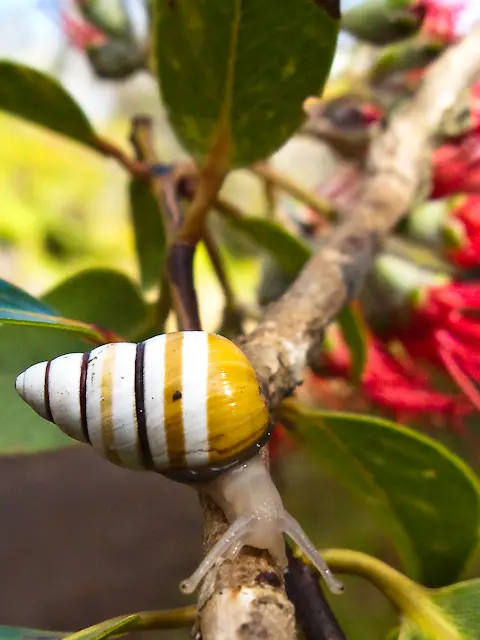
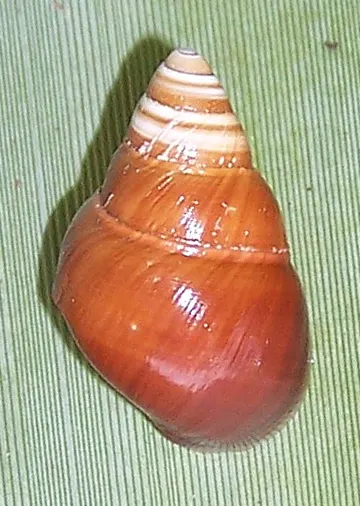
The Lanai tree snail (Partulina variabilis) lives only in the wet forest on Lanaihale, the high ridge of the Hawaiian island of Lanai. Its glossy shell varies hugely in colour and banding. The IUCN Red List rated it Endangered in 1996, and only 9 to 11 small wild populations are known.
How to recognise it
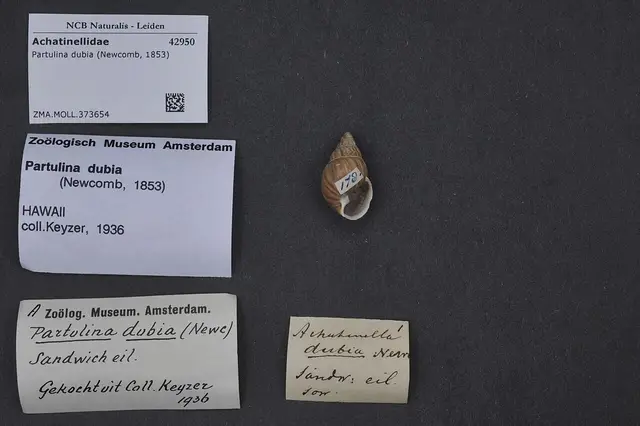
Adult shells are oblong to ovate and 14 to 16 mm long, with 5 to 7 whorls and a glossy surface. The base colour may be white, yellow, black or other shades, with spiral bands of varying width or none at all. Newcomb, who described the species in 1854, called it the most variable in its markings yet recorded among the Achatinellidae.
The shell may coil to the right or to the left, and both kinds occur in a single population. Only snails with the same coil direction can mate.
Where it lives
It occurs nowhere else but Lanai. Its home is the wet forest of Lanaihale, in areas that get more than 190 cm (75 inches) of rain a year, at roughly 1,000 to 1,100 m. Newcomb first described it in 1854 as Achatinella variabilis.
Pins are Wikidata “endemic to” fields. Orange dots, when present, are GBIF occurrence tiles — survey bias included.
How it lives
It grazes on microbes growing on the leaves, branches and trunks of native plants, including ohia, kanawao, kopiko, pilo and alani, and on dead hapuu fern. It is sometimes found on introduced guava and New Zealand ti.
Like other Hawaiian tree snails it matures late and breeds slowly. It reaches adult size in 4 to 7 years and can live longer than 15 years. Each snail is both male and female, is not known to self-fertilise, and can store sperm and produce live young for a year or more without mating again.
Why it is in trouble
At the time of its federal listing in 2013 there were 12 wild populations, each with fewer than 100 individuals. By 2019 the minimum estimate was 10 small populations, all on Lanaihale, and a 2024 review put the number at 9 to 11. More may survive on cliffs that surveyors cannot reach.
Rats, rosy wolf snails, Jackson's chameleons and flatworms prey on tree snails, and hoofed animals trample the forest. Loss of host plants, disease, fire, drought and hurricanes also matter. Because each population is so small, any of them could be lost outright.
What is being done
In 2018 Pulama Lanai finished a predator-proof enclosure holding a stable to increasing population, and in 2019 built a second around a related species that could later host translocated Lanai tree snails. No rats or wolf snails have been reported inside either.
The Snail Extinction Prevention Program keeps a captive colony that grew from 26 snails in 2019 to 48 in 2022, then fell to 28 in 2023. Deaths in captivity have been tied to pathogens, parasites or leaf toxins, and to newborn mortality. No captive snails have yet been released.
Sources
Written for this catalog in our own words from the sources below, checked against them on 12 November 2026. Population figures are estimates and carry the year they were made. Status and assessment year: IUCN. 2026. The IUCN Red List of Threatened Species. Version 2026-1. iucnredlist.org.