Endangered
Partulina physa
Partulina physa
Partulina physa is a Hawaiian tree snail with a left-coiled shell, once found across much of the island of Hawai'i. Surveys in the late 1990s located one population, in the Kohala Mountains, and a 2009 report called that site the only known one. The Red List assessed it as Endangered in 1996.
How to recognise it
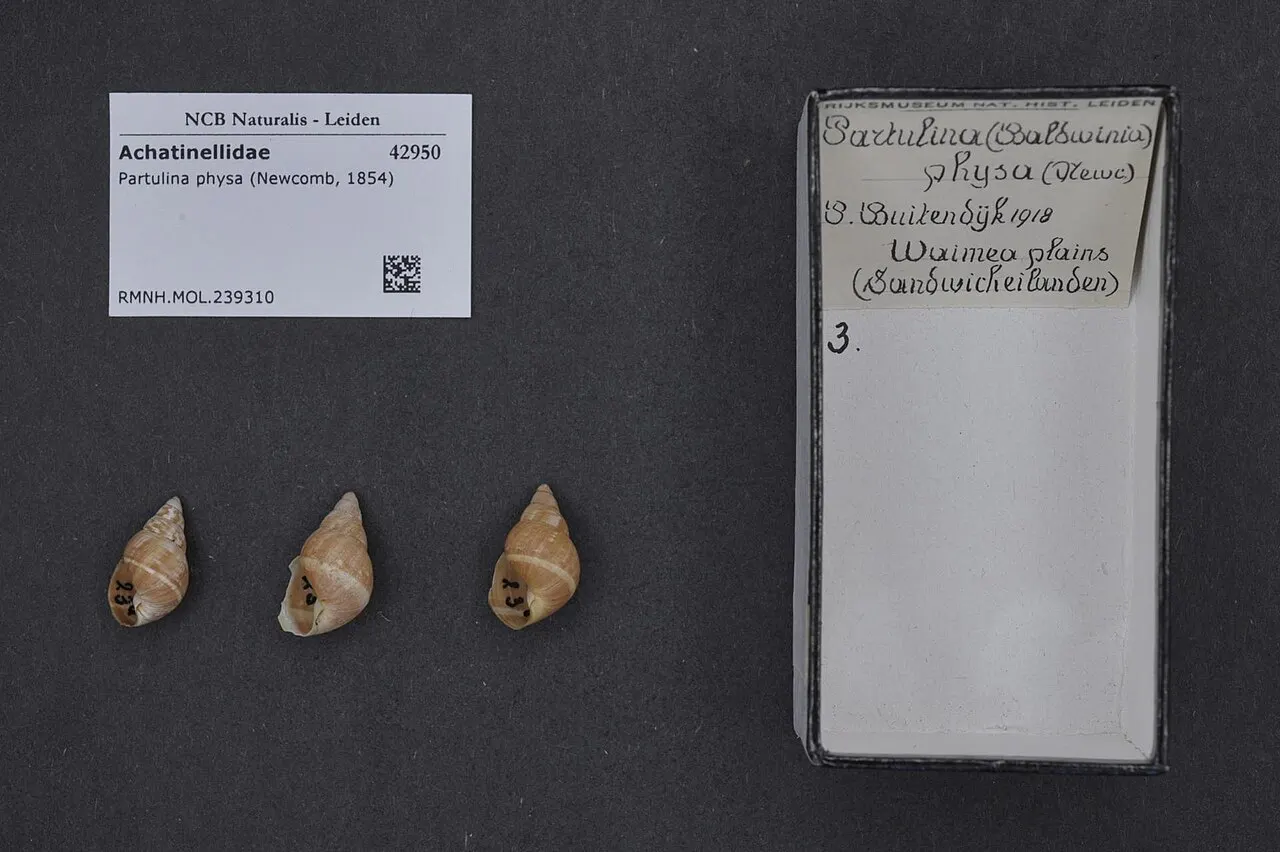
The shell is left-coiled (sinistral), swollen toward the base, with a pointed tip and about six rounded whorls. It is greyish white above with faint brown spots, grey below, with a narrow whitish band on the last whorl. A survey of the Kohala population measured 82 snails, and adults averaged 15.08 mm in shell length.
Where it lives
It belongs to the Achatinellidae, the Hawaiian tree snails, and occurs only in Hawai'i. Wesley Newcomb described it in the 1850s as Achatinella physa (sources give 1853 or 1854), and two subspecies have since been named.
A 1999 study in Pacific Science by Hadway and Hadfield reported that the species was once found nearly island-wide on Hawai'i. Field surveys between May 1995 and December 1997 located only one population, in a narrow range in the Kohala Mountains. Until 1992 there had been no recorded sighting of Hawai'i Island's Partulina snails for more than 46 years.
A 2009 conservation blog report placed that population at Pupu Kani Oe on Ponoholo Ranch, which covers 96 acres on the rim of Honokane Valley at about 3,400 to 3,800 feet, in forest that gets over 100 inches of rain a year. A Nature Conservancy staffer was quoted calling it the only population in the world.
Pins are Wikidata “endemic to” fields. Orange dots, when present, are GBIF occurrence tiles — survey bias included.
Why it is in trouble
Hadway and Hadfield concluded that habitat loss, much of it between 100 and 200 years ago, was probably the biggest cause of decline among Hawai'i Island's Partulina snails. Predation and shell collecting also contributed, and possibly climate change and disease.
At Kohala, wild cattle and feral pigs have degraded the forest, and rats and the predatory snail Euglandina rosea are possible threats. A small captive group at the University of Hawai'i at Manoa suffered 78 percent juvenile mortality.
What is being done
As of 2009 the ranch owner had signed a 15-year conservation agreement with The Nature Conservancy, and the land had been in the Kohala Watershed Partnership for about five years. The partnership has done fencing, though funding cuts limit further work. The Conservancy planned baseline surveys and a management plan focused on the snails. NatureServe reportedly ranks the species G1, critically imperiled.
Sources
Written for this catalog in our own words from the sources below, checked against them on 12 November 2026. Population figures are estimates and carry the year they were made. Status and assessment year: IUCN. 2026. The IUCN Red List of Threatened Species. Version 2026-1. iucnredlist.org.