Endangered
Partulina redfieldi
Partulina redfieldi
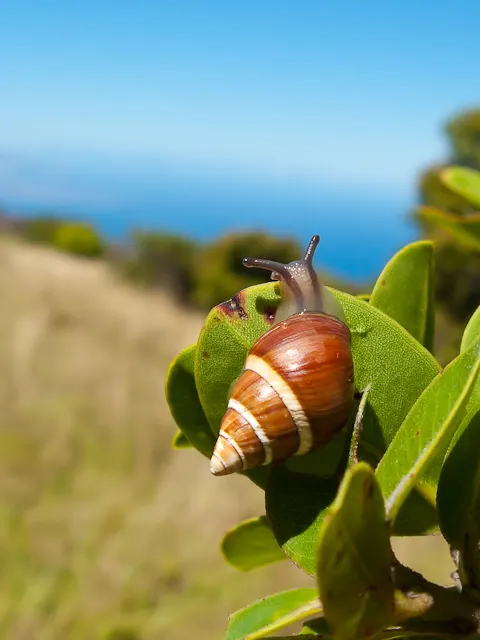
Partulina redfieldi is a Hawaiian tree snail with a left-coiling shell, found in the native forests of Molokai. The IUCN Red List classed it as Endangered in 1996, and that assessment has not been updated. Rats cut its best-studied population by about 85 percent from 1995.
How to recognise it
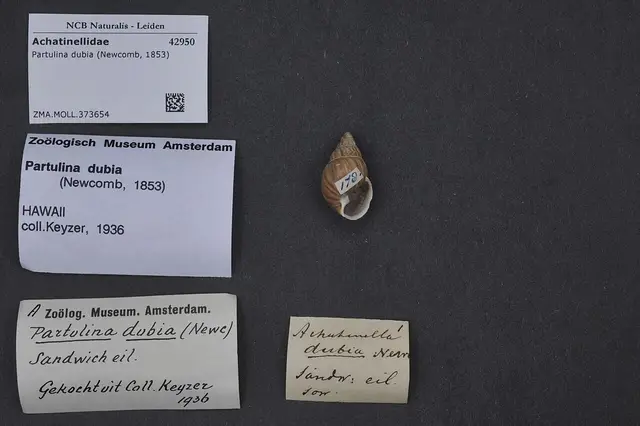
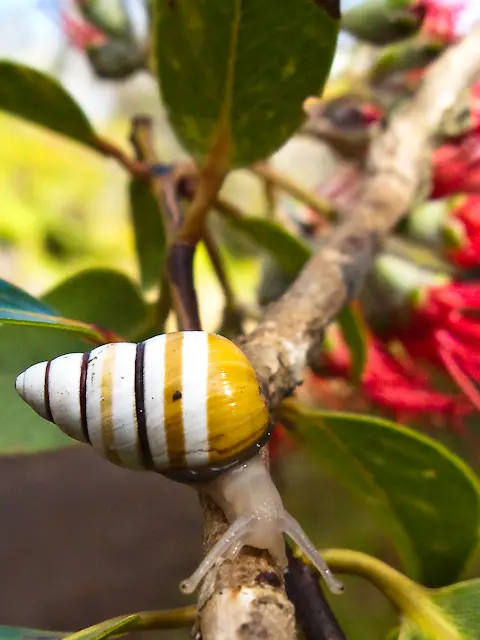
The shell is elongate and conical, coils to the left (sinistral), has six whorls and fine lengthwise ridges. It reaches about 25 mm long and 11 mm across. Colour varies a lot between individuals, from white to brown, and some shells carry white or brown bands. The species was first described by Wesley Newcomb in 1853 under the name Achatinella redfieldi, and a second form, kamaloensis, was named as a subspecies in 1914.
Where it lives
The species is native to the Hawaiian Islands and is chiefly recorded from Molokai. Some accounts also list Maui, while others give Molokai alone, so its full range is uncertain. On Molokai, the best-studied population lives in a mountain meadow at roughly 4,000 feet in the Kamakou Preserve, near the island's summit.
It is typically found on the smooth leaves of 'ohi'a lehua trees (Metrosideros polymorpha), a native Hawaiian tree.
Pins are Wikidata “endemic to” fields. Orange dots, when present, are GBIF occurrence tiles — survey bias included.
How it lives
These snails are slow and long-lived. Individuals spend their whole lives, often 16 to 20 years or more, in a single tree. They start breeding at 3 to 5 years old and produce about five young a year. That slow pace makes recovery after a crash a matter of decades, not seasons.
Why it is in trouble
Researchers from the University of Hawaii at Manoa monitored snails on four 'ohi'a trees in the Kamakou meadow from 1982. Counts rose from 19 to 195 between 1983 and 1995. Then they fell by about 85 percent, and shells chewed by rats piled up beneath the trees. A 2009 paper in Biological Invasions by Hadfield and Saufler attributes the crash to rats, which had apparently found the trees full of food. Numbers were still low in 2006.
Rats are not the only danger to Hawaiian tree snails. The carnivorous rosy wolfsnail, brought to Hawaii in 1955 and 1956 to control giant African snails, is considered worse than rats in many areas, and Jackson's chameleons have been seen eating tree snails. The Red List assessment for this species dates from 1996 and gives no population estimate.
What is being done
The Nature Conservancy began poisoning rats around the study trees after the 1995 crash, but snails kept disappearing as rats moved back in and shifted toward eating them. Elsewhere in Hawaii, predator-proof fenced enclosures have protected other tree snails, and a University of Hawaii laboratory has reared snails in captivity since 1989. The Red List lists no specific actions for this species.
Sources
Written for this catalog in our own words from the sources below, checked against them on 12 November 2026. Population figures are estimates and carry the year they were made. Status and assessment year: IUCN. 2026. The IUCN Red List of Threatened Species. Version 2026-1. iucnredlist.org.