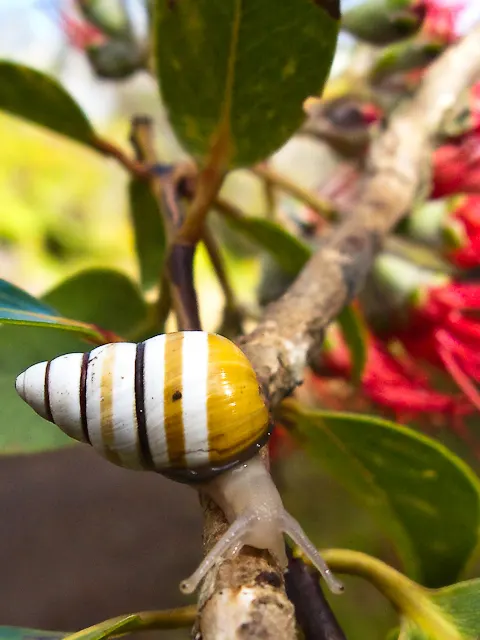
Endangered
Partulina mighelsiana
Partulina mighelsiana
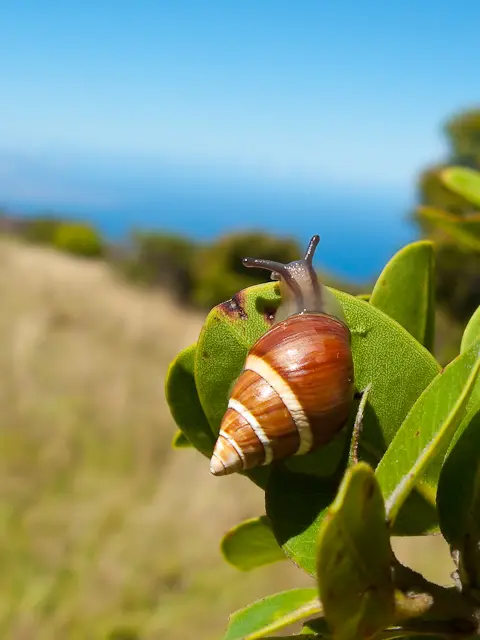
Partulina mighelsiana is a small tree snail found only on the Hawaiian island of Moloka'i, where it lives on native trees. The IUCN Red List lists it as Endangered, but that assessment dates from 1996, and a later survey summary gave a minimum count of just 63 snails seen in the wild.
How to recognise it
The shell is striped in shades of brown, black and white, and the soft body is a transparent brown. It belongs to the Achatinellidae, the family of Hawaiian tree snails, and was described by Pfeiffer in 1847.
Where it lives
It is native to Moloka'i, in Hawaii, and is found nowhere else. It lives on trees, trunks, stems and leaves, and occurs only in very small, fragmented populations.
Pins are Wikidata “endemic to” fields. Orange dots, when present, are GBIF occurrence tiles — survey bias included.
How it lives
Hawaiian tree snails of this group are nocturnal and graze on the fungi that grow on the surface of native leaves. They are hermaphrodites and give birth to live young instead of laying eggs. Growth and reproduction are slow, adults can live for many years, and on O'ahu most individuals spend their whole lives on one tree. Those details come from related species and are likely to be similar here.
A University of Hawaii study of captive tree snails found that individuals of this species, isolated for several years before maturity, still gave birth. That means a single snail can produce young on its own, through self-fertilisation or long-term sperm storage.
Why it is in trouble
Habitat destruction, over-collecting and predators brought to the islands have all taken a toll. The named predators are introduced rats, the snail genus Oxychilus and possibly the rosy wolfsnail (Euglandina). The rosy wolfsnail is described as the most serious threat to Hawaiian tree snails in general. Because these snails reproduce slowly, even small losses are hard to replace.
The IUCN assessment dates from 1996 and uses the older version 2.3 of the Red List categories. A 2015 PeerJ study of captive Hawaiian tree snails tabulated the species as Critically Endangered, with a minimum wild count of 63. That figure is the lowest number seen during surveys in the preceding ten years, taken from a 2013 state program report. NatureServe ranks the species Critically Imperiled.
What is being done
Since 2012, Hawaii's Snail Extinction Prevention Program has worked to stop extinctions among Hawaiian snails. It is run by the US Fish and Wildlife Service, the state Division of Forestry and Wildlife and the University of Hawaii. The team rears and breeds close to 40 rare species in captivity, monitors wild groups, controls predators and maintains predator-proof enclosures. The program's page shows Partulina mighelsiana on Moloka'i but gives no details of work on this species. Captive snails of the species have been kept at the University of Hawaii.
Sources
Written for this catalog in our own words from the sources below, checked against them on 12 November 2026. Population figures are estimates and carry the year they were made. Status and assessment year: IUCN. 2026. The IUCN Red List of Threatened Species. Version 2026-1. iucnredlist.org.