Endangered
Partula radiolata
Partula radiolata
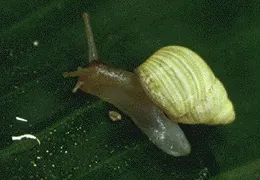
The Guam tree snail, or akaleha' (Partula radiolata), is a small, thin-shelled tree snail found only on the island of Guam in the western Pacific. The IUCN Red List lists it as Endangered (assessed 2024). It is the most commonly encountered of Guam's tree snails, but introduced predators have hit it hard.
How to recognise it
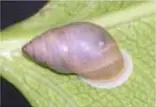
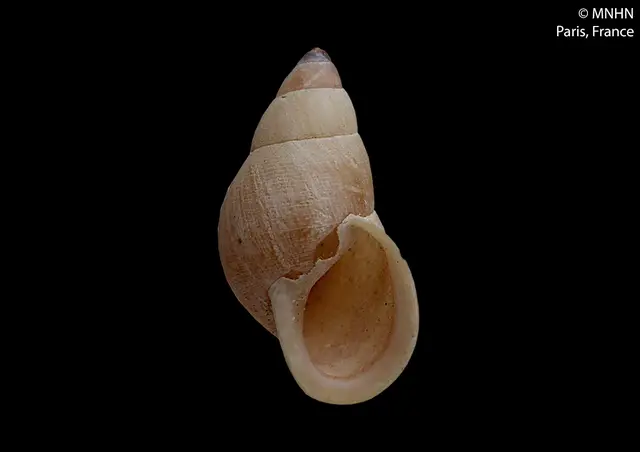
The shell is slim, thin and tapering, usually with five gently rounded whorls that spiral to the right. Adults are about 13 to 19 millimetres long. The base colour is pale straw, marked with darker streaks and brown lines, and there are six recognised colour patterns.
Like other partulid snails, it gives birth to live young. The eggs hatch inside the parent, which releases single babies every few weeks.
Where it lives
It lives nowhere but Guam. Its original 1846 description wrongly gave its home as New Ireland, in Papua New Guinea, a mistake noticed in 1851 and corrected by most authors. On Guam it lives in beach-back vegetation, in forest along rivers and in limestone and ravine forest, often at 50 to 100 metres above sea level.
Snails sit on the underside of large leaves of almost any plant, native or introduced, including ferns. They want cool, shaded, humid places with little air movement, and surveys have found them mainly where there is a canopy above 4 metres and ground cover below.
Pins are Wikidata “endemic to” fields. Orange dots, when present, are GBIF occurrence tiles — survey bias included.
How it lives
Partulid tree snails grow slowly, live for years and breed slowly, but this species has an edge. In a 2018 study of captive snails, it carried more young at a time than any of 19 partulid species compared, and ranked third for births per adult among 13 groups. That may explain why it has fared better than its relatives on the island.
It grazes on the surface of leaves and branches, probably eating fungus or microalgae. A 1925 account says it may come down at night to feed on decaying plant material.
Why it is in trouble
The worst threat is a flatworm, Platydemus manokwari, which reached Guam in 1978 and had spread over the island by 1980. It climbs wet trees and tracks snails by scent. The rosy wolfsnail, brought in during the 1950s and 1960s to control another invasive snail, also eats them.
Forest loss adds to the damage. Native forest now covers less than 17 percent of Guam, wildfires in 1991 and 1992 eliminated at least one population, and feral deer, pigs and goats browse the understory and wear down the habitat. Moving US Marine Corps personnel to Guam will permanently modify about 1,200 acres of limestone forest.
Counts vary with the source. The IUCN assessment treats the species as having one location and an area of occupancy of 24 square kilometres, with the population trend unknown. A 2023 US Fish and Wildlife Service report counts more than 50 populations, up from no more than 26 reported at listing in 2015, though the increase may reflect survey effort. Populations range from a few snails to thousands. A 1989 survey found the species at only 9 of the 34 sites that Crampton had sampled in 1920.
What is being done
The snail was listed as endangered under the US Endangered Species Act on 1 October 2015 and by the Government of Guam in 2009. No critical habitat has been designated, and a draft recovery plan for 23 Mariana Islands species was published in November 2022. Predator control, fencing and land protection are the main tools, though most of these measures were still in the planning stage in 2023.
Zoos in Europe and North America bred this species in captivity as part of a partulid programme, but it is no longer raised in captivity. About 275 snails in the path of military construction were slated to be moved to suitable habitat, and whether that has worked has not yet been judged.
Sources
Written for this catalog in our own words from the sources below, checked against them on 12 November 2026. Population figures are estimates and carry the year they were made. Status and assessment year: IUCN. 2026. The IUCN Red List of Threatened Species. Version 2026-1. iucnredlist.org.