Critically Endangered
Crampton's Partula Tree Snail
Partula cramptoni
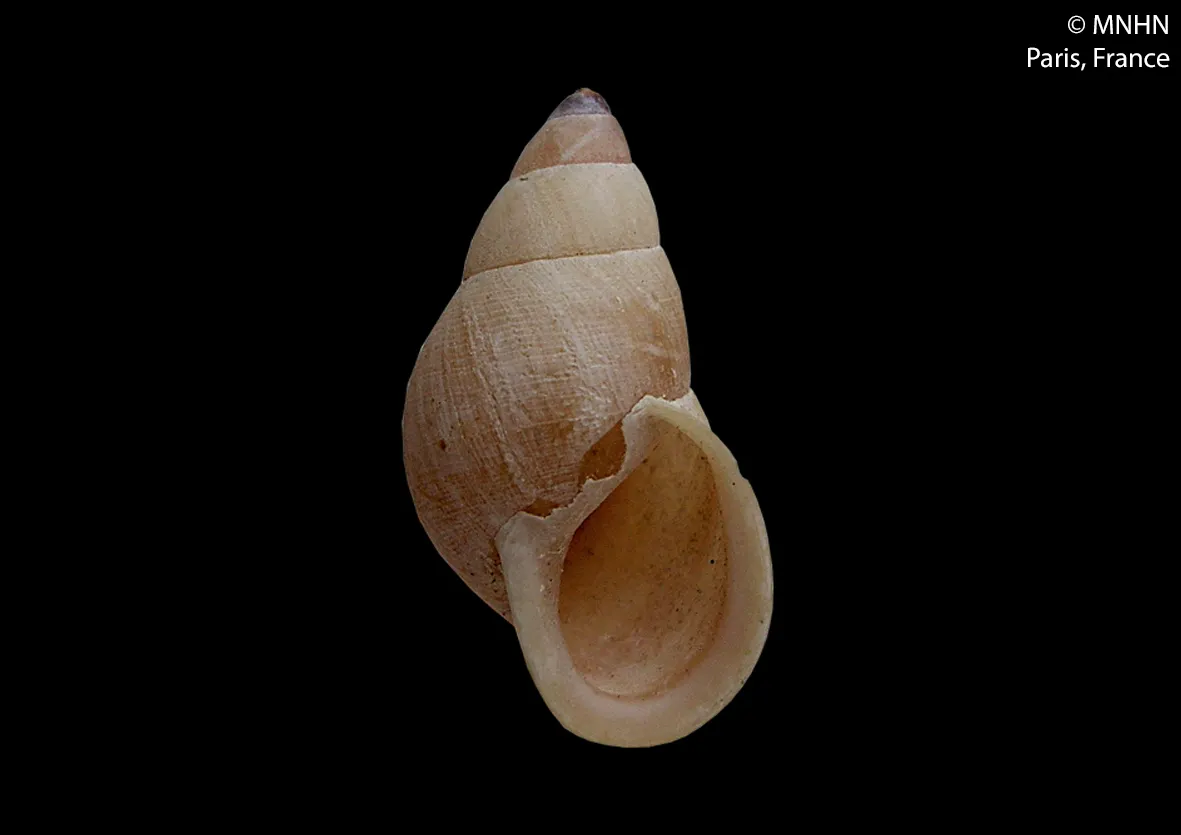
Crampton's partula tree snail (Partula cramptoni) is a small land snail from the Solomon Islands, recorded only on the islands of Rennell and Bellona. The IUCN Red List rated it Critically Endangered in 2024, based on one location, a tiny range and ongoing habitat loss. How many survive is unknown.
What it is
Partula cramptoni belongs to the Partulidae, a family of small, air-breathing tree snails scattered across Pacific islands. Shells in the genus Partula average roughly 13 to 19 mm long, though no size is given for this species in particular.
Its scientific name dates to William J. Clench, who described it in 1941. Very little else about its biology, such as diet or breeding, appears in the sources available.
Where it lives
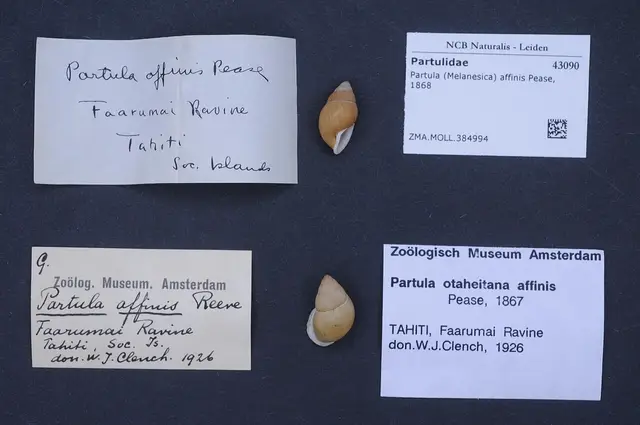
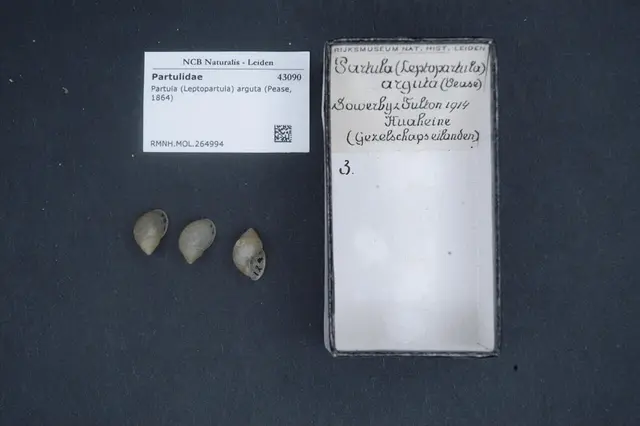
Museum specimens place it on Rennell and Bellona, in the Solomon Islands. Rennell records come from sites including Lavanggu, Te-Avamanggu and Lake Tegano. Bellona records are from Nggonggona and Pauta, collected in 2015. The oldest dated record is from Rennell in 1930.
The IUCN assessment, based on a 2018 evaluation, treats the species as endemic to the Solomon Islands and counts a single location. Its extent of occurrence is 19 square km, and its area of occupancy is estimated at 4 to 20 square km depending on how it is calculated. The habitat is moist lowland tropical forest.
Sources disagree on Rennell. One published summary of the genus lists the species as extirpated from Rennell but surviving on Bellona. Museum records, however, include a specimen from Lake Tegano on Rennell dated 2015, though a preserved specimen does not show whether the animal was alive.
Pins are Wikidata “endemic to” fields. Orange dots, when present, are GBIF occurrence tiles — survey bias included.
Why it is in trouble
The IUCN names agriculture, of unknown scale, as an ongoing threat causing rapid declines over the majority of the range. It also lists small-scale subsistence harvest of other resources as a possible unintended effect. Both lead to forest conversion and degradation, and both its range and its habitat are recorded as still shrinking.
The population trend is listed as unknown. Elsewhere in the Pacific, the introduced predatory snail Euglandina rosea devastated the Partula snails of Tahiti. As of the 2024 Red List update, 32 of 73 Partula species were listed as extinct, which makes the genus one of the most threatened groups of snails. Whether the predator reaches the Solomon Islands is not recorded in the sources available.
What is being done
The IUCN lists site protection as the only conservation action. Its assessment records no recovery plan and no systematic monitoring scheme for the species.
Sources
Written for this catalog in our own words from the sources below, checked against them on 12 November 2026. Population figures are estimates and carry the year they were made. Status and assessment year: IUCN. 2026. The IUCN Red List of Threatened Species. Version 2026-1. iucnredlist.org.