Critically Endangered
Partula affinis
Partula affinis
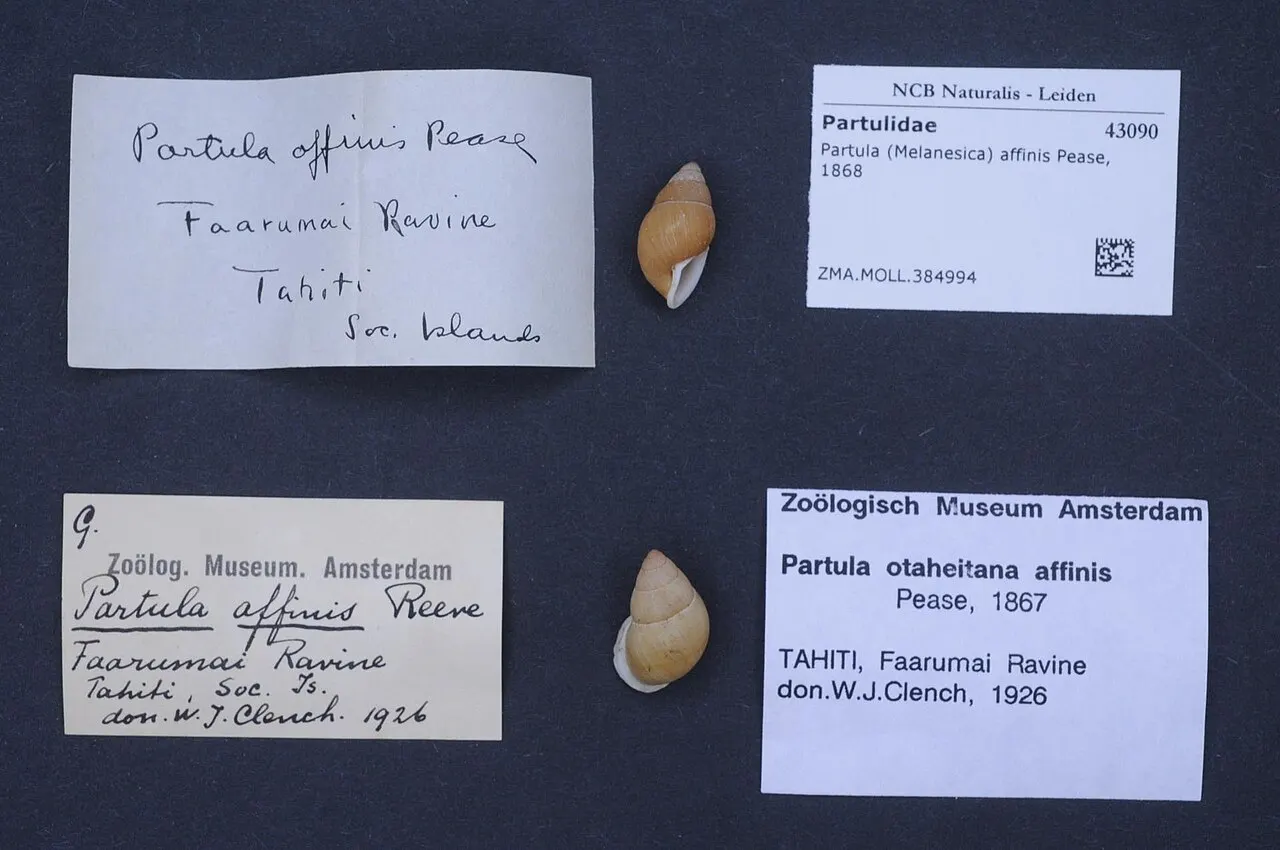
Partula affinis, sometimes called the similar partula, is a small land snail that lives only on the island of Tahiti in French Polynesia. The IUCN Red List assessed it as Critically Endangered in 2022, with a single wild population of 1 to 50 mature individuals. Captive-bred snails are being released.
How to recognise it
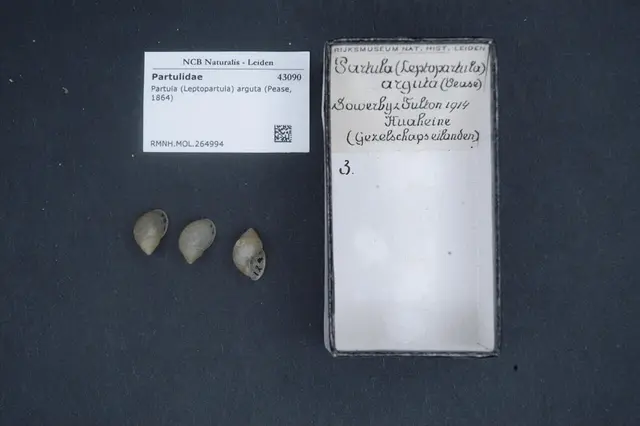
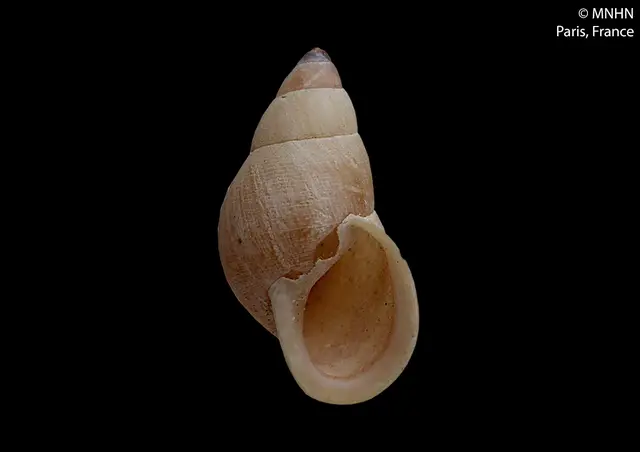
Detailed descriptions of this species' shell are scarce. Partula snails in general are small, with adults typically 13 to 19 millimetres long. William Harper Pease described P. affinis in 1868, first as a form of Partula otaheitana, and it is now treated as its own species. Genetic work shows the two are sister species.
Where it lives
The species is endemic to Tahiti, in the Society Islands. It once occurred across almost all of the island and now survives in one place on Tahiti Iti, the island's southeastern peninsula, which makes it a single-valley species. The Red List counts one location with an area of occupancy of about 4 square kilometres, in moist lowland forest up to about 100 metres.
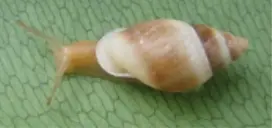
Across Tahiti, partulas mostly lived on the undersides of plantain and Caladium leaves, and in some valleys on Dracaena and turmeric.
Pins are Wikidata “endemic to” fields. Orange dots, when present, are GBIF occurrence tiles — survey bias included.
Why it is in trouble
The main cause is a predatory snail. The rosy wolfsnail (Euglandina rosea) was brought to Tahiti to control the introduced giant African land snail, and it also preyed on native Partula. Across Tahiti and neighbouring islands, all but about 12 of roughly 76 species are reported to have gone extinct within about a decade, and Partula were gone from the wild by the late 1980s. The Red List names Euglandina rosea as a threat to most of the population, causing rapid declines, and names a second invasive species, Platydemus manokwari, as a threat to the whole population.
The 2022 assessment, under criterion D, records 1 to 50 mature individuals, all in one subpopulation, and the population trend as decreasing. It records the area of occupancy as not currently declining, but numbers this small leave the species open to a single event.
What is being done
P. affinis belongs to the international captive breeding programme for Partula, which began in 1986. Zoos collected the last surviving snails and have bred them since. The Zoological Society of London coordinates a consortium with programmes in the UK, France and the US.
Reintroductions to Tahiti began in 2015. In July of that year, captive-bred P. hyalina, P. affinis and P. nodosa were released, about 100 into a predator-proof reserve and 150 into forest. About 30 percent were still found two weeks later, and more were probably hidden in dense vegetation. Later work has favoured releasing into forest rather than small fenced reserves, and P. affinis has had a slow release in Tahiti's Papehue valley. The pandemic disrupted the programme, and releases became possible again in 2023, when 5,522 snails were released on Moorea and Tahiti.
The assessment lists captive breeding, reintroduction, awareness work and habitat protection as actions.
Sources
Written for this catalog in our own words from the sources below, checked against them on 12 November 2026. Population figures are estimates and carry the year they were made. Status and assessment year: IUCN. 2026. The IUCN Red List of Threatened Species. Version 2026-1. iucnredlist.org.