Endangered
Simpson's toadlet
Simpson's toadlet
Simpson's toadlet (Simpson's toadlet), also called Simpson's plumb toad, is a tiny warty toad of cloud forest on the eastern slope of the Ecuadorian Andes. The IUCN Red List classed it as Endangered in 2022, with a decreasing population, and it is known from only three locations.
How to recognise it
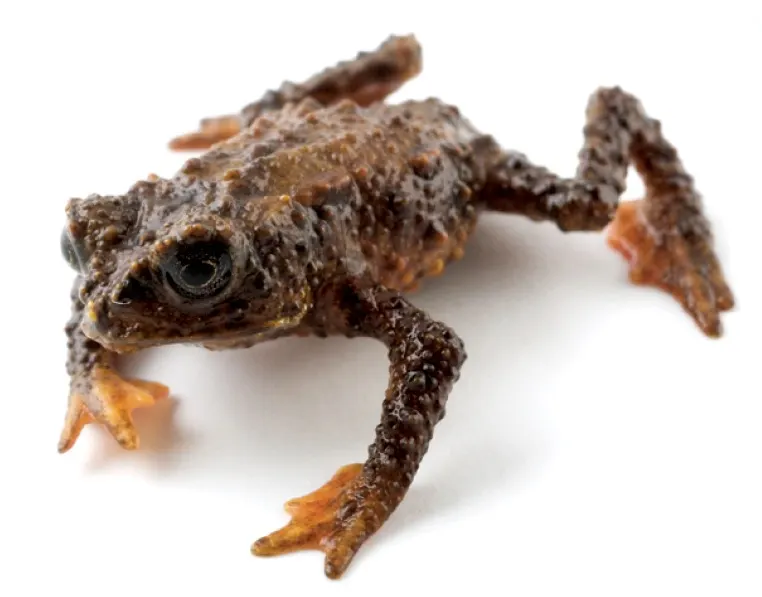
This is a very small, warty toad. In the 2011 description, adult males measured about 17.6 to 26.1 mm from snout to vent, and the one female known at the time was 33 mm. The back, head and limbs are dark to light brown with paler patches, while the upper eyelids, snout and flank bumps are orange to yellow and the belly is orange-brown.
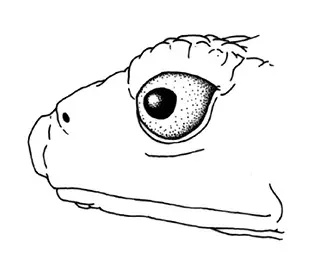
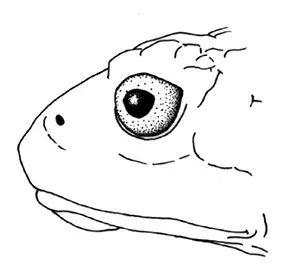
The snout is short and rounded, with a small tip, and the fourth and fifth toes are longer than the first three. It was described as separate from Osornophryne guacamayo, a similar toad from the same genus, which has a more conspicuous proboscis-like snout.
Where it lives
The species is found only in Ecuador, in montane cloud forest on the eastern slope of the Andes. The type specimen came from the Ankaku-Zona reserve in Pastaza Province, and others from near the Rio Zunac reserve in Tungurahua Province. The Red List gives a recorded elevation of 2,200 to 2,266 m, counts three locations and puts the extent of occurrence at about 1,260 square km.
Pins are Wikidata “endemic to” fields. Orange dots, when present, are GBIF occurrence tiles — survey bias included.
How it lives
Little is known about its life. Individuals have been found at night on the leaves of bromeliads and ferns, in forest dominated by Clusia trees. Adult males have no vocal sacs.
The toad is reportedly nocturnal and semi-arboreal, and when handled it moves slowly and curls into a ball. Its breeding habits have not been described, though it is reportedly thought to develop directly, without a free-swimming tadpole stage.
Why it is in trouble
The Red List gives a decreasing trend and a continuing decline in the area it occupies. The threats it lists are small-holder farming and grazing, temperature extremes, and accidental harm from small-scale harvesting. Because it lives within a narrow band of altitude, climate change is reportedly a further concern.
It is reportedly common where it occurs, so the worry is its small range rather than rarity at a given site.
What is being done
The Red List records that its known range lies in at least one protected area, and gives the share of the population inside protected areas as 100 percent. It lists site management and resource and habitat protection as conservation actions. The toad was described only in 2011, when its authors rated it Data Deficient. A third location was reportedly added in later surveys.
Sources
Written for this catalog in our own words from the sources below, checked against them on 12 November 2026. Population figures are estimates and carry the year they were made. Status and assessment year: IUCN. 2026. The IUCN Red List of Threatened Species. Version 2026-1. iucnredlist.org.