Endangered
Small-scaled skink
Oligosoma microlepis
The small-scaled skink (Oligosoma microlepis) is a sun-loving lizard of New Zealand's central North Island that lives on scattered rock piles, outcrops and scree. The IUCN Red List rated it Endangered in 2019 because its few populations are fragmented, shrinking in number and exposed to introduced predators.
How to recognise it
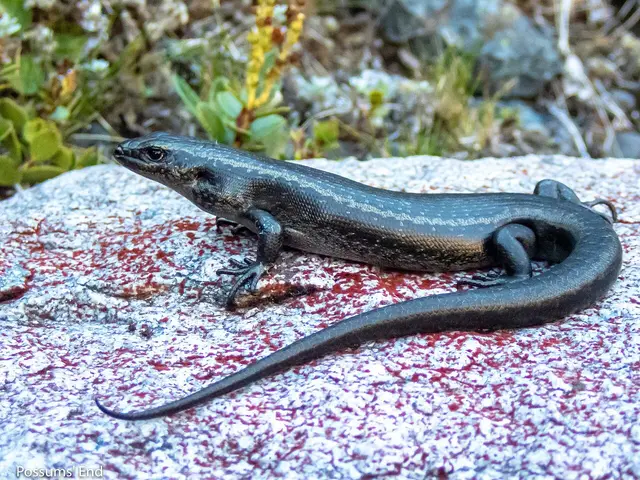
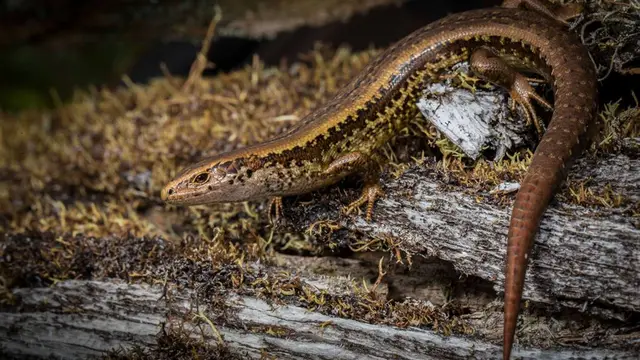
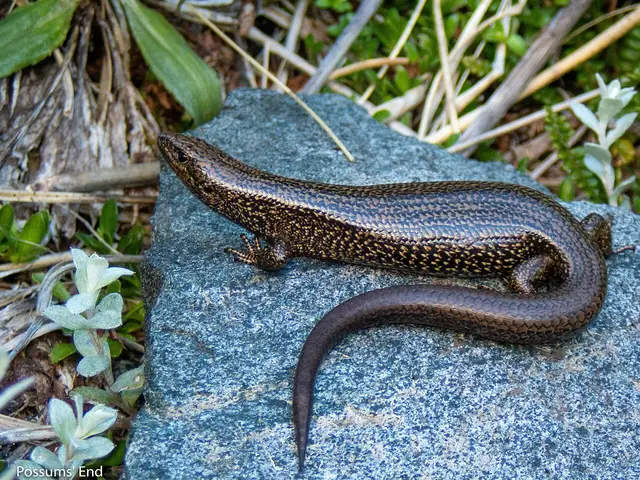
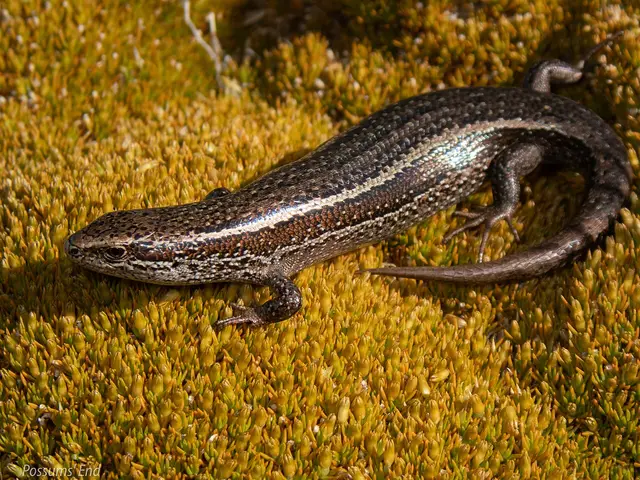
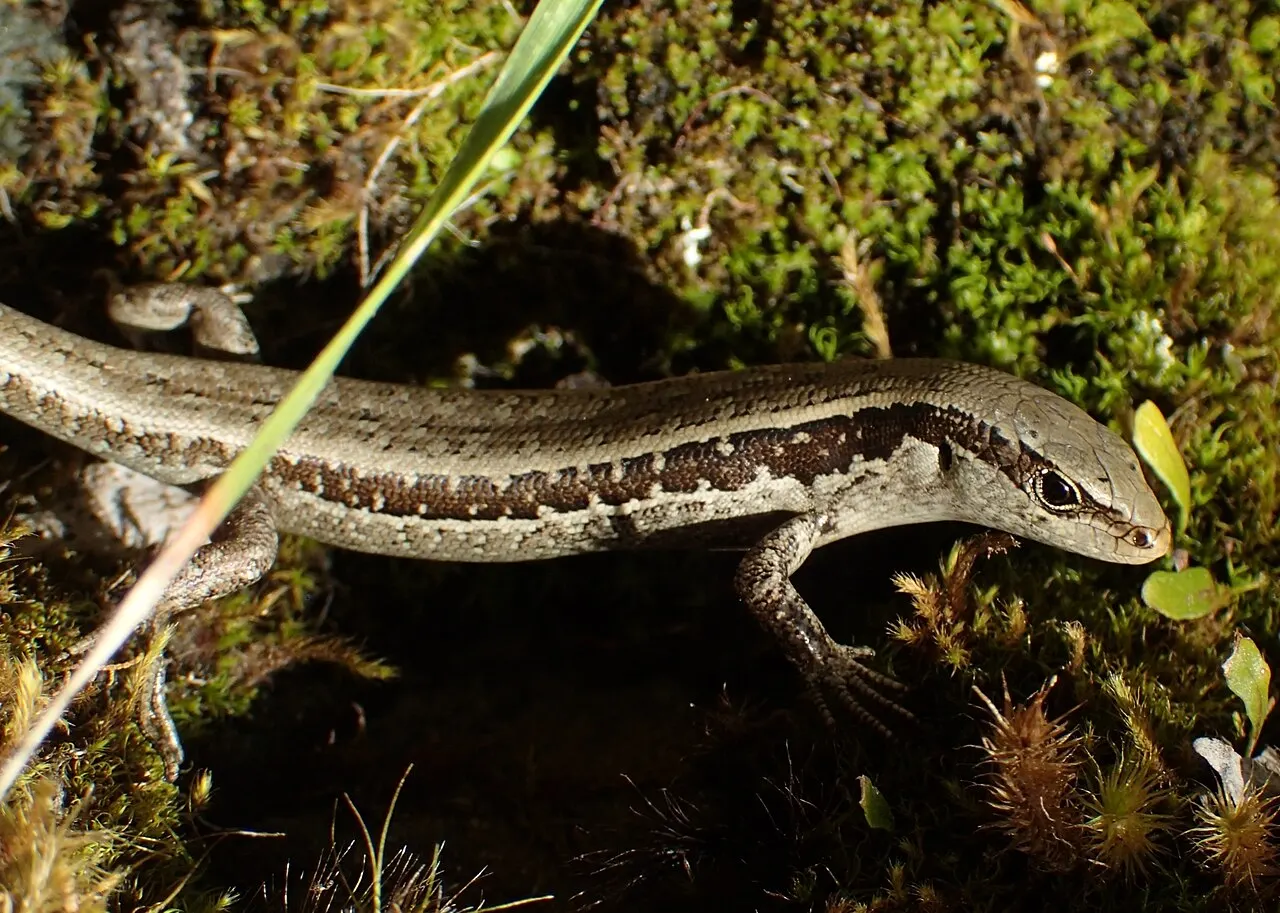
It's a small skink, reaching about 73 mm from snout to vent and up to 13 g, with an intact tail that's longer than the body. The head is short and blunt, with a teardrop marking beneath each dark eye. The back is light grey-brown with a dark stripe down the middle and pale, crinkly-edged stripes that give a checkerboard look, and a broad dark brown-grey band runs along each flank. The belly is pale cream or white and unspeckled.
Individual skinks can be told apart by their natural markings, which is how researchers have counted them from photographs.
Where it lives
The first specimen was caught in January 1971 on Motutaiko Island in Lake Taupo, and the species was formally described in 1990. Today it is known from small pockets in the central North Island around Lake Taupo, the Rangitikei River, the Ruahine Ranges and just north of Taihape. A 2016 genetic study put its whole range at roughly 100 square kilometres, with most occupied sites in a district known as Inland Patea, between the Kaimanawa and Ruahine ranges. The IUCN, which measures range differently, gives an extent of occurrence of about 3,060 square kilometres and an area of occupancy of about 52 square kilometres, at 400 to 900 m.
It needs sun-exposed rock: scree, outcrops, cliffs, and boulder or pebble banks along rivers. The patches it uses are often tiny, typically under 3 square metres. Most are now on heavily grazed pasture, and many were created by roading, stock tracks, quarrying and erosion after forest clearance. Only three populations are known on relatively unmodified land.
Pins are Wikidata “endemic to” fields. Orange dots, when present, are GBIF occurrence tiles — survey bias included.
How it lives
It is active by day, basks openly and is mostly solitary, although it can form dense colonies where rocks are suitable. It eats small invertebrates, and probably native berries too. Breeding is poorly known. Captive females have given birth to litters of 2 or 3 young between January and March.
Numbers at a good site can be high. At Springvale Station near the Rangitikei River, a 2009 photo-resighting study estimated about 252 skinks on roughly 0.02 hectares of rock, out of 0.23 hectares known to be occupied there. Density varied widely from plot to plot, so that figure can't be scaled up to the whole population.
Why it is in trouble
The IUCN calls the population severely fragmented and records continuing declines in the area occupied and in the number of locations. Outside predator-free Motutaiko Island, the skinks face the full set of introduced mammals on the mainland, and with only two or three young per litter they recover slowly from losses.
A genetic survey reported in 2016 found that populations come and go. Of 13 rock patches where the skink had been recorded, three were now empty, and one loss was probably caused by a flood in 2001. Five new populations were also found, so the pattern is shifting rather than a simple retreat.
The shape of its range has a natural cause. The Taupo eruption about 1,800 years ago devastated much of the area, so the skink must have spread back in since. The 2016 study concluded it can re-establish populations if farming intensification and introduced predators are held in check.
What is being done
New Zealand's Department of Conservation ranked it Nationally Vulnerable in 2012. The IUCN records a recovery plan and lists control of invasive species as the action in place. A captive population is held as insurance.
Sources
Written for this catalog in our own words from the sources below, checked against them on 12 November 2026. Population figures are estimates and carry the year they were made. Status and assessment year: IUCN. 2026. The IUCN Red List of Threatened Species. Version 2026-1. iucnredlist.org.
- IUCN Red List assessment, Oligosoma microlepis (2019)
- Nelson-Tunley, Morgan-Richards and Trewick 2016, Biological Journal of the Linnean Society 119: 37-51
- Gebauer 2009, DOC Research and Development Series 318, trapping and identification of small-scaled skinks
- New Zealand Herpetological Society, small-scaled skink
- Wikipedia, Small-scaled skink