Endangered
Montipora grisea
Montipora grisea
Montipora grisea is a reef-building stony coral that grows as crusts, lumps or thick plates on shallow tropical reefs across the Indian and Pacific oceans. The IUCN Red List moved it from Least Concern to Endangered in its 2024 assessment, projecting a fall of about 62 percent as reef habitat declines.
How to recognise it
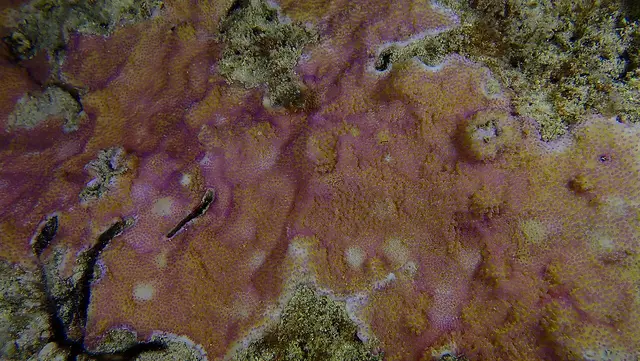
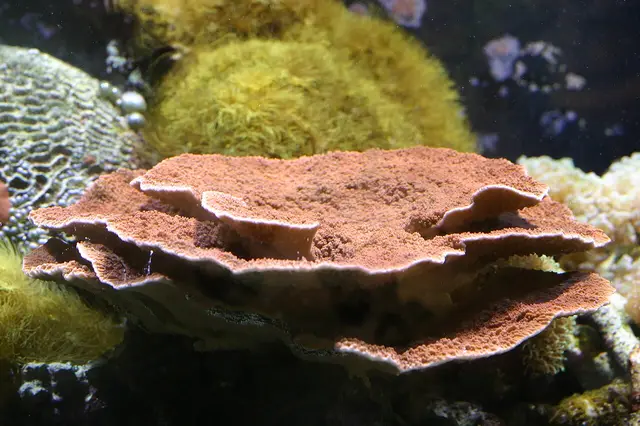
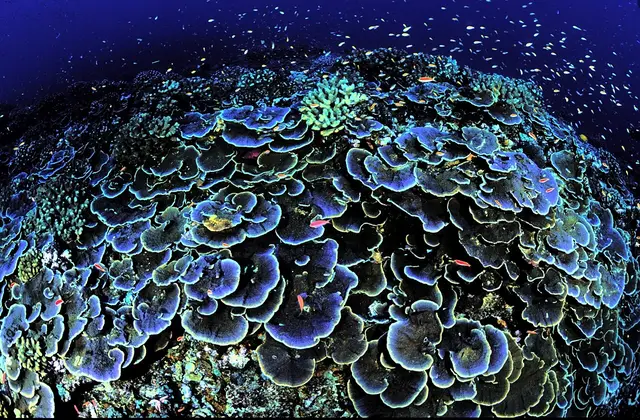
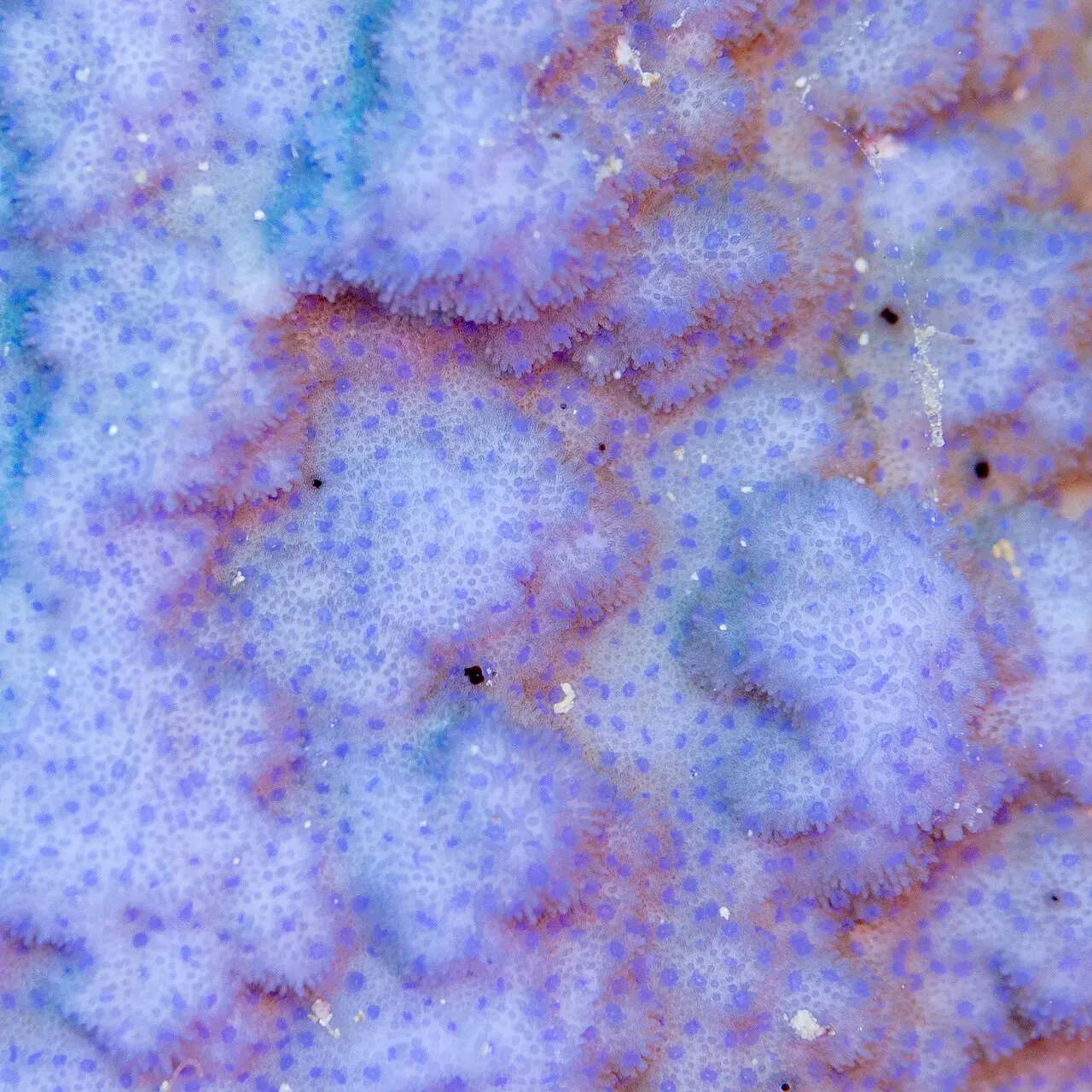
Colonies are massive, encrusting or built of thick plates that are attached on one side only. Colour varies a lot: dark brown or green are usual, but pale shades, bright blue and pink also occur. Up close, the small cups that hold the polyps (corallites) stand slightly proud of the surface and are ringed by partly fused bumps called papillae, with more papillae on the skeleton between them.
Where it lives
The coral grows on upper reef slopes in warm, shallow water. Depth ranges are given as 0 to 20 m, 3 to 20 m and, in the Red List assessment, 1 to 50 m. The assessment lists dozens of countries and territories in its range, spread from East Africa and Madagascar through India and Southeast Asia to Australia and islands across the Pacific, including Japan, Fiji, French Polynesia and Pitcairn.
It was first described by Bernard in 1897. The Red List treats it as a coral of marine reef habitat only.
Pins are Wikidata “endemic to” fields. Orange dots, when present, are GBIF occurrence tiles — survey bias included.
How it lives
Colonies can be hermaphroditic, with both sexes in one colony, or have separate sexes. The fertilised egg develops into a free-swimming larva, called a planula, which later settles on the reef and starts a new colony. The generation length used in the Red List assessment is 10 years.
Montipora is reportedly moderately prone to bleaching, though less so than the staghorn and table corals of the genus Acropora. Little else is recorded about the biology of this particular species.
Why it is in trouble
This coral was assessed as Least Concern in 2008 and again in 2014. The 2024 reassessment rated it Endangered under criteria A3ce, which look to the future: a projected reduction of about 62 percent, based on decline in habitat area and quality and on the effects of introduced species, pathogens, pollutants or competitors. The Red List records its population as decreasing.
The listed threats are mostly the ones facing reefs generally: temperature extremes, storms and flooding, sediment and erosion, coastal housing and commercial development, shipping lanes, and tourism and recreation.
The change fits a wider pattern. IUCN's November 2024 coral reassessment covered 892 reef-building species and found 44 percent threatened, up from roughly one-third in 2008, with climate change as the leading threat. Among Indo-Pacific Acroporidae, the family that includes Montipora, 191 of 279 species were classified as Endangered.
What is being done
The species is on CITES Appendix II, so international trade is monitored. Whether it occurs inside a protected area is recorded as unknown. The assessment lists habitat restoration, site protection and management, species recovery, captive breeding and a genome resource bank as relevant approaches. IUCN's own advice for corals is to cut greenhouse gas emissions first, tackle other pressures to build resilience, and study whether corals can adapt to warmer water.
Sources
Written for this catalog in our own words from the sources below, checked against them on 12 November 2026. Population figures are estimates and carry the year they were made. Status and assessment year: IUCN. 2026. The IUCN Red List of Threatened Species. Version 2026-1. iucnredlist.org.