Endangered
Montipora capitata
Montipora capitata
Montipora capitata, the rice coral, is a stony coral of Pacific reefs and most familiar from Hawaii. The IUCN Red List rated it Endangered in 2024 and projects a steep decline over coming decades. It is pale brown with small white bumps, and repeated marine heat waves have hit it hard.
How to recognise it
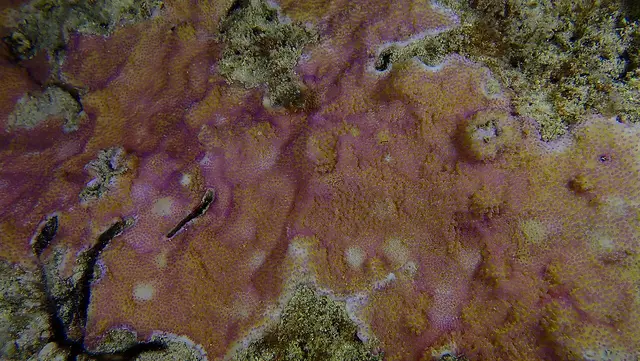
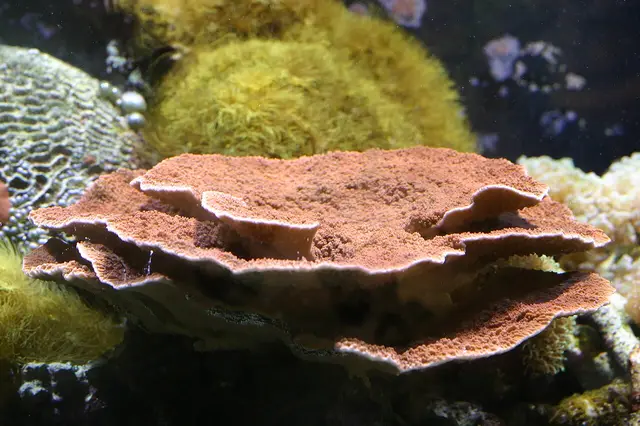
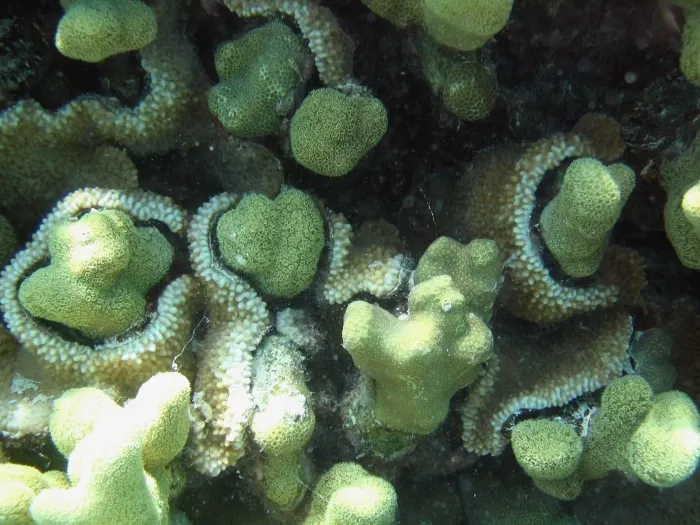
Rice coral starts as an encrusting crust and grows into branching, tree-like colonies as it matures. It is usually pale brown with white bumps, and those small, smooth, rice-grain-like projections (verrucae) give it its common name. Its skeleton is porous, with tiny, widely spaced corallites.
James Dwight Dana described it in 1846. It is also called pore coral.
Where it lives
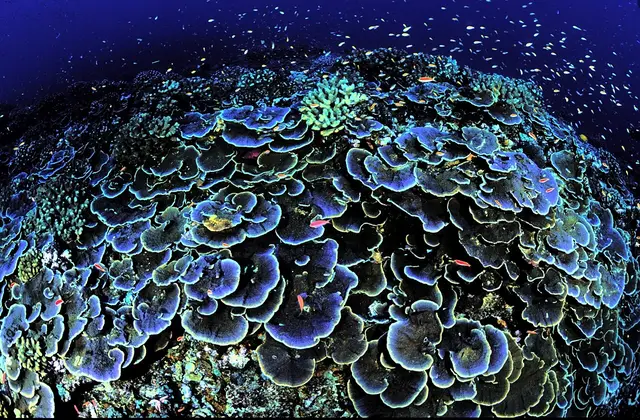
It is a reef-building coral of the tropical Pacific and is common around Hawaii, especially where the water is turbulent. The Red List records it as native in about 40 countries and territories, from Hawaii, Midway, Johnston Atoll and the Line Islands across Micronesia, Melanesia and Polynesia to the Philippines, Indonesia, Australia, Japan and parts of the Indian Ocean and Red Sea.
It lives on coral reefs from the surface down to about 70 m according to the Red List. One general reference gives a shallower limit of about 20 m, so depth figures differ.
Pins are Wikidata “endemic to” fields. Orange dots, when present, are GBIF occurrence tiles — survey bias included.
How it lives
Like other reef corals, it relies on symbiotic algae living in its tissue, which give it colour and energy. Heat stress makes the coral expel them, which is bleaching. Corals that bleach often die, and weakened ones catch disease more easily.
The Red List uses a generation length of 10 years. The crown-of-thorns starfish reportedly prefers to feed on Montipora corals and can badly damage slow-growing ones, though no study of its effect on this species was found.
Why it is in trouble
Warming seas are the main worry. A University of Pennsylvania team followed 40 large colonies of two Hawaiian coral species in Kāne‘ohe Bay, Oahu, for nearly a decade through marine heat waves in 2014, 2015 and 2019, and reported the results in PNAS in 2023. Rice coral colonies that were prone to bleaching bleached in every heat wave, despite some sign of acclimatization, and suffered heavy mortality for up to three years after the last one. Recovery of the algae and tissue was only partial even 35 months later.
Colonies that resisted bleaching stayed pigmented throughout, but pigment alone did not show they were healthy, and many still lost part of their tissue.
The 2024 assessment lists the population as decreasing and projects a reduction of about 66 percent in the future, based on decline in habitat quality and the effects of pathogens, pollutants, competitors or parasites. Smaller pressures include siltation, storms, coastal development, tourism and unintentional small-scale harvest.
What is being done
All stony corals are listed in CITES Appendix II, which regulates international trade. The Red List names site protection and management, habitat restoration, species recovery, captive propagation and genome banking as needed actions. It is unknown whether the species occurs in a protected area.
Sources
Written for this catalog in our own words from the sources below, checked against them on 12 November 2026. Population figures are estimates and carry the year they were made. Status and assessment year: IUCN. 2026. The IUCN Red List of Threatened Species. Version 2026-1. iucnredlist.org.