Endangered
Javan leafbird
Chloropsis cochinchinensis
The Javan leafbird (Chloropsis cochinchinensis) is a small green songbird found only on Java, Indonesia. It was assessed as Endangered in 2021 after a suspected fall of more than half its numbers, driven by trapping for the cage-bird trade. Its habitat is mostly still standing, but the birds are vanishing from it.
How to recognise it
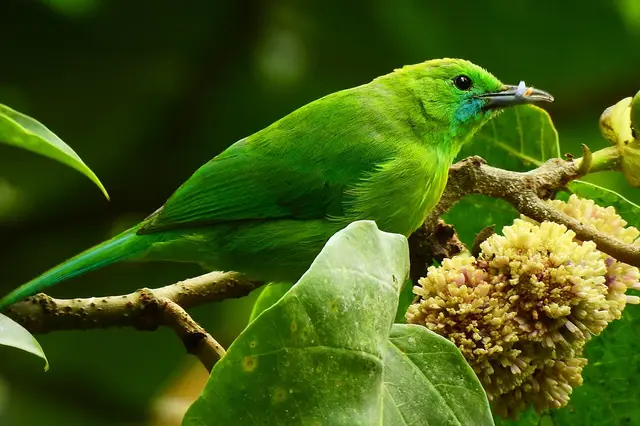
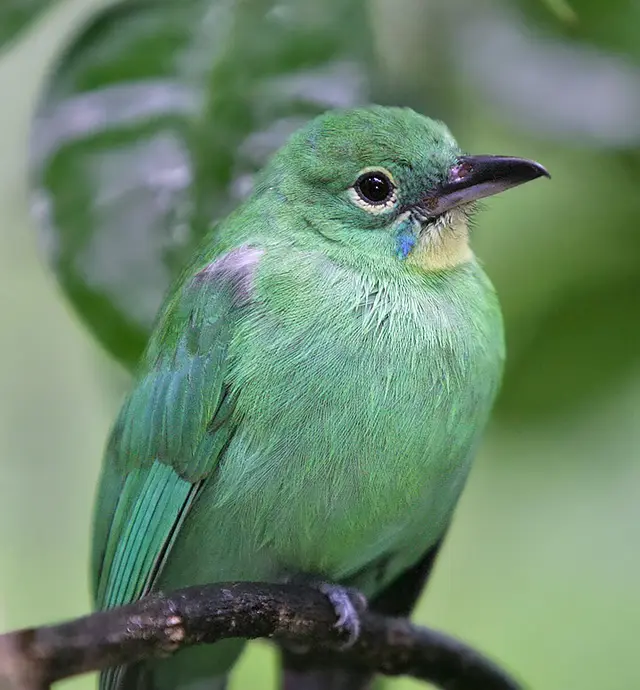
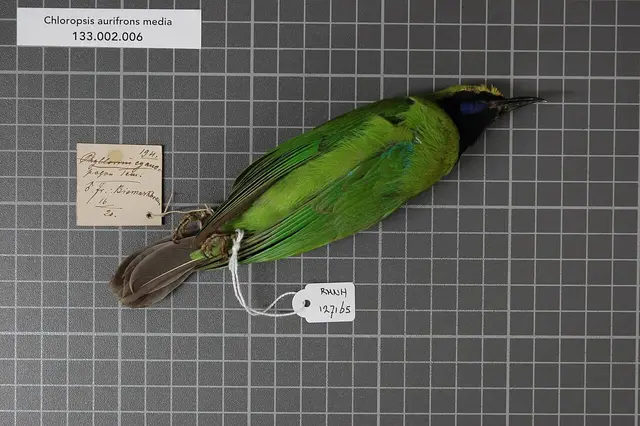
It's a compact bird, 15 to 18 cm long and 20 to 28 g, with grass-green upperparts and a subtle turquoise panel in the wing. The male has a black mask running down to the throat, edged with golden yellow and an intense deep blue stripe along the jaw. The female lacks the mask.
For years it was treated as one species with the blue-winged leafbird of mainland Asia. It's now regarded as separate, so older records and population figures may blur the two.
Where it lives
It's confined to Java, in old-growth and second-growth forest, mostly at lower elevations, though the Red List gives a range of 100 to 1,800 m. Plantations and rural gardens are also listed among its habitats. It doesn't migrate.
Pins are Wikidata “endemic to” fields. Orange dots, when present, are GBIF occurrence tiles — survey bias included.
How it lives
It's classed as omnivorous. Individuals first breed at around one year old, and the generation length used in the Red List is about 3.4 years.
Why it is in trouble
Trapping is the threat the Red List records. Leafbirds were a moderately popular cage bird for years, but demand grew sharply once the greater green leafbird became highly sought after. The Javan leafbird's whole range is accessible to trappers, and birds have disappeared from sites where the habitat looks unchanged.
The assessment puts the past and ongoing reduction at 50 to 79%, with exploitation as the basis. A citizen-science count in January 2020 across Java and Bali recorded it in only 3 of 7,935 survey squares. It was rated Near Threatened in 2016 and Endangered in 2019 and again in 2021. Its population size is unknown.
What is being done
Actions recorded include site protection, trade management, and measures at international, national and private-sector level. Conservation sites are identified over the whole range and the bird occurs in at least one protected area, but no recovery plan or monitoring scheme is in place. The Red List notes use of the bird both as a pet and as food.
Sources
Written for this catalog in our own words from the sources below, checked against them on 12 November 2026. Population figures are estimates and carry the year they were made. Status and assessment year: IUCN. 2026. The IUCN Red List of Threatened Species. Version 2026-1. iucnredlist.org.