Endangered
Greater Green Leafbird
Chloropsis sonnerati
The greater green leafbird (Chloropsis sonnerati) is the largest of the leafbirds, a loud, leaf-coloured canopy bird of lowland forest in Sundaland and nearby mainland Southeast Asia. The IUCN Red List rated it Endangered in 2021. Trapping for the cage bird trade, driven by demand for its song, is the main cause of its decline.
How to recognise it
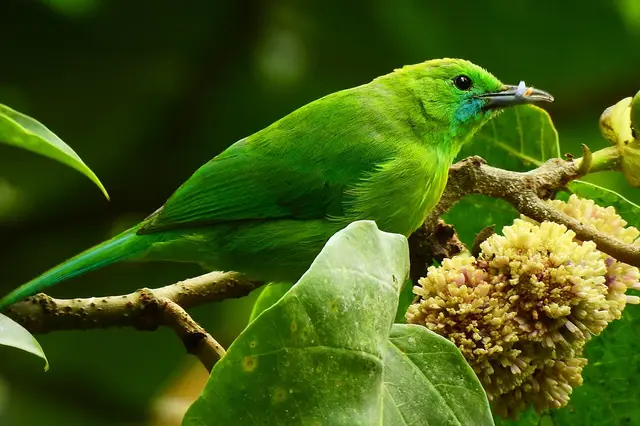
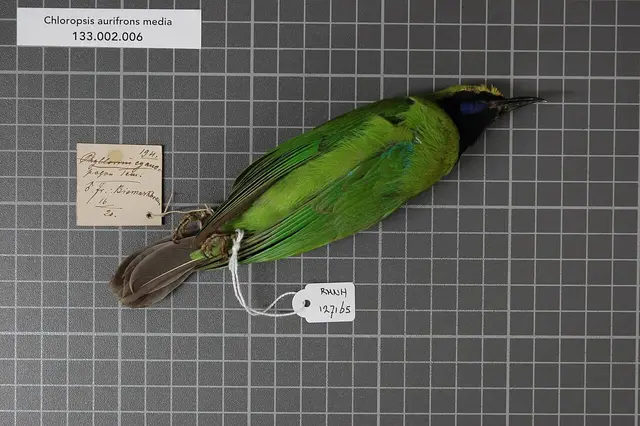
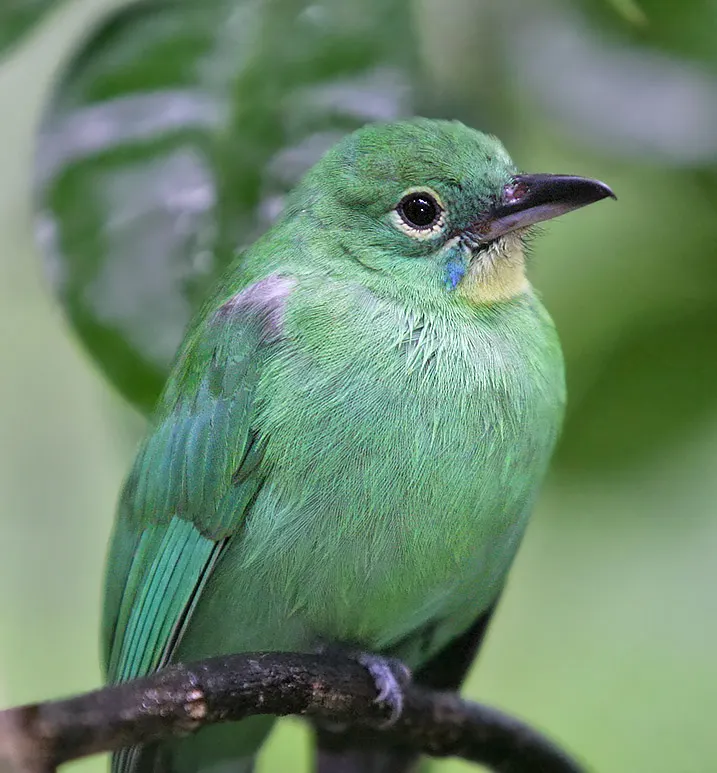
It is bright green all over, with a heavy bill for a leafbird. Males carry a black throat patch without the yellow border seen on the similar lesser green leafbird (Chloropsis cyanopogon). Females have a yellow throat and a yellow ring around the eye.
The call is a loud, rising whistle, usually written as chee-zi-chee. The bird often gives itself away by voice long before it is seen among the leaves.
Where it lives
The species is native to Brunei, Indonesia, Malaysia, Myanmar, Singapore and Thailand. In Indonesia it occurs on Sumatra, Borneo and Java, and a 2017 TRAFFIC report adds the Natuna Islands, the Riau archipelago, Nias, Bangka and Belitung. On the mainland it reaches only the south of Myanmar and Thailand.
It lives in lowland moist forest and mangrove forest, mostly old-growth but also secondary forest and forest edges. The IUCN also lists shrubland, plantations and rural gardens among its habitats. One form, zosterops, was once described as common in wooded parkland and shaded plantations, but both forms are now thought to be uncommon and getting scarcer.
Pins are Wikidata “endemic to” fields. Orange dots, when present, are GBIF occurrence tiles — survey bias included.
How it lives
Greater green leafbirds are conspicuous in the canopy, hopping between branches and flying from tree to tree. They visit fruiting fig trees often and also eat insects and other small invertebrates. They are not migratory. The IUCN puts a generation at about 3.7 years.
Why it is in trouble
Trapping is the main cause. The bird is prized in Indonesia for its song, and singing contests have helped drive demand. A 2017 TRAFFIC report said the winner of the president's cup, described as Indonesia's most prestigious bird-singing prize, was a greater green leafbird from Kapuas Hulu in West Kalimantan. The same report counted 3,008 of these birds in 515 shops across the Indonesian provinces surveyed. In a 2014 Jakarta survey it was the fourth most numerous species on sale, at 6.6 percent of all birds recorded.
Prices have climbed. When 20 shop owners in West Kalimantan were asked which species had risen most in price over five years, the greater green leafbird and the white-rumped shama were named most often, with 75 percent of owners reporting a rise. One trader in Bengkayang district reportedly handled as many as 6,000 greater green leafbirds a month moving from Malaysian Borneo into Kalimantan, and trappers were said to be seeking new forests as local birds ran short.
The IUCN judges that trapping affects the majority of the population (50 to 90 percent) and is causing very rapid declines. Small-holder and industrial farming affect a minority of the population, the first with slow declines and the second with rapid ones. The Red List category has climbed steadily: Least Concern through the 2012 assessment, Vulnerable in 2016, Endangered in 2019 and again in 2021. The total population has not been estimated, but the trend is down.
What is being done
Malaysia, Singapore and Thailand ban capture and trade. In 2017 TRAFFIC reported that Brunei, Indonesia and Myanmar did not, although Indonesia sets a zero harvest quota for songbirds, which technically made the trade illegal. According to the IUCN assessment, Indonesia added the species to its protected list in August 2018, so there is now no legal trade there, though enforcement is the weak point.
The 2016 uplisting was part of a Red List update covering 17 species threatened by the Indonesian cage bird trade. Experts met in Singapore in September 2015 for the first Asian songbird trade crisis summit, and again in February 2017 for a second, to coordinate trade monitoring, breeding and enforcement work. The IUCN assessment lists trade management, site protection, and action at national, international and private-sector level among its conservation measures, and records no species recovery plan.
Sources
Written for this catalog in our own words from the sources below, checked against them on 12 November 2026. Population figures are estimates and carry the year they were made. Status and assessment year: IUCN. 2026. The IUCN Red List of Threatened Species. Version 2026-1. iucnredlist.org.
- IUCN Red List assessment, Chloropsis sonnerati (2021)
- Wikipedia, Greater green leafbird
- TRAFFIC Bulletin 29(1), Greater green leafbird trade article and second Asian songbird trade crisis summit report (2017)
- TRAFFIC news, IUCN Red List update highlights trade threat to Southeast Asian birds (December 2016)