Endangered
Sumatran Leafbird
Chloropsis media
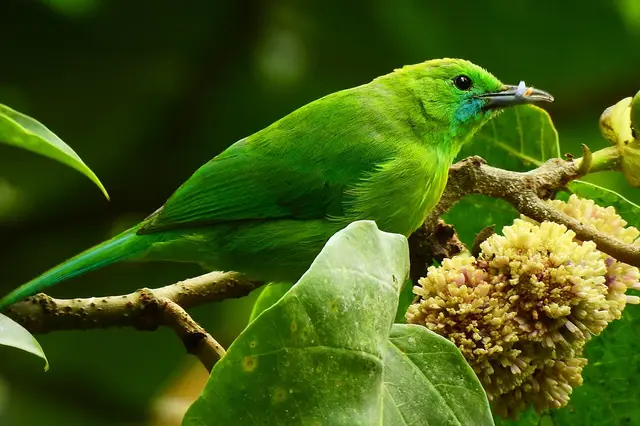
The Sumatran leafbird (Chloropsis media) is a bright green and yellow songbird found only on the island of Sumatra, Indonesia. Once rated Least Concern, it was uplisted to Endangered on the IUCN Red List in 2019 because trapping for the cage-bird trade has caused a steep, continuing decline.
How to recognise it
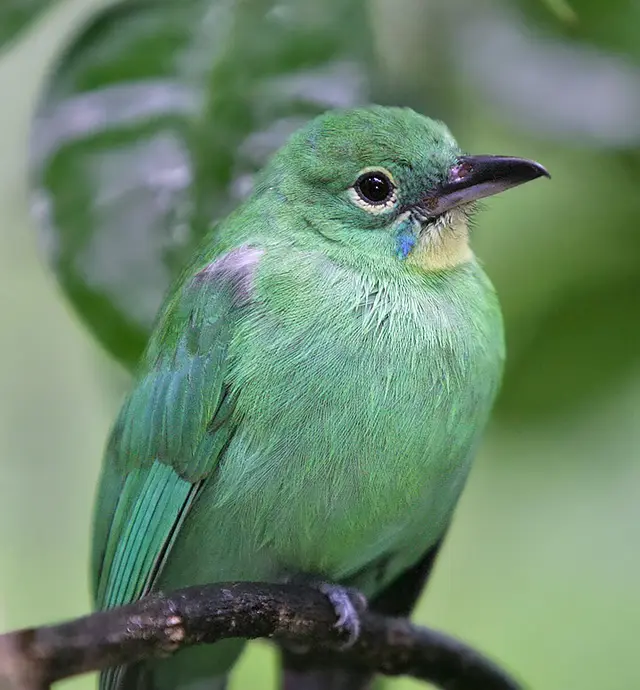
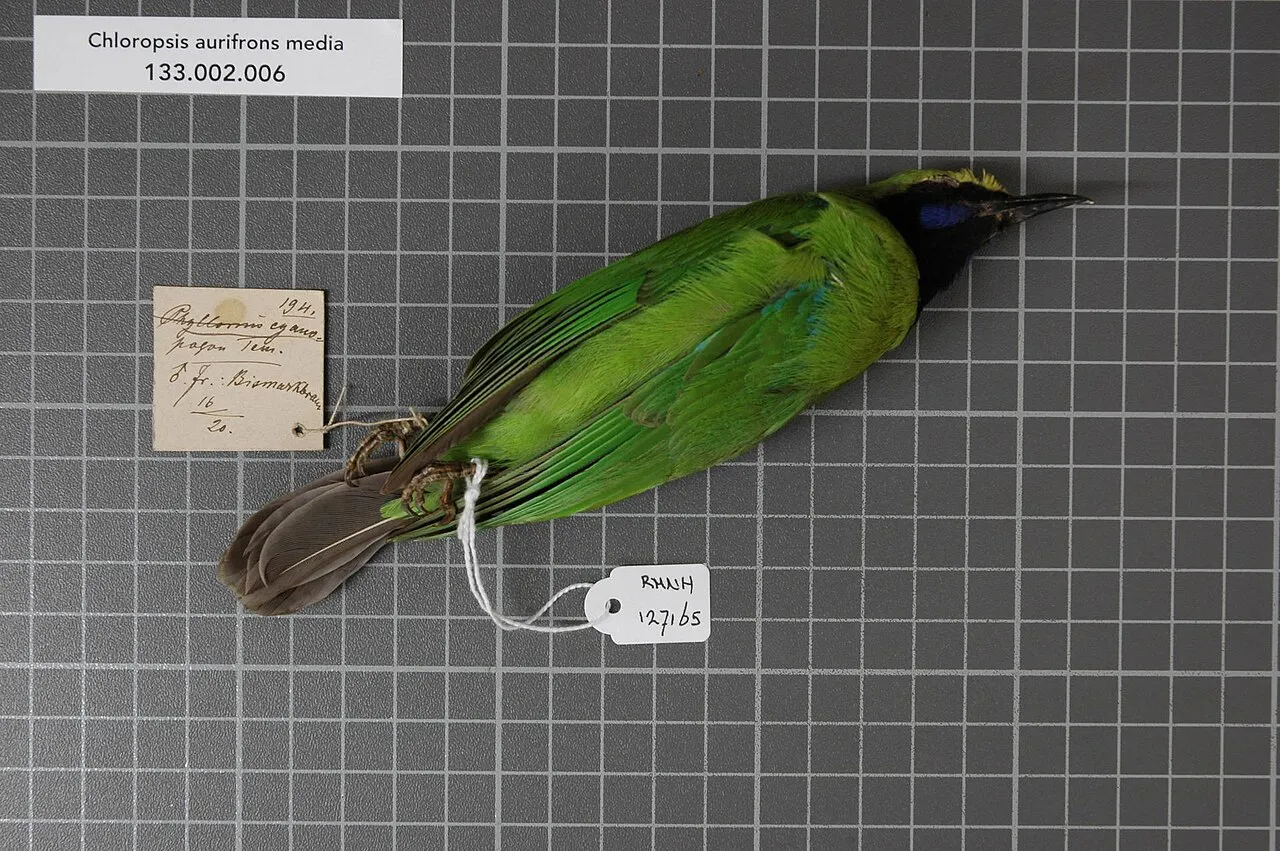
The Sumatran leafbird measures about 17 to 18 cm and is bright yellow below, with a clear yellow crown. The male has a black mask that reaches the lower throat, edged by a vivid purple line along the jaw. The female has no mask. She shows a yellow ring around the eye and a turquoise streak along the jaw. Both sexes have bright blue patches at the bend of the wing.
The bird was long treated as a subspecies of the golden-fronted leafbird (Chloropsis aurifrons), but the two differ in plumage. The male Sumatran has a yellow forehead rather than deep orange, and in this species the sexes look very different from each other, unlike in the golden-fronted.
Where it lives
The species is endemic to Sumatra. It lives in moist lowland and montane forest, and also turns up in plantations and rural gardens. The IUCN gives an elevation range of 600 to 1000 m and an estimated extent of occurrence of about 130,000 square km. It is not a migrant, and it occurs in at least one protected area.
Pins are Wikidata “endemic to” fields. Orange dots, when present, are GBIF occurrence tiles — survey bias included.
How it lives
The species is reportedly found alone or in pairs, foraging in the upper canopy for insects, spiders, nectar and fruit. It is also said to mimic the calls of other birds. Breeding details are scarce.
Why it is in trouble
The IUCN names deliberate capture as the threat, with birds taken for sale as pets. Leafbirds are targeted for the cage-bird trade, and trapping demand is reported to have surged since about 2012. The 2019 assessment estimates a population reduction of 50 to 79% in the past, the present and the projected future (three generations, with a generation about 4.2 years), and the trend is still downward. No population count exists.
The Red List history shows how fast this happened. The bird was Least Concern in 2006, 2009 and 2012, Vulnerable in 2016, and Endangered in 2019. Conversion of forest to plantations is also reported to add to the pressure.
What is being done
The IUCN records that the species occurs in at least one protected area and that conservation sites have been identified across its whole range. It also records no recovery plan, no systematic monitoring scheme, no harvest management plan and no captive breeding programme. It calls for trade management, site protection and action at national and international level, along with research on harvest, trade trends and population.
Sources
Written for this catalog in our own words from the sources below, checked against them on 12 November 2026. Population figures are estimates and carry the year they were made. Status and assessment year: IUCN. 2026. The IUCN Red List of Threatened Species. Version 2026-1. iucnredlist.org.