Endangered
Isopora crateriformis
Isopora crateriformis
Isopora crateriformis is a stony coral that grows as flat, plate-like crusts on shallow, wave-battered reefs of the Indo-Pacific. The IUCN Red List assessed it as Endangered in 2024, based on a projected decline, and the United States lists it as threatened under its Endangered Species Act.
How to recognise it
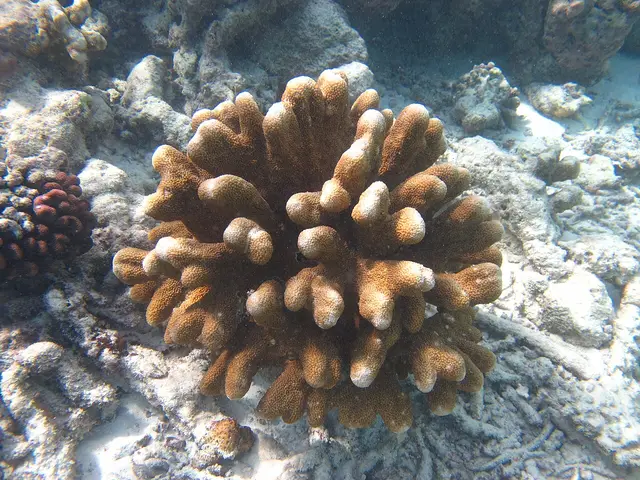
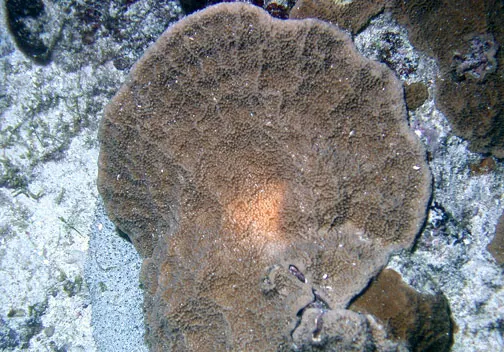
Colonies are solid, encrusting plates, sometimes more than a metre across, usually with ripples on the surface. The usual colour is tan or pale brown, sometimes with pink or blue margins, and a few colonies show tiny green spots, which are retracted polyps. The corallites, the small cups that house each polyp, are smooth and rounded. Colonies can occasionally form short branchlets.
It belongs to the family Acroporidae, a large group of reef-building corals. Gardiner described it in 1898.
Where it lives
It grows on shallow fore reefs and on reef flats and back reefs that are exposed to strong wave action. The IUCN gives a depth range of 1 to 40 metres, though it mostly occurs between 1 and 20 metres. The species is recorded across a broad stretch of the Indo-Pacific, from the north-eastern Indian Ocean through the Coral Triangle (Indonesia, Malaysia, the Philippines, New Guinea, the Solomon Islands) to the central Pacific. Records include Fiji, Samoa, New Caledonia, the Marshall Islands and eastern Australia. Within the United States it occurs in American Samoa.
The IUCN calls the species rare overall and gives no population estimate, although a coral reference describes it as common in Indonesia. The IUCN says it is most probably a brooder, which means limited reproductive output and limited dispersal, and gives a generation length of about 10 years.
Pins are Wikidata “endemic to” fields. Orange dots, when present, are GBIF occurrence tiles — survey bias included.
Why it is in trouble
The Endangered listing rests on criterion A3. The assessment suspects a decline of about 10 percent over the past three generations, and projects a decline of at least 62 percent by 2050 as warming seas bring annual severe bleaching. NOAA names ocean warming and acidification, disease, habitat degradation and land-based pollution as the main threats.
The Red List also lists storms and flooding, soil erosion and sediment, shipping lanes, and tourism and recreation areas among the pressures on this species.
What is being done
In September 2014 the United States listed it as threatened under the Endangered Species Act, as one of 20 corals. It is also on Appendix II of CITES, which regulates trade. A final rule published on 15 July 2025 designated critical habitat in American Samoa. NOAA Fisheries held a recovery planning workshop in May 2021 and developed a recovery status review in July 2023. A five-year review completed in 2024 found no change in listing status was warranted.
An interim recovery outline for 15 listed Indo-Pacific corals provides guidance until a full plan is approved. The IUCN notes that parts of the species' range overlap marine protected areas, though whether the species lives inside one is recorded as unknown. It recommends research, new and expanded protected areas, and artificial propagation.
Sources
Written for this catalog in our own words from the sources below, checked against them on 12 November 2026. Population figures are estimates and carry the year they were made. Status and assessment year: IUCN. 2026. The IUCN Red List of Threatened Species. Version 2026-1. iucnredlist.org.