Endangered
São Tomé giant reed frog
São Tomé giant reed frog
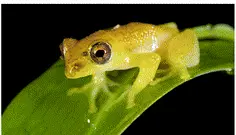
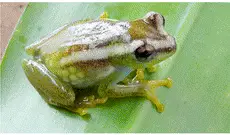
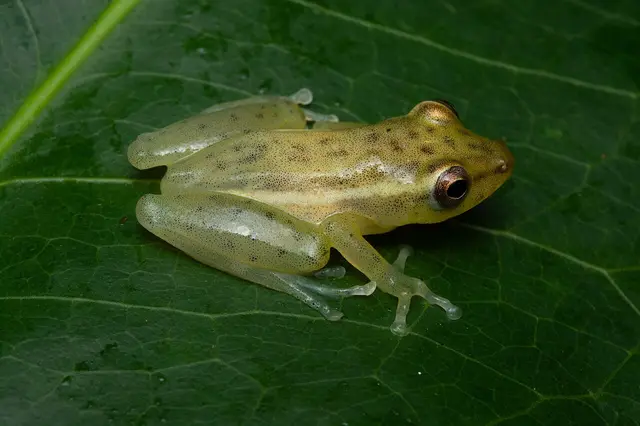
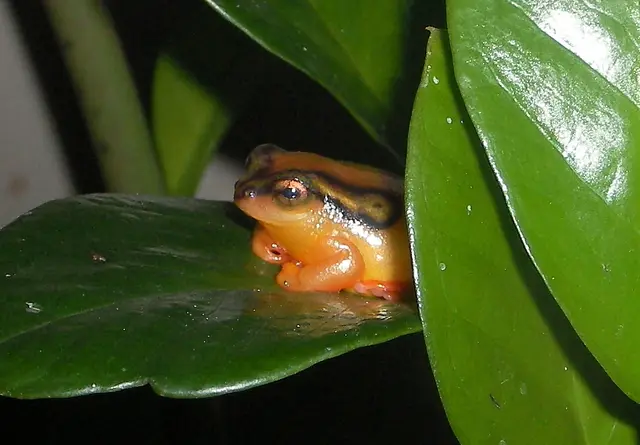
The São Tomé giant reed frog is the largest frog in its genus and lives only on São Tomé, an island in the Gulf of Guinea. It clings to remnants of primary rainforest, mostly high up, and breeds in tree holes. The Red List rates it Endangered (2020 assessment).
How to recognise it
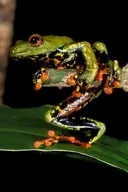
For a reed frog it is big. Males measure 27 to 41 mm from snout to vent and females 36 to 49 mm. The back is plain brown, green or blue-green, while the belly is marbled white, orange and black and the undersides of the limbs are marbled orange and black. The pupil is horizontal, and the backs of males are covered in tiny spines.
Where it lives
It is found nowhere but São Tomé, reportedly including Obô Natural Park. The Red List counts a single location with an extent of occurrence of about 642 square kilometres, and records continuing decline in the area of habitat. It lives in lowland and montane moist forest, usually above 800 m, though it has been recorded as low as 350 m.
Pins are Wikidata “endemic to” fields. Orange dots, when present, are GBIF occurrence tiles — survey bias included.
How it lives
Its breeding habits were only worked out in 2001. On 9 April that year, a California Academy of Sciences expedition found 11 adults, 38 tadpoles and at least three egg masses in one water-filled hole in a buttressed tree in primary forest at 1,280 m. Two more adult males turned up on a return visit a week later. The hole sat about 1.7 m above the ground and held roughly 20 cm of stagnant water.
Each egg mass held 20 to 40 large eggs, and the mix of ages suggested several frogs use the same hole at different times. That makes it one of the few African treefrogs known to breed in tree holes. In early May the team estimated nine males calling from about 4.5 m up in the canopy, and the frogs stopped calling when disturbed. Across 10 weeks of fieldwork the team found the species at only two sites and heard none in cultivated land.
Why it is in trouble
The Red List assessment lists small farms, grazing and housing as threats and records a decreasing population. Threats are poorly known, but forest loss to farming, livestock, wood extraction and settlement is probably the main pressure. Because the frog seems tied to primary forest, clearing at higher elevations matters.
Disease is a second worry. A survey reportedly found the amphibian chytrid fungus on São Tomé from 2001 onward, with no sick or dead frogs of this species reported. But the island carries the highly virulent Bd-GPL strain, which keeps scientists watching.
What is being done
The Red List record says the species occurs in at least one protected area, and lists site protection, site management and habitat protection among the conservation actions. No species-specific recovery plan appears in that record.
Sources
Written for this catalog in our own words from the sources below, checked against them on 12 November 2026. Population figures are estimates and carry the year they were made. Status and assessment year: IUCN. 2026. The IUCN Red List of Threatened Species. Version 2026-1. iucnredlist.org.