Critically Endangered
Haplochromis vonlinnei
Haplochromis vonlinnei
Haplochromis vonlinnei is a fish-eating cichlid known only from the Mwanza Gulf region of Lake Victoria in Tanzania. The IUCN Red List rated it Critically Endangered in 2010 and flags it as possibly extinct. Five specimens, all caught between 1978 and 1980, are the only known records.
How to recognise it
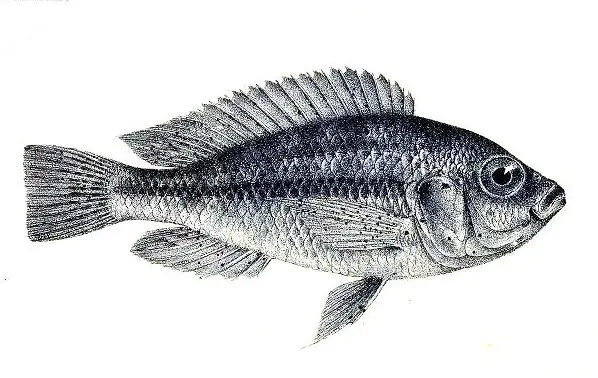
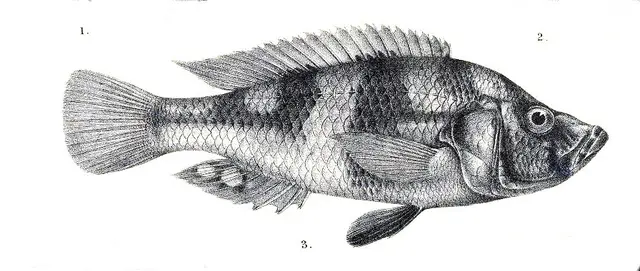
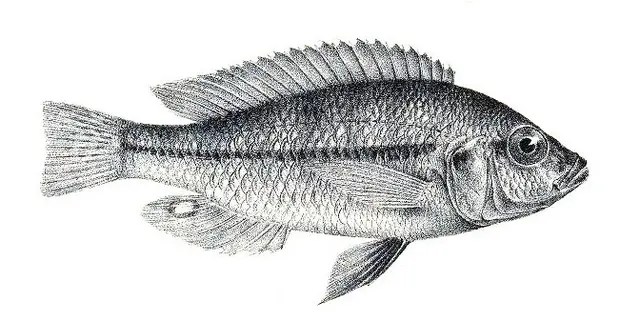
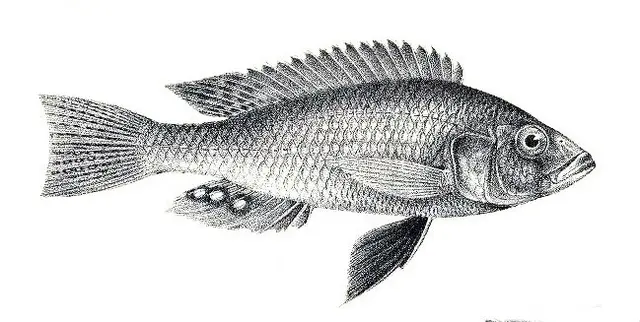
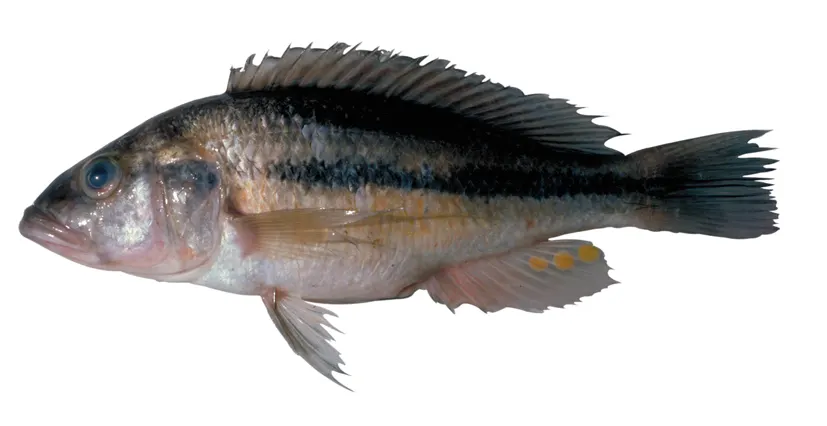
This was a slender, moderately large haplochromine, reaching about 15.9 cm (6.3 in) in standard length. The body is greyish, with a broader dark band running along the middle of the flank and a narrower, broken blackish band higher up. The flanks are yellowish and the belly white.
The snout is pointed, the lower jaw sticks out slightly, and the teeth are curved. Males have a grey anal fin marked with two to four orange spots ringed in white. Females have a yellowish anal fin with two darker yellow spots.
Where it lives
It is endemic to Lake Victoria and is known from the Mwanza Gulf in the south of the lake. The IUCN treats it as a single location and lists Tanzania as the only country, with its presence marked as possibly extinct.
Specimens were taken near the lake bed over mud. FishBase gives a depth of 6 to 18 m, and other sources give 5.5 to 18 m.
Pins are Wikidata “endemic to” fields. Orange dots, when present, are GBIF occurrence tiles — survey bias included.
How it lives
Almost nothing was recorded about its life before it disappeared. Stomach and gut contents from the specimens held remains of smaller haplochromine cichlids, so it was a specialist predator of other small fish.
It was named for the Swedish naturalist Carl Linnaeus. Martien van Oijen and Marnix de Zeeuw described it as a new species in 2008, long after the last fish had been caught. The IUCN says it was already rare in the 1970s.
Why it is in trouble
The Nile perch (Lates niloticus) was introduced to Lake Victoria in the 1950s to boost fisheries. A 2024 genome study in Molecular Biology and Evolution links its upsurge to the extinction of more than 200 endemic cichlids, and the IUCN names it as the main threat to this species.
The IUCN also lists sewage and silt running into the lake, along with possible hybridisation. Cloudier water makes it harder for cichlids to recognise mates by colour, and that can blur species lines. The same genome study found that some other haplochromines went through severe population bottlenecks in the 1970s and 1980s, then recovered in the 1990s and 2000s. This species has not been seen since 1980.
What is being done
No targeted action for this species is known. The IUCN assessment calls for policy action to reduce the lake's degradation and prevent overfishing, for protected areas, and for more research on the fish and the extent of its range in the lake. It says that if any survive, they are likely extremely rare, and the species may already be extinct.
Sources
Written for this catalog in our own words from the sources below, checked against them on 12 November 2026. Population figures are estimates and carry the year they were made. Status and assessment year: IUCN. 2026. The IUCN Red List of Threatened Species. Version 2026-1. iucnredlist.org.
- IUCN Red List assessment, Haplochromis vonlinnei (2010)
- Haplochromis vonlinnei, encyclopedia entry
- FishBase, Haplochromis vonlinnei
- Artensterben.de, Haplochromis vonlinnei
- Severe Bottleneck Impacted the Genomic Structure of Egg-Eating Cichlids in Lake Victoria (Molecular Biology and Evolution, 2024)
- Recently Extinct Species, Haplochromis vonlinnei