Endangered
Gephyromantis corvus
Gephyromantis corvus
Gephyromantis corvus, the Isalo Madagascar frog, is a small, dark frog of the dry sandstone canyons of south-central Madagascar. The IUCN Red List classes it as Endangered (2016 assessment) because its habitat area is shrinking and its population is split into small, scattered groups.
How to recognise it
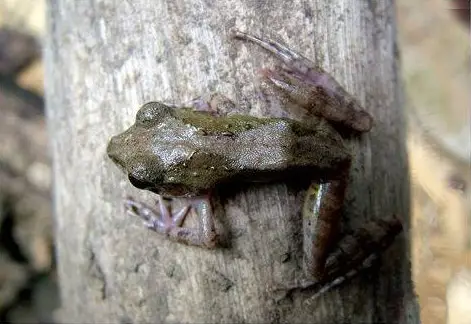
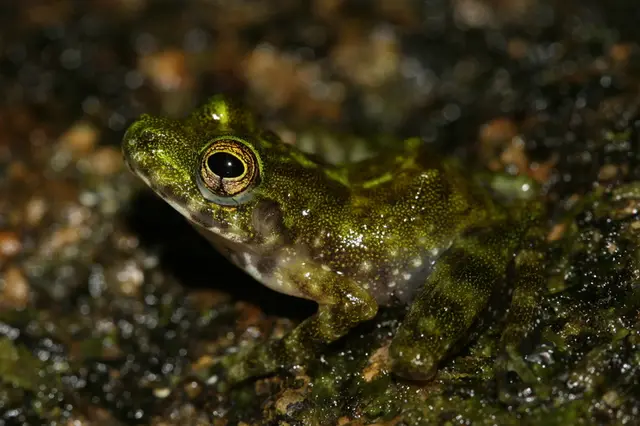
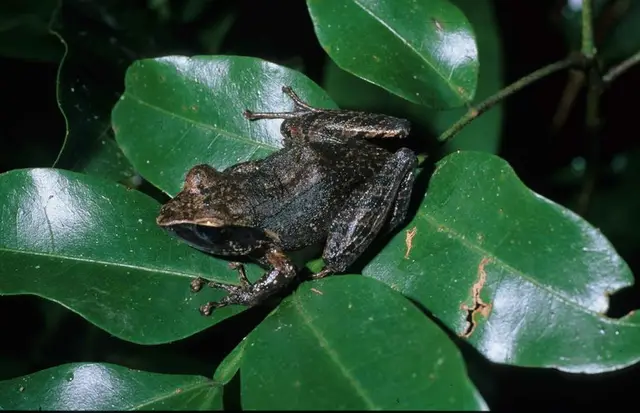
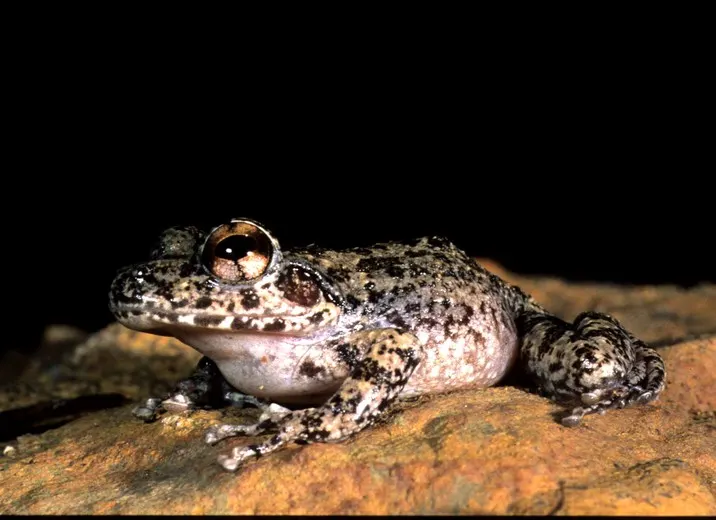
It is a medium-small mantellid frog. Males measured in a 2020 study ran from about 37 to 44 mm from snout to vent, and two females measured 37 and 42 mm. The back is dark brown, often with a broad stripe down the middle.
The belly, throat and thighs are brown or dark, which is the easiest way to tell it from its close relative Gephyromantis kintana, whose underside is dirty white. Males have a brown-black vocal sac. The two species also differ in song, and they can be found together in the same place.
Where it lives
The frog was described in 1994 by Glaw and Vences from the Namazaha valley in Isalo National Park, and it has been recorded at several other canyons in the Isalo Massif. It prefers older, deeper canyons with dry deciduous gallery forest along the stream.
A 2020 paper in ZooKeys (Cocca and colleagues) reported it from three sites in the Haute Matsiatra region, at Tsaranoro, Anja and Sakaviro, extending the range by about 200 km. The same paper concluded that Gephyromantis azzurrae, described in 2007 from Isalo canyons, is the same species, so azzurrae is now a junior synonym. Both changes came after the 2016 Red List assessment, which counted two locations and an extent of occurrence of about 2,589 square km.
The assessment gives an elevation of 200 to 800 m. The 2020 paper lists the three Haute Matsiatra sites at roughly 950 to 1,020 m.
Pins are Wikidata “endemic to” fields. Orange dots, when present, are GBIF occurrence tiles — survey bias included.
How it lives
Frogs of this subgenus are mostly active at dusk and at night. In Isalo, males are usually found calling from low vegetation on the lower branches of trees overhanging canyon streams. Each call runs 10 to 14 notes at a fairly low pitch, around 2,400 to 2,700 Hz.
Tadpoles that an earlier study (Reeve and colleagues, 2011) attributed to azzurrae belong to this species. Tadpoles in this group are carnivorous and can make sounds, possibly as a signal to rivals when catching prey.
Why it is in trouble
The Red List counts a continuing decline in the area the frog occupies and a severely fragmented population. It names housing, shifting agriculture, and small-scale farming and grazing as the pressures on the dry forest, grassland and stream habitats it relies on. No population count exists.
What is being done
The frog occurs in at least one protected area, Isalo National Park, and the 2020 records include the Sakaviro Community Reserve (about 14 ha) and the Anja Reserve. The Red List calls for site protection and management, plus more work on its threats and population. The 2020 paper says the new records and the name change may require the assessment to be revised.
Sources
Written for this catalog in our own words from the sources below, checked against them on 12 November 2026. Population figures are estimates and carry the year they were made. Status and assessment year: IUCN. 2026. The IUCN Red List of Threatened Species. Version 2026-1. iucnredlist.org.