Endangered
Orange-breasted laughingthrush
Garrulax annamensis
The orange-breasted laughingthrush (Garrulax annamensis) is a plain brown songbird with an orange breast, found only on the Da Lat Plateau in southern Vietnam. The IUCN rated it Least Concern as late as 2016, then Endangered in 2024, after steep declines linked mainly to trapping for the cage-bird trade.
How to recognise it
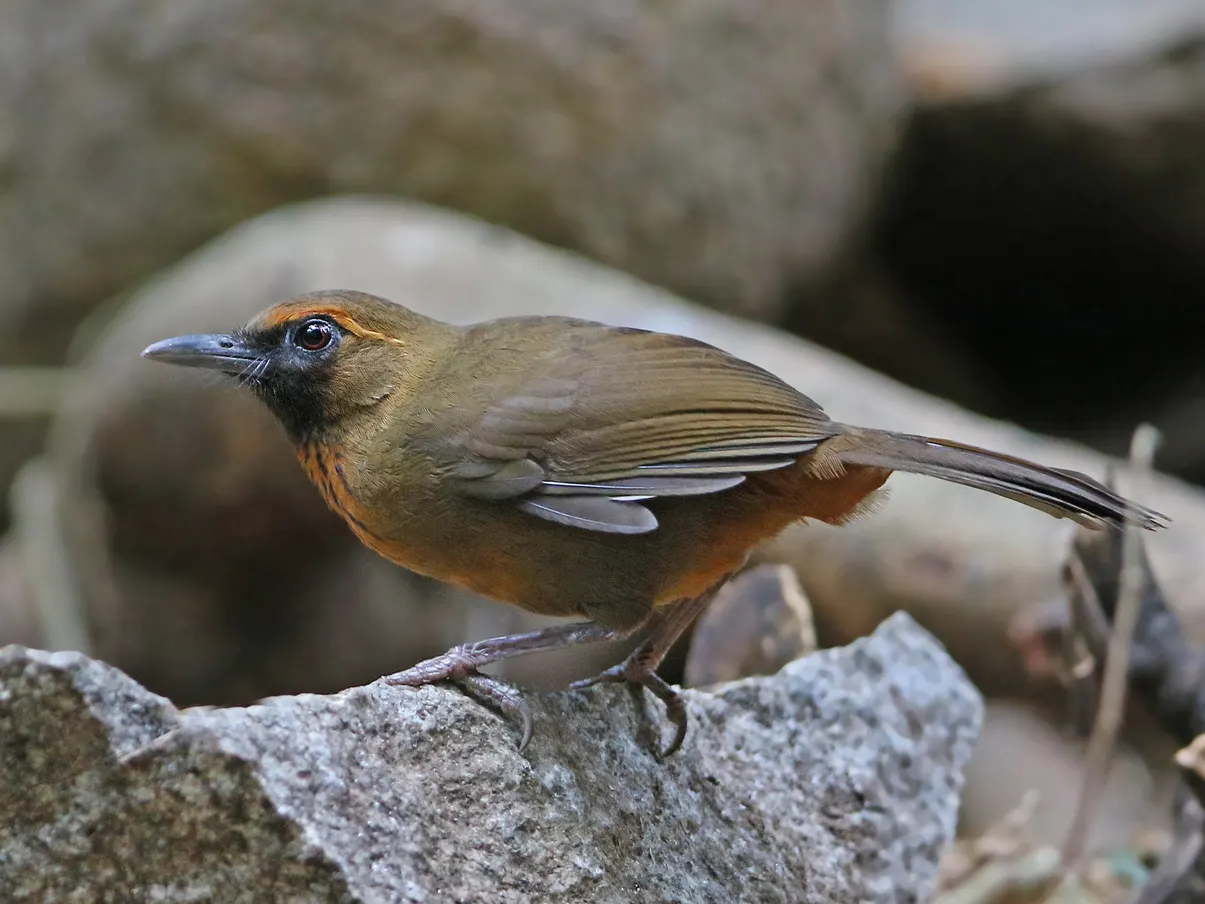
It is a medium-sized, long-tailed bird, 24 to 25 cm long, with a strong bill and sturdy legs. Most of the plumage is plain brown. An orange stripe runs over the eye, the throat is black, and the orange breast is streaked with black.
It was once treated as a subspecies of the spot-breasted laughingthrush, which has a pale throat and breast with dark spots and a pale stripe above the eye. It is now a species in its own right. It has a loud, melodious song and is most often seen in pairs.
Where it lives
The species is endemic to Vietnam, on the Da Lat Plateau in the south of the Annam region. It lives in montane forest between 915 and 1,510 m and can persist in degraded habitat, including secondary forest and farmland close to forest. The 2024 assessment gives an extent of occurrence of about 14,100 square kilometres and estimates it occurs at 3 to 20 locations.
Pins are Wikidata “endemic to” fields. Orange dots, when present, are GBIF occurrence tiles — survey bias included.
Why it is in trouble
The 2024 assessment (criteria A2cd+4cd) estimates a population reduction of 30 to 79 per cent, both over the past and continuing, with a generation length of about 3.9 years. The threats it lists are trapping, with the species as the target, along with housing development, small-holder plantations and shifting agriculture. The bird has disappeared from several localities within its already small range.
BirdLife held a public consultation on the species in early 2024 and announced a recommendation of Endangered on 26 February, after reports that it had vanished from several places and become very hard to find. Birders and local observers commenting there blamed trapping for the cage trade and said photographers' hides and feeding stations make trapping easier. These were stakeholder comments rather than measured data. The population trend is recorded as decreasing and no population estimate has been published.
What is being done
Conservation sites have been identified across the whole range, and the species occurs in at least one protected area. The assessment lists site protection and national-level action as actions needed. It records no recovery plan, no monitoring scheme, no captive breeding and no international trade controls.
Sources
Written for this catalog in our own words from the sources below, checked against them on 12 November 2026. Population figures are estimates and carry the year they were made. Status and assessment year: IUCN. 2026. The IUCN Red List of Threatened Species. Version 2026-1. iucnredlist.org.