Endangered
Rufous-fronted laughingthrush
Garrulax rufifrons
The rufous-fronted laughingthrush (Garrulax rufifrons) is a large songbird of the mountain forests of Java, Indonesia. The IUCN Red List rated it Endangered in 2024, with an estimated 500 to 2,500 mature birds. Trapping for the cage-bird trade is its main threat, and it was rated Critically Endangered in 2016 and 2018.
How to recognise it
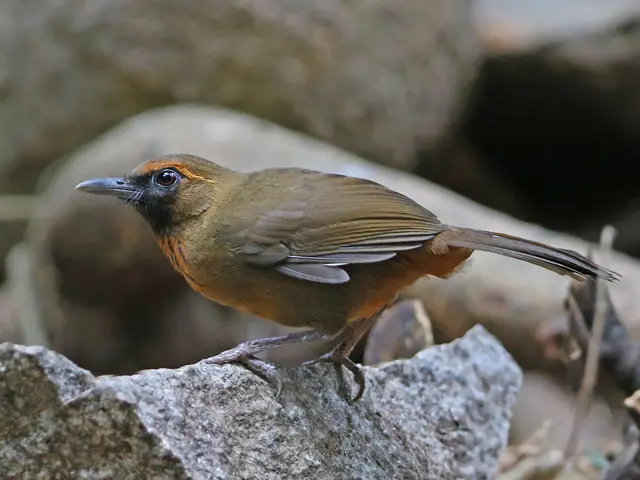
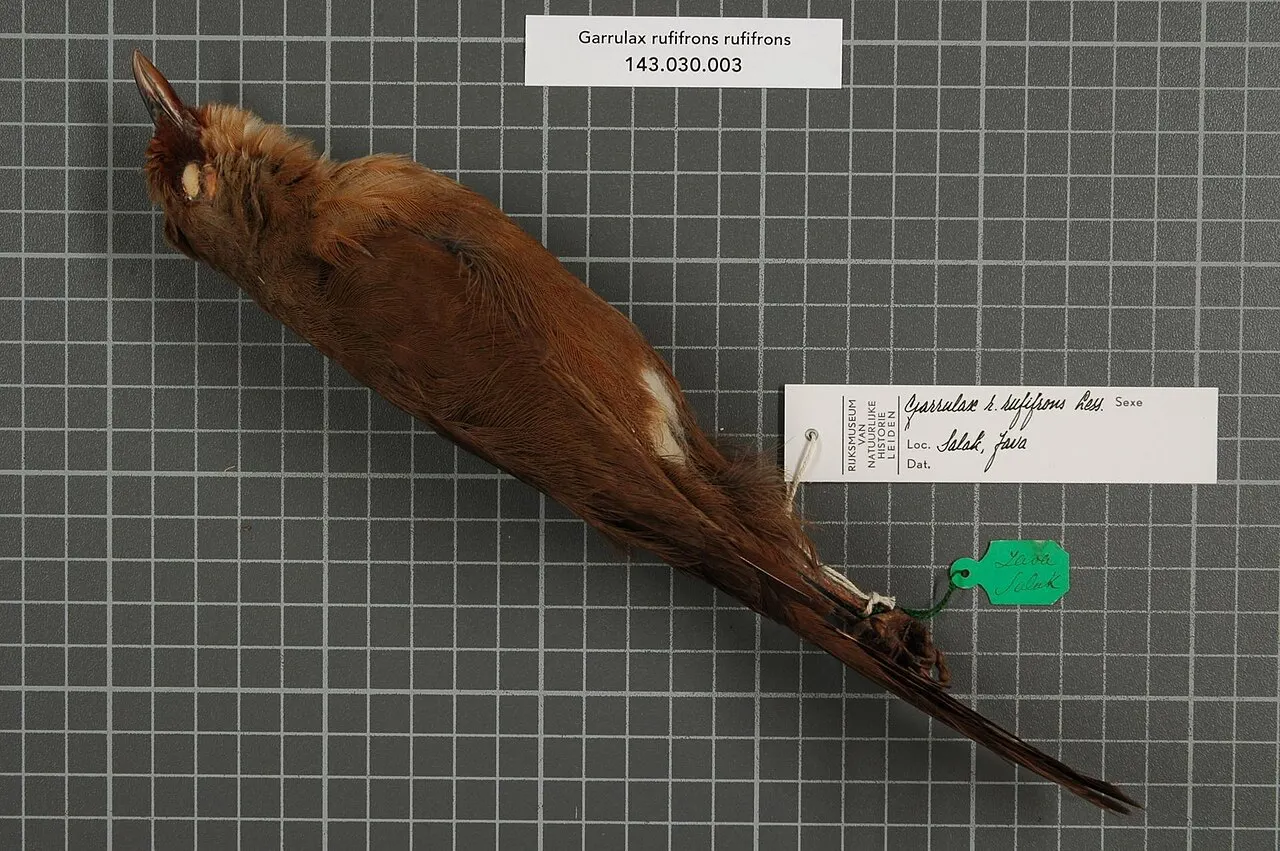
It's a big laughingthrush, about 27 cm (11 inches) long, brownish grey, with a rich rufous-chestnut patch above the bill and a dark patch between bill and eye. The eye is pale yellow, and it stands out.
Groups travel through dense low and middle-level vegetation. When agitated the birds give a call likened to a horse's whinny, which is where the Indonesian name, poksai kuda, comes from (kuda means horse).
Where it lives
The species is found only on Java, in broadleaved evergreen forest on mountain slopes between roughly 900 and 2,500 m. It has been recorded on 15 mountains in the past, but a 2020 study in Forktail found that records since 2000 came from only two, Gunung Gede-Pangrango in West Java and Gunung Slamet in Central Java.
The Slamet birds are treated as a separate subspecies (slamatensis). The IUCN counts nine to 15 subpopulations, the largest holding an estimated 100 to 400 birds, and gives the extent of occurrence as about 16,700 square km.
Pins are Wikidata “endemic to” fields. Orange dots, when present, are GBIF occurrence tiles — survey bias included.
How it lives
Small family groups of around five or six birds forage together, eating insects and fruit. Breeding in the wild is poorly documented, and the species is reportedly hard to breed in captivity.
It doesn't migrate. Its generation length is estimated at 3.9 years, the time frame used when judging how fast a population is declining.
Why it is in trouble
Java is one of the most crowded places on Earth, and little natural forest is left. Within what remains, the main danger is trapping. The bird is sold as a songster in Javan bird markets. Between August 2016 and February 2020, researchers surveyed 11 markets 174 times and found the species on sale in 21 percent of visits, recording 61 adult-sized birds, plus seven more offered online. From turnover times they estimated about 90 birds are sold in those markets every year.
Prices were modest, around US$69 on average. A market expert quoted in earlier work said a bird cost about US$16 at the start of the 2000s and that prices had risen tenfold by 2010 or 2011. The species has been protected under Indonesian law since 1979, yet the 2020 study knew of no one ever fined or prosecuted for trading it. The IUCN also lists small-holder farming and unintended losses from harvesting aimed at other species.
What is being done
The species occurs in at least one protected area, and key sites have been identified across its range. Some birds are held in captive breeding programs, though no recovery plan or monitoring scheme was in place at the 2024 assessment.
The Red List category has moved several times: Near Threatened in 2012, Endangered in 2013, Critically Endangered in 2016 and 2018, and Endangered again in 2024. The 2020 market study raised the possibility that the bird survives on other western Javan mountains beyond the two known sites.
Sources
Written for this catalog in our own words from the sources below, checked against them on 12 November 2026. Population figures are estimates and carry the year they were made. Status and assessment year: IUCN. 2026. The IUCN Red List of Threatened Species. Version 2026-1. iucnredlist.org.
- IUCN Red List assessment, Garrulax rufifrons (2024)
- Nijman et al., The trade in Rufous-fronted Laughingthrush in Java, Forktail 36 (2020), full text
- Nijman et al. 2020 (repository abstract)
- Shepherd, Eaton and Chng, Bird Conservation International 26 (2016)
- Rufous-fronted laughingthrush, general reference