Critically Endangered
Blue-crowned Laughingthrush
Pterorhinus courtoisi
The blue-crowned laughingthrush (Pterorhinus courtoisi) is a small songbird with a vivid blue crown and a black mask, found in the wild only in Jiangxi Province, China. The IUCN Red List has rated it Critically Endangered since 2007, and the current 2018 assessment records a declining population.
How to recognise it
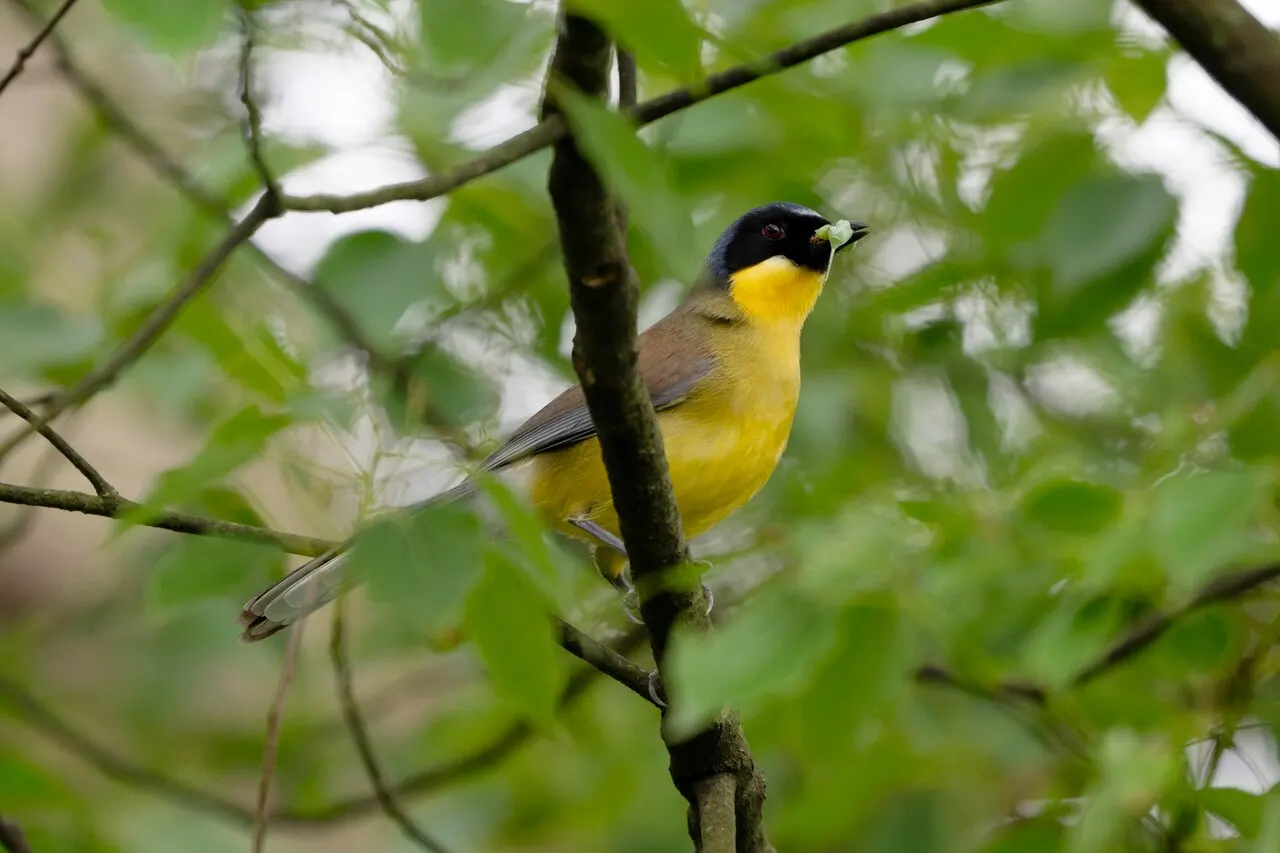
It's a small laughingthrush, about 23 cm long, with a blue crown and nape and a black mask. The throat and belly are yellow, with a greyish band across the breast. The back is brown with an olive tint, the vent is white, and the tail is grey at the base and black at the end, with a white tip.
For decades it was treated as a subspecies of the yellow-throated laughingthrush, which has a pale grey crown rather than a blue one. Its calls have been compared to human laughter.
Where it lives
The wild birds are confined to Jiangxi, with the stronghold around Wuyuan County. The IUCN assessment lists China as the only country, six to ten locations, and a severely fragmented population. The main breeding habitat is subtropical moist lowland forest, with moist shrubland used less. A field study of nine breeding sites in Wuyuan, run from 2012 to 2016, found the birds nesting in small, isolated stands of broad-leaved trees beside villages along a river and its tributaries.
Pins are Wikidata “endemic to” fields. Orange dots, when present, are GBIF occurrence tiles — survey bias included.
A species nearly lost to a taxonomic footnote
Until 1988 the bird was known from only five museum skins, two collected in Wuyuan County in 1919 and three near Simao in Yunnan in 1956. It then turned up in the international bird trade, and it was reportedly rediscovered in the wild in Wuyuan in 2000. Because it was long treated as a form of a more common relative, it drew little conservation attention, and it was reportedly listed as Least Concern in 2006 before being moved to Critically Endangered in 2007.
Wild numbers are uncertain and have been quoted differently over time. A 2014 article put the wild population at about 250. The 2017 field study cited about 240 mature birds and estimated 200 to 240 since 2000. Conservation-programme material now gives about 300, and the 2018 IUCN assessment gives a range of 50 to 249 for population size. Annual counts are made by Chinese researchers, but the species is hard to survey.
Why it is in trouble
Capture for the cage-bird trade wiped the species out at several sites. Exports were banned in 1998, but by then much of the damage was done. The IUCN assessment lists roads and railroads, persecution and intentional capture among the ongoing threats, and tourism development as a future one. Roads and resorts have destroyed breeding sites.
Visitors are a newer problem. At the best-known colony, in the 2012 to 2016 study, photographers followed birds from dawn to dusk, and nests there were built higher up (about 16 m, against about 11 m elsewhere), which the study linked to lower breeding success. The birds are very nervous when breeding.
What is being done
In 2022 China raised the bird to first-class protected status under its Wildlife Protection Law, replacing a position in which, as the 2017 study put it, there was no legal basis for regulating photographers. The county forestry bureau in Wuyuan supports protection of several key breeding sites, and the IUCN assessment records conservation sites identified across the whole range. Awareness work in village schools where breeding has been recorded is a recommended action.
A captive breeding network backs up the wild birds. In February 2024 the European programme held 186 birds in 38 institutions plus two private holders, and Asian zoos held 35 at three institutions. North American zoos held 102 birds at 22 facilities, a population that has grown since 2008 through better breeding and imports from European zoos.
Sources
Written for this catalog in our own words from the sources below, checked against them on 12 November 2026. Population figures are estimates and carry the year they were made. Status and assessment year: IUCN. 2026. The IUCN Red List of Threatened Species. Version 2026-1. iucnredlist.org.
- IUCN Red List assessment (BirdLife International, 2018)
- IUCN Red List API record for the assessment
- Blue-crowned laughingthrush (encyclopedia entry)
- WAZA, Blue-crowned laughingthrush global species management plan
- Scientific American, Extinction Countdown, 16 Feb 2014
- Avian Conservation and Ecology 12(1):15, nest-site study in Wuyuan




