Endangered
Sumatran laughingthrush
Garrulax bicolor
The Sumatran laughingthrush (Garrulax bicolor) is a loud, sociable songbird of the mountain forests of Sumatra, Indonesia, found nowhere else. The IUCN Red List assessed it as Endangered in 2021, with 2,500 to 9,999 adults left. Trapping for the cage-bird trade, plus forest loss, is driving its decline.
How to recognise it
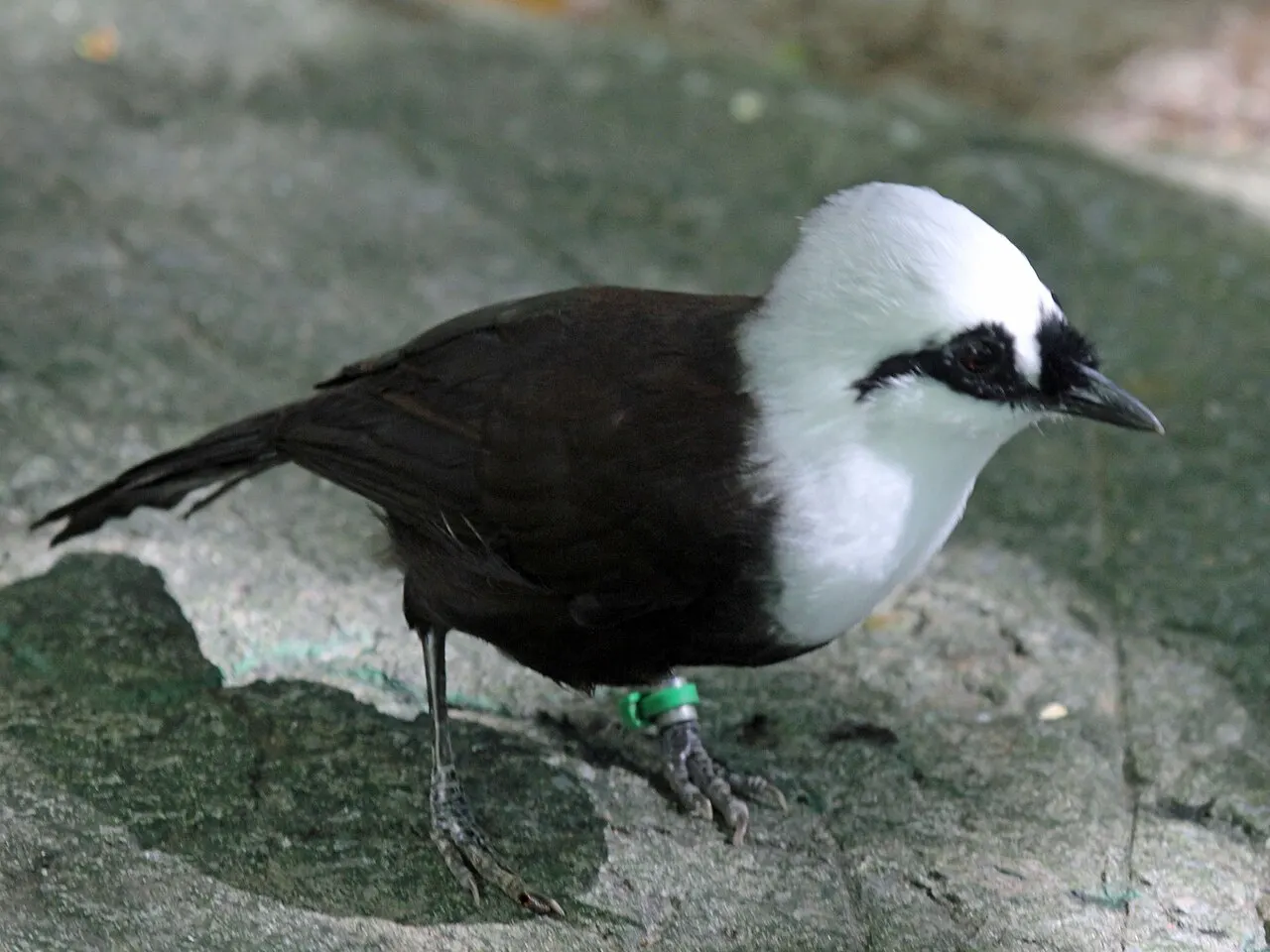
It's a bird of about 30 cm (one zoo guide gives 24 to 28 cm), with brownish-black plumage and a striking white head. The white extends onto the breast, with a slightly raised crest, a triangular black patch on the forehead and a drooping black stripe through the eye. Until 2006 it was lumped with the white-crested laughingthrush (Garrulax leucolophus), which looks similar. The Sumatran bird is darker and lacks that species' rufous or mouse-brown tones.
Where it lives
The species is endemic to Sumatra. It once ranged along the island's mountain spine from Aceh in the north to Lampung in the south, and was reported as common. Today it's known from a small number of scattered sites, including parts of Aceh and North Sumatra, with older records from Bukit Barisan Selatan National Park. Recent surveys in Kerinci Seblat National Park failed to find it where it had been seen before.
It lives in evergreen forest on the hills and mountains, mainly between 750 and 2,000 m, with unsubstantiated reports from one lowland reserve. A 2015 study on the Sinabung volcano in North Sumatra found it at 1,300 to 1,600 m. Because of trapping, the birds appear to be pushed into higher and more remote ground.
Pins are Wikidata “endemic to” fields. Orange dots, when present, are GBIF occurrence tiles — survey bias included.
How it lives
Laughingthrushes are restless and noisy. A 1918 account described Sumatran birds travelling in parties of seven or eight through low and middle vegetation, calling harshly. On Sinabung volcano in 2015, a researcher watched a flock of five and later confirmed two more flocks nearby. Related species breed cooperatively, so these groups may be extended families, though that hasn't been shown for this species.
Stomach contents from five museum specimens held fruit seeds and the remains of beetles, and the genus as a whole feeds mainly on insects and other small invertebrates. The Sinabung flock was seen searching vegetation for insects. No wild nest has been described. In zoos, nestlings have fledged at about 13 days.
Why it is in trouble
The main threat is capture for sale as a cage bird. A TRAFFIC researcher's 65 surveys of the bird markets in Medan between 1997 and 2008 counted more than 11,000 laughingthrushes of 10 species for sale, and dealers said the Sumatran species was becoming scarce. Surveys of eight Java markets in 2014 and 2015 found 615 laughingthrushes. Sumatran laughingthrush prices in Jakarta ran from about USD 60 to 129 in 2014, and had risen sharply since 2007, which the study's authors linked to growing rarity.
Forest clearance adds to the pressure. The 2021 assessment estimates the population fell by 50 to 79 percent over the past three generations (about 13 years) and expects a similar fall over the next three. It counts 2 to 100 subpopulations, with the largest holding 251 to 1,000 birds, and puts the overall range at about 218,000 square kilometres.
What is being done
The species has no legal protection in Indonesia, but no harvest quota has been set, so taking it from the wild is not allowed. A 2016 study in Bird Conservation International urged that it be given protected status, and the IUCN also lists full legal protection as an action needed. It also calls for stronger regulation of the cage-bird industry, surveys to find surviving groups, and a review of its trade status for possible CITES listing.
A breeding population exists outside the wild. A programme began in Java in 2008, and European zoos run a managed breeding programme that grew from a few wild-caught founders collected between 2004 and 2006. It became a European Endangered Species Programme in 2016.
Sources
Written for this catalog in our own words from the sources below, checked against them on 12 November 2026. Population figures are estimates and carry the year they were made. Status and assessment year: IUCN. 2026. The IUCN Red List of Threatened Species. Version 2026-1. iucnredlist.org.
- IUCN Red List assessment, Garrulax bicolor (2021)
- EAZA Sumatran Laughingthrush Best Practice Guidelines (2017)
- Shepherd, Eaton and Chng 2016, Bird Conservation International: Nothing to laugh about
- Shepherd 2010, Observations on trade in laughingthrushes in North Sumatra
- Sumatran laughingthrush (encyclopedia article)