Endangered
Fat Guam partula
Partula gibba
The fat Guam partula, or humped tree snail (Partula gibba), is a small tree snail with a glossy, translucent shell, living on a few islands of the Mariana archipelago. The IUCN Red List rated it Endangered in 2024. Only scattered colonies survive, and Sarigan has the largest estimated colony.
How to recognise it
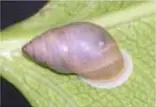
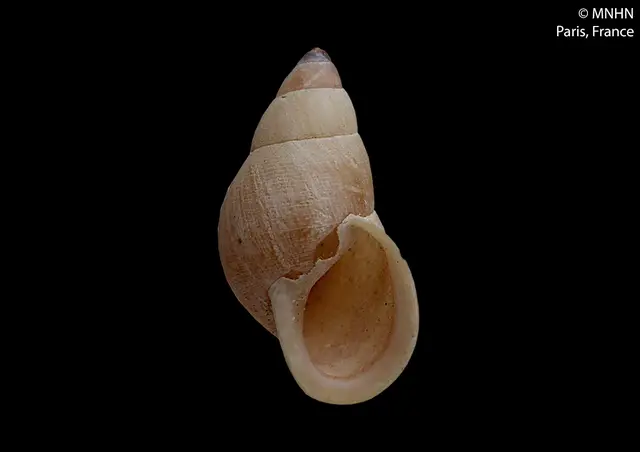
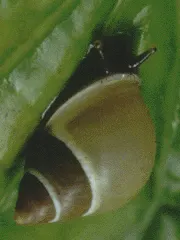
The shell is translucent and egg-shaped to conical, with about four and a half whorls and a large final whorl. It can coil to the left or the right. Colours range from white through orange and brown to purple. Adults are 14 to 18 millimetres long and 10 to 14 millimetres wide.
Where it lives
The species belongs to the Mariana Islands. A 2008 survey by University of Guam researchers called it the most widely spread tree snail in the archipelago, recorded from nine islands: Guam, Rota, Aguiguan, Tinian, Saipan, Anatahan, Sarigan, Alamagan and Pagan. Many of those populations are gone. The IUCN counts four locations today, covering about 16 square kilometres, in lowland forest between 10 and 300 metres above sea level.
US Fish and Wildlife Service counts in a 2024 review give a sense of the scale. Guam has one population, about 900 snails at the Haputo reserve in 2022. Rota has nine colonies, from a few snails to several hundred. Tinian had 43 snails found in 2022, and the single small colony on Alamagan was counted at 35. Pagan had about 346 when last surveyed in 2010. On Saipan a single snail was last detected in 2019. Sarigan has the largest estimate, several thousand in 2010.
Pins are Wikidata “endemic to” fields. Orange dots, when present, are GBIF occurrence tiles — survey bias included.
How it lives
Fat Guam partulas live in cool, shaded, humid forest, usually on the undersides of large leaves of native trees, shrubs and ferns. Colonies run from tens to hundreds of animals. They eat fungi and microalgae, and move about more in wet weather, especially after typhoon rains. On Sarigan in 2015, snails were reportedly seen eating Pandanus fruit waste dropped by Mariana fruit bats.
They give birth to live young, one at a time, at intervals of several weeks. Each snail is both male and female. Reproductive snails on Saipan averaged about 0.2 births per adult per week. In captivity, partulid snails start breeding at about a year old and live more than five years.
Why it is in trouble
Habitat loss and introduced predators did the most damage. The University of Guam survey points to farming and urban development, and to predators brought in to control the giant African snail. Today the Fish and Wildlife Service lists vegetation clearing along roads and utility lines as a continuing threat, since cutting a plant can kill the snails on it and dry out the surrounding forest. The IUCN assessment also lists military activity, invasive species and habitat change.
Typhoons add to the risk. A 2015 storm likely wiped out a colony on Saipan, and counts at Haputo dropped sharply after Typhoon Mawar struck Guam in 2023. Collecting shells for jewellery and decoration once added pressure, but that practice appears to have stopped.
What is being done
The species was listed as endangered under the US Endangered Species Act in 2015. Rodent control using baited camera traps began in 2021 at two Rota colonies, and the number of rodents there fell. A fence to keep hoofed animals out of the Haputo reserve on Guam is partly built and awaiting repair after Typhoon Mawar. The IUCN lists invasive species control and captive breeding as conservation actions. Genetic data may also show that the Rota snails are a separate species, which would leave a much smaller main population.
Sources
Written for this catalog in our own words from the sources below, checked against them on 12 November 2026. Population figures are estimates and carry the year they were made. Status and assessment year: IUCN. 2026. The IUCN Red List of Threatened Species. Version 2026-1. iucnredlist.org.