Endangered
Dhlinza dwarf chameleon
Bradypodion caeruleogula
The Dhlinza dwarf chameleon (Bradypodion caeruleogula), also called the Eshowe or uMlalazi dwarf chameleon, is a small forest chameleon known from just three forest remnants in KwaZulu-Natal, South Africa. The IUCN Red List rates it Endangered (assessed 2022), with a decreasing population.
How to recognise it
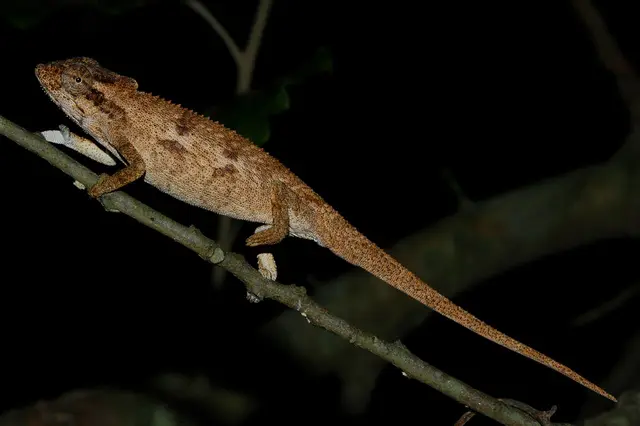
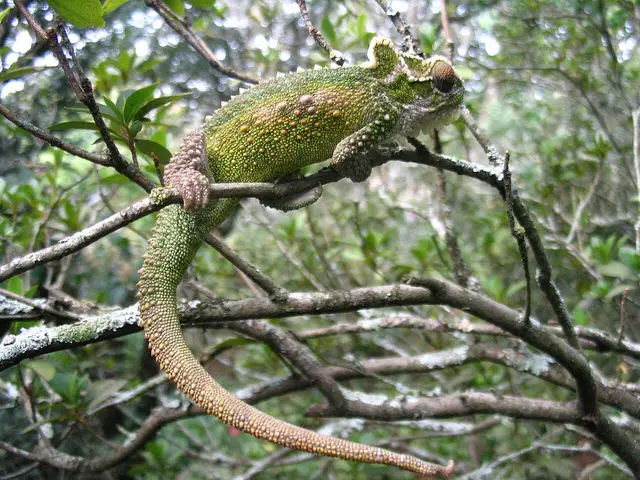
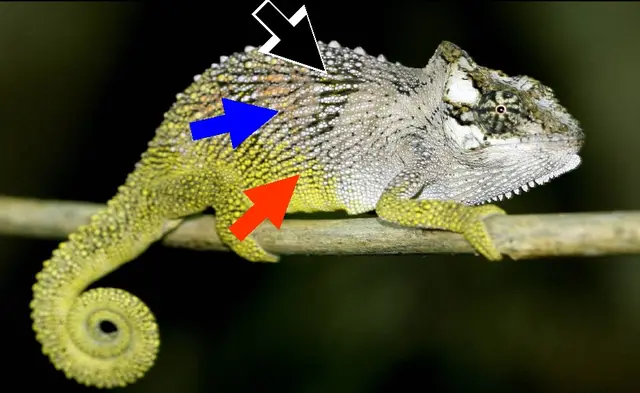
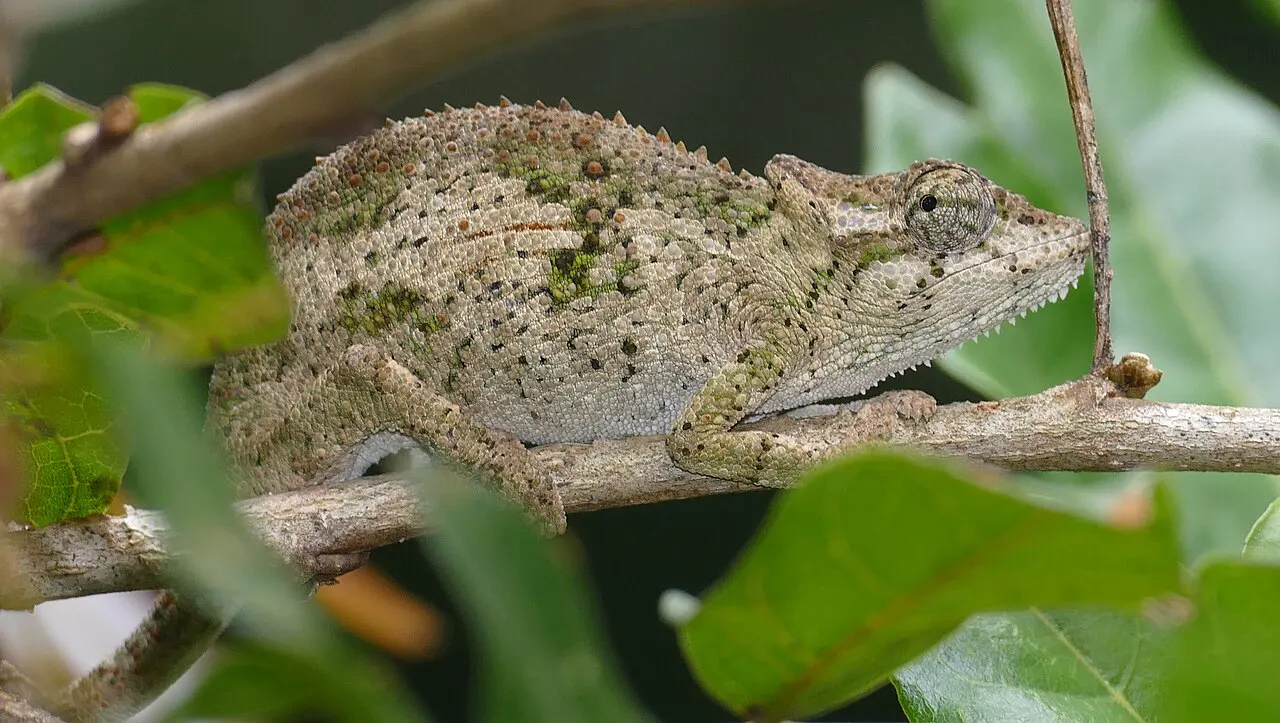
This is a small chameleon, growing to just under 13 cm. It is mostly plain brown, with two or three bright green hourglass-shaped marks along each side. The skin grooves are bright red, and red tubercles are scattered down the tail.
Its scientific name points to the throat. Caeruleogula means blue throat, and Raw and Brothers, who described the species in 2008, named it for the dark blue-grey grooves on the throat. In living animals those grooves, together with red grooves on the flanks, separate it from other dwarf chameleons.
Where it lives
It is endemic to KwaZulu-Natal and has been recorded only in the Dhlinza (Dlinza), Entumeni and Ongoye forests, with the type locality at Eshowe in Zululand. A 2006 study in Oryx put its extent of occurrence at about 88 square km and the area it actually occupies at about 49 square km. The 2022 IUCN assessment gives larger figures, about 230 and 108 square km, and counts three locations.
The habitat is coastal scarp forest, and the chameleons also turn up along forest edges beside roads and in naturally kept suburban gardens within the range. They favour the high canopy but are seen from a little over 1 m up to well over 6 m, especially where light breaks through the trees.
Pins are Wikidata “endemic to” fields. Orange dots, when present, are GBIF occurrence tiles — survey bias included.
How it lives
Females give birth to live young. The species is ovoviviparous, meaning the eggs develop inside the mother.
A 2006 survey in Oryx by Reisinger, Stuart-Fox and Erasmus found these chameleons more often in forest gaps and near paths than in the interior or in heavily disturbed edges. Estimated densities were about 4.7 per hectare in the interior, 8.7 at edges and 29.7 in gaps. The team suggested that warmth and food supply may explain the pull of gaps, and described the species as moderately common where it occurs.
Why it is in trouble
The whole species depends on three small forest patches. The IUCN assessment records a decreasing population, a continuing decline in habitat area and severe fragmentation. The pressures it lists are commercial and small-holder farming, which clear and degrade forest, along with collection of chameleons, both targeted and accidental.
What is being done
The Dhlinza dwarf chameleon is on CITES Appendix II, which regulates international trade, and the IUCN notes that it occurs in at least one protected area. Habitat restoration and site management are listed among the conservation actions relevant to it. No systematic monitoring scheme was recorded as in place at the time of the 2022 assessment.
Sources
Written for this catalog in our own words from the sources below, checked against them on 12 November 2026. Population figures are estimates and carry the year they were made. Status and assessment year: IUCN. 2026. The IUCN Red List of Threatened Species. Version 2026-1. iucnredlist.org.