Endangered
Costate Cinderella Snail
Desbruyeresia costata
The costate cinderella snail (Desbruyeresia costata) is a ribbed, yellowish-brown snail about a centimetre tall that lives around hot-water vents on the deep sea floor, at roughly 1,500 to 1,600 metres. The IUCN Red List rated it Endangered in 2020 because of its tiny known range and the threat of seabed mining.
How to recognise it
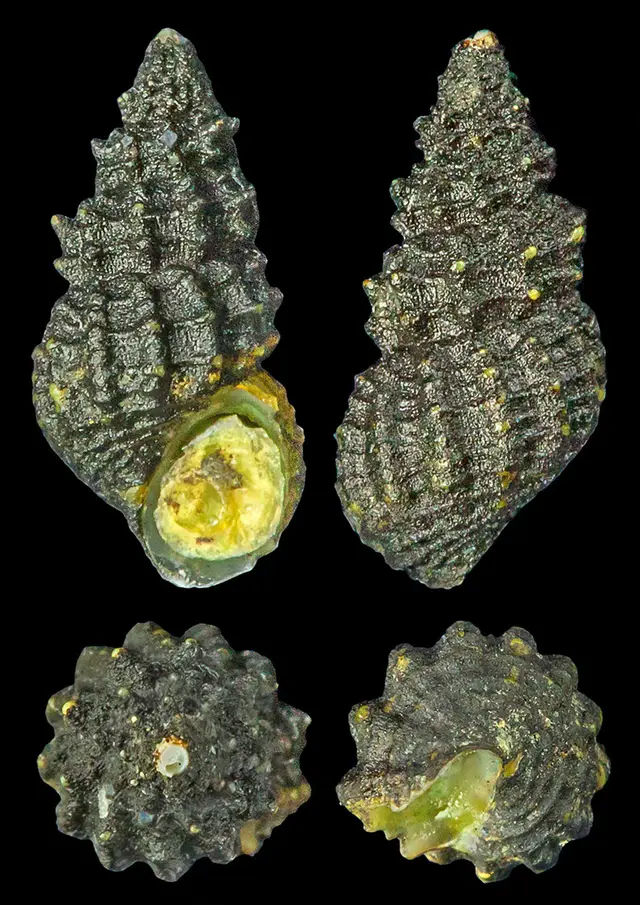
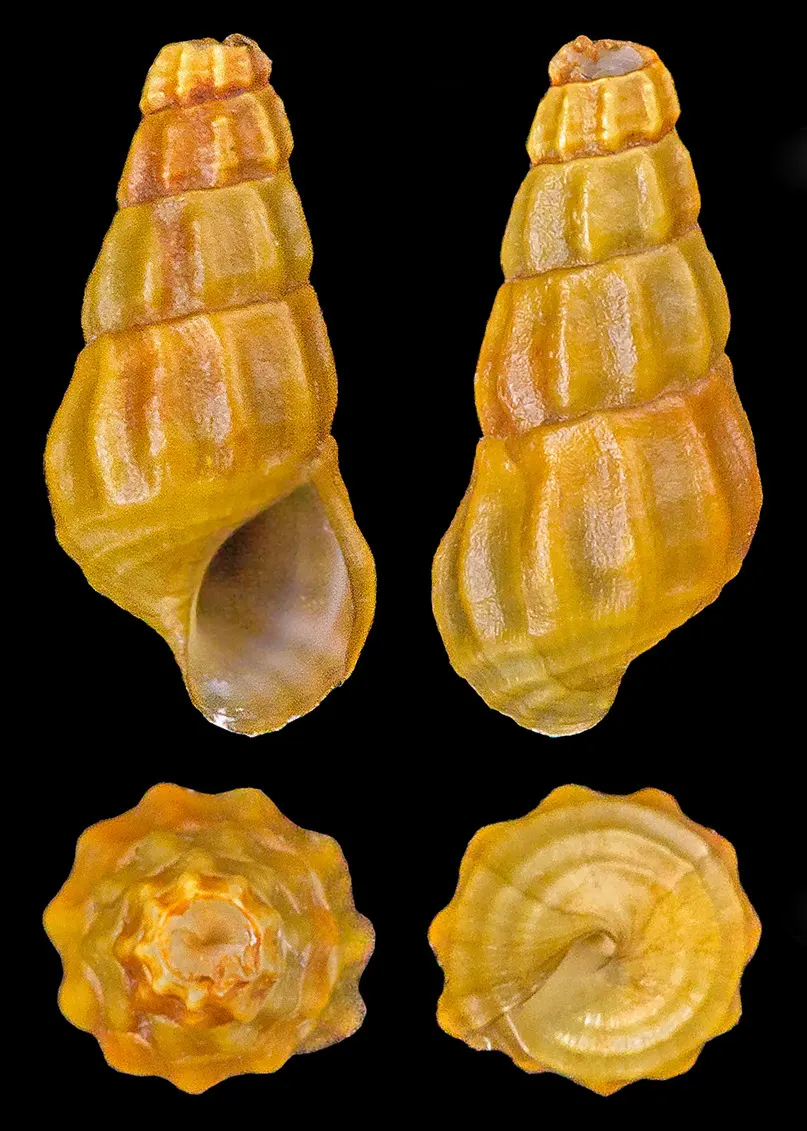
It's a small snail. The largest shell measured when the species was described in 2019 reached 10.5 mm, and the main type specimen was 9.3 mm tall. The shell is thick, tall and narrowly coiled, covered by a yellowish-brown outer skin that sometimes has a hint of red. Some shells carry a thin coating of sulfide minerals.
The name comes from the Latin for ribbed. Ten to twelve strong ribs run lengthwise across the last whorl, while the spiral ridges that make a lattice pattern on its relatives fade away in adults. In big animals the tip of the spire is often corroded away, and the opening is sealed with a plug of extra shell.
Where it lives
Hydrothermal vents are cracks in the sea floor where mineral-rich hot water seeps out, and whole communities live off the chemicals rather than sunlight. The snail was first found at two vent fields in the middle Okinawa Trough, off southern Japan: the Hakurei site in Izena Hole, 1,617 m down, and the Higa field near Gima Hill, 1,483 m down.
A 2022 genetic survey of vent snails in the south-west Pacific found the species only in the Manus Basin, off Papua New Guinea, among the basins it sampled. The IUCN assessment, however, lists only Japan, with two locations, an extent of occurrence of about 232 square kilometres and an area of occupancy of about 8 square kilometres.
Pins are Wikidata “endemic to” fields. Orange dots, when present, are GBIF occurrence tiles — survey bias included.
How it lives
Very little is known about its daily life. It belongs to the provannid snails, a group closely tied to vents and seeps. Its nearest relative among the species compared in the 2019 description is another North Pacific vent snail, Desbruyeresia chamorrensis, which differs by about 6 percent in the mitochondrial gene used for comparison.
Most species in the genus appear to start life as drifting larvae. The apex of every shell examined was corroded, so how this species disperses has not been shown, and it is an open question how well it could recolonise a damaged vent.
Why it is in trouble
The IUCN lists mining as the one ongoing threat, affecting most of the population. Seafloor massive sulfide deposits form at vents, and Japan has tested excavation in the Okinawa Trough. In January 2017 the Japan Organization for Metals and Energy Security removed about 20 cubic metres of material over six hours at an inactive vent about 1,600 m down. Japan aims to start working toward commercial sulfide mining by the late 2020s.
The population trend is unknown. The 2022 survey concluded that species which disperse poorly are among the most vulnerable to mining, and that a vent community's recovery depends on its animals recolonising from other sites.
What is being done
Little so far. The IUCN assessment records no protected area covering the species, no recovery plan and no monitoring scheme. It lists protection of the vents as an action needed, along with research on its biology, population and habitat trends.
Sources
Written for this catalog in our own words from the sources below, checked against them on 12 November 2026. Population figures are estimates and carry the year they were made. Status and assessment year: IUCN. 2026. The IUCN Red List of Threatened Species. Version 2026-1. iucnredlist.org.
- IUCN Red List assessment, Desbruyeresia costata (2020)
- Chen, Watanabe and Sasaki 2019, Royal Society Open Science, four new provannid snails from Japan
- Poitrimol et al. 2022, PLoS ONE 17(10): e0275638, vent gastropod phylogeography in the south-west Pacific (Ifremer Archimer copy)
- Mongabay, Japan prepares to mine its deep seabed by decade's end (March 2024)