Endangered
Armed Cinderella Snail
Desbruyeresia armata
Desbruyeresia armata is a tiny, spiny deep-sea snail living around hydrothermal vents in Japan's Izu-Ogasawara Arc, at depths of roughly 800 to 1,250 metres. Scientists only named it in 2019. The IUCN Red List rated it Endangered in 2020 because it occupies one small area that mining could damage.
How to recognise it
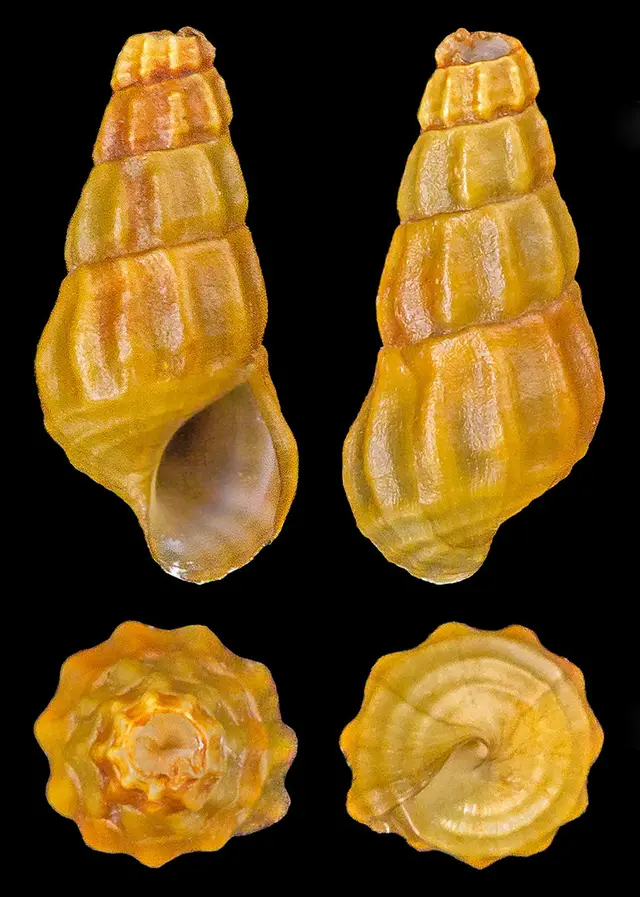
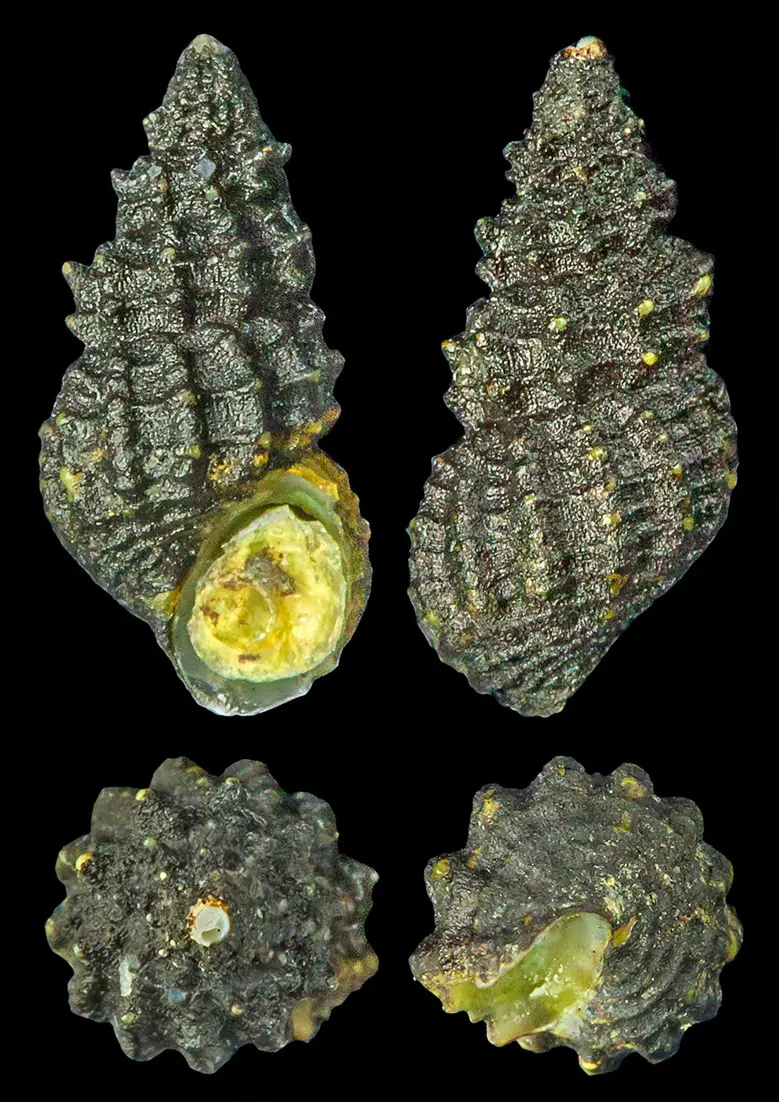
The shell is stout and thick, up to 9.8 millimetres tall, with rapidly widening whorls. A grid of 12 to 14 strong ribs running along the shell crosses several spiral ribs, and short spines or tubercles rise where they meet. Under a thin yellowish-green outer skin, most specimens are caked in black sulfide that precipitates around vents.
Its radula, the toothed feeding ribbon, has unusually coarse marginal teeth with just four large cusps, where most relatives have ten or more fine ones. The species name comes from the Latin for armed, a nod to the spines and the crust. Among its relatives it looks most like Desbruyeresia marianensis, but has coarser sculpture and real spines.
Where it lives
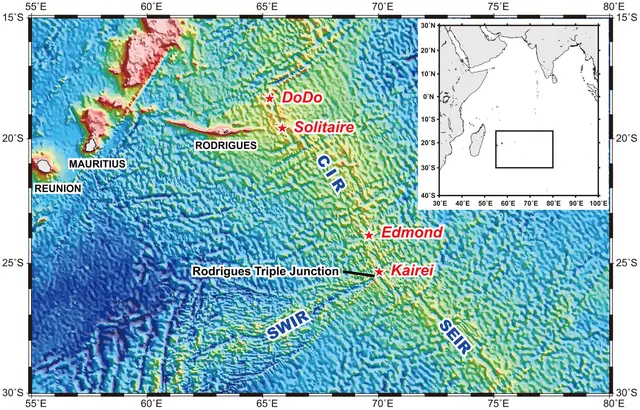
It is known from three hydrothermal sites on the Izu-Ogasawara Arc, south of Tokyo. The type specimen came from Bayonnaise Knoll at 806 metres, collected by the remotely operated vehicle Hyper-Dolphin on 29 August 2007. Three more snails came from Myojin Knoll at 1,244 metres and one from Myojin-sho Caldera at 883 metres.
DNA sequencing places it next to Desbruyeresia cancellata. Its other close relative, Desbruyeresia costata, lives only in the Okinawa Trough, and the scientists who named it suggest geographic barriers keep the two apart.
Pins are Wikidata “endemic to” fields. Orange dots, when present, are GBIF occurrence tiles — survey bias included.
How it lives
Very little is known beyond the shell. The species was described in Royal Society Open Science in 2019 alongside three other new snails from Japanese vents and seeps. The soft parts were not examined because the tissue went to DNA work, and the apex of every shell was corroded. The describing team speculated that the odd radula could reflect whatever surface the snail grazes, but that is a guess, and no abundance figures exist.
Why it is in trouble
The Red List assessment (2020) rates it Endangered under criterion B1ab(iii)+2ab(iii), based on a single location, and lists the population trend as unknown. Its only identified threat is mining and quarrying, which here means seabed mining. A faunal survey of Sumisu Caldera, another vent site on the same arc, points out that nearby Bayonnaise Knoll has a major sulfide deposit, which raises concern for vent animals in the area.
None of the known sites is recorded as a protected area, and no monitoring scheme or recovery plan is in place. The assessment lists resource and habitat protection and action at the international level as the conservation actions needed.
Sources
Written for this catalog in our own words from the sources below, checked against them on 12 November 2026. Population figures are estimates and carry the year they were made. Status and assessment year: IUCN. 2026. The IUCN Red List of Threatened Species. Version 2026-1. iucnredlist.org.