Endangered
Dawkinsia assimilis
Dawkinsia assimilis
The mascara barb (Dawkinsia assimilis) is a small, schooling river fish from the Western Ghats of southwest India. The IUCN Red List assessed it as Endangered in 2023 because of a very small range and ongoing habitat decline. It also turns up in the aquarium trade, often under a wrong name.
How to recognise it
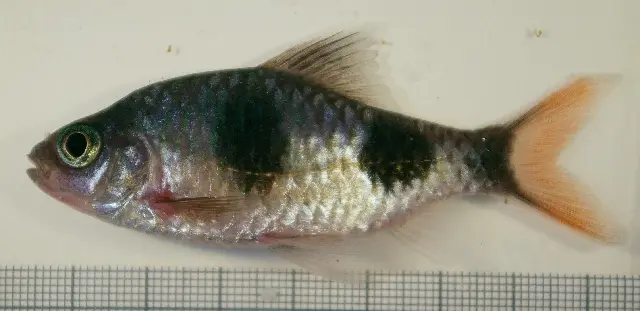
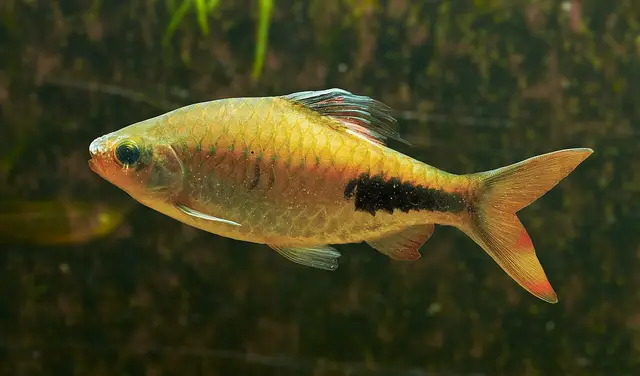
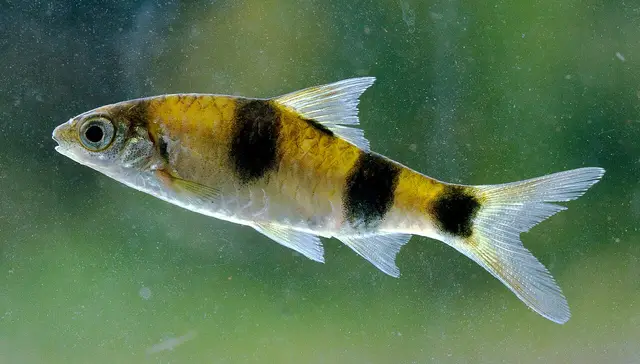
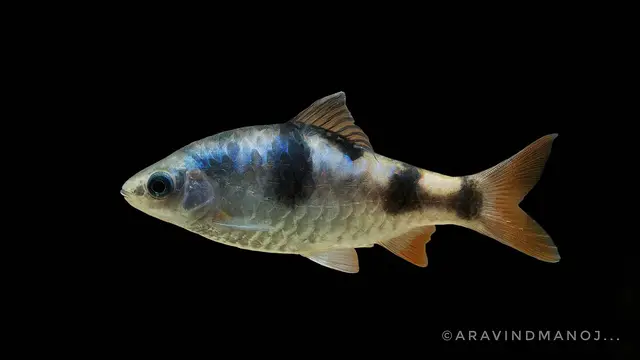
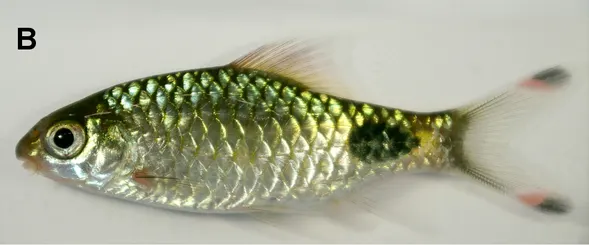
Adults grow to about 12 cm in standard length. The fish has an inferior mouth and a dark blotch on the base of the tail, two to five scales long. The tips of the tail fin lobes carry a black band about as wide as the eye, though this is faint or missing in fish from the Kallada River.
Males are more brightly coloured and grow small bumps on the head when ready to spawn. Females are heavier-bodied and duller. Some populations develop thread-like extensions on the dorsal fin.
Where it lives
It is endemic to the southern Western Ghats. Jerdon described it in 1849 from "a river in Canara", and the type locality is now given as the Netravati River at Dharmasthala in Karnataka. Specimens in recent years have also come from the Chalakudy and Kallada basins in Kerala, several hundred kilometres further south across the Palghat Gap. The full range is unclear. A syntype of a fish from the Bhavani River in Tamil Nadu was once treated as this species, but it may be a separate one, and that question is still being looked at.
The IUCN assessment lists only Karnataka, counts two locations, and gives an elevation band of roughly 39 to 143 m, in permanent rivers and streams. Its extent of occurrence is put at about 2,700 square kilometres and its area of occupancy at 16 square kilometres.
Pins are Wikidata “endemic to” fields. Orange dots, when present, are GBIF occurrence tiles — survey bias included.
How it lives
Habitat differs from river to river. In the Netravati it sits in slow, muddy margins. In the Chalakudy it uses clear, rocky, flowing stretches between waterfalls. In the Kallada it lives in shallow water, under 50 cm deep, among granite boulders.
It eats worms, insects, crustaceans, plant material and organic debris, and lives in groups. In aquariums it scatters eggs with no parental care, and the eggs hatch in 24 to 48 hours. Keepers describe it as intolerant of organic pollution, needing very clean, well-oxygenated water.
Why it is in trouble
The Red List assessment (criteria B1ab(iii)+2ab(iii)) rests on a small, shrinking range. Threats it lists include large dams, nutrient and sewage pollution, run-off, herbicides and pesticides, erosion and silt, and harvesting for food and trade. The population trend is recorded as unknown, and no population size has been estimated.
Dawkinsia barbs are popular with hobbyists, and fish of the genus are both collected from rivers and bred for sale. This species is often sold as the 'mahecola barb', a name that trade lists apply to several Dawkinsia and that properly belongs to a different, smaller, silvery fish.
What is being done
The assessment records that the species occurs in at least one protected area, with an estimated 11 to 20 percent of the population inside protected areas. It lists site and area protection, harvest and trade management, habitat restoration and a genome resource bank among the actions relevant to the species, and records that no recovery plan or systematic monitoring scheme was in place when it was written.
Sources
Written for this catalog in our own words from the sources below, checked against them on 12 November 2026. Population figures are estimates and carry the year they were made. Status and assessment year: IUCN. 2026. The IUCN Red List of Threatened Species. Version 2026-1. iucnredlist.org.