Endangered
Arulius barb
Dawkinsia arulius
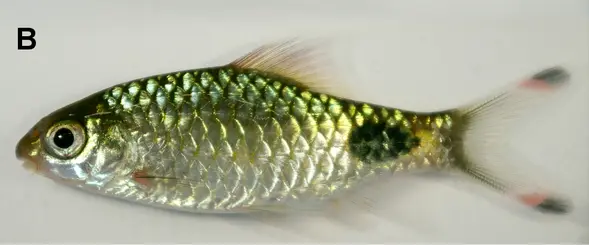
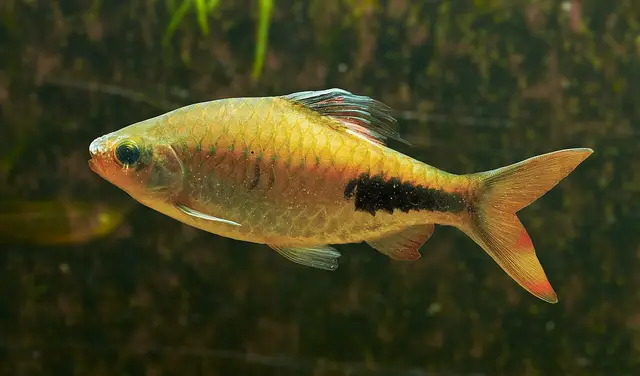
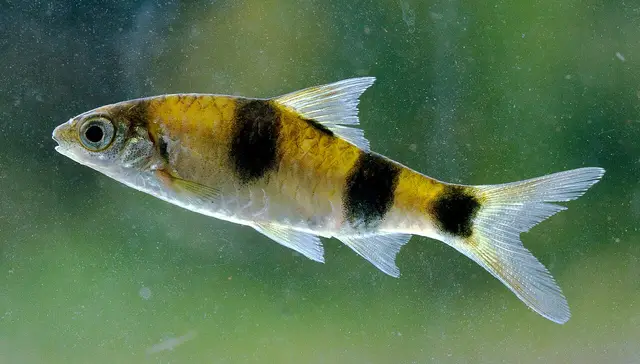
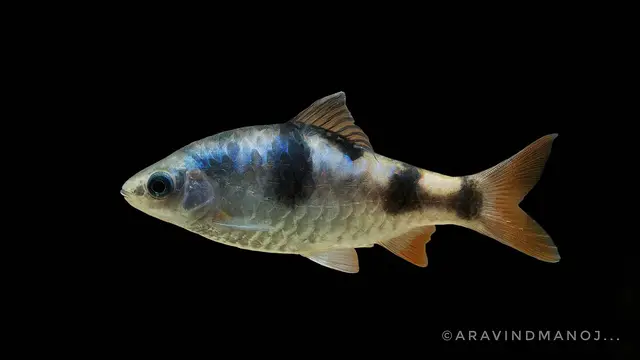
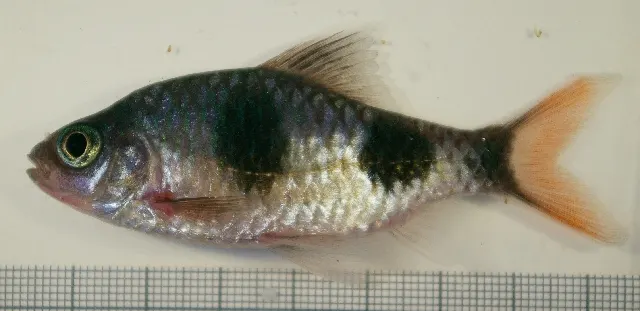
The arulius barb (Dawkinsia arulius) is a small river fish of the Western Ghats in southern India, known from the upper Cauvery and Tungabhadra systems in Karnataka. The IUCN Red List rated it Endangered in 2015. It has three large, smudgy dark blotches and has disappeared from the Cauvery at Srirangapatna, where Jerdon first recorded it.
How to recognise it
This is a slim, active barb that reaches about 10 cm in standard length (12 cm overall in one database). Its most useful marks are three large, diffuse dark blotches on the body. Jerdon placed them beneath the start of the dorsal fin, over the anal fin and at the base of the tail. Short barbels sit at the mouth.
Males are more intensely coloured than females and grow small tubercles on the head when ready to spawn. Females grow slightly larger and heavier. Males of this species lack the thread-like dorsal fin extensions seen in some close relatives.
Where it lives
Jerdon described the species in 1849 as Systomus arulius and noted that people at Seringapatam (now Srirangapatna) on the Cauvery called it aruli. When Pethiyagoda and Kottelat searched there in 2005, they found none, and even local fishers could not identify photographs. The river had been impounded upstream, and the fish is thought to have disappeared from that stretch.
Recent records come from the upper Cauvery around Coorg (Kodagu) and from the Tungabhadra system, including the Tunga and Bhadra headwaters, all in Karnataka. The IUCN lists Karnataka, Kerala and Tamil Nadu, but a 2011 study in the Journal of Threatened Taxa showed that older Wayanad records in Kerala belong to a look-alike with smaller, sharper blotches, which Jerdon described as Systomus rubrotinctus. Other southern Kerala records could not be checked and remain uncertain.
It lives in clean, fast, well-oxygenated streams and rivers over gravel, cobble and boulders. The IUCN counts six to eight locations, an area of occupancy of roughly 200 to 300 square kilometres and an extent of occurrence of about 50,200 square kilometres.
Pins are Wikidata “endemic to” fields. Orange dots, when present, are GBIF occurrence tiles — survey bias included.
How it lives
In the wild it is probably an omnivore that forages for its food. Southern India's monsoon changes stream flow through the year, and some of its streams may partly dry out. In aquariums it scatters eggs with no parental care, and the adults will eat them.
Why it is in trouble
The IUCN names commercial abstraction of surface water and small-scale harvest of fish as the ongoing threats, and records use of the species in the pet and display trade. Its trend is decreasing, and the area of suitable habitat is still shrinking. Dams and polluted water are part of the story. The lower Tungabhadra is described as one of the most polluted rivers in India.
Mix-ups with look-alike species cloud the picture. Fish sold in the aquarium trade as the arulius barb are often the Tamiraparani barb (Dawkinsia tambraparniei), a different species restricted to the lower Tambraparni River, so trade and conservation figures can refer to the wrong animal.
What is being done
Little is in place. The 2015 assessment records no recovery plan and no monitoring scheme, though it notes that the species occurs in at least one protected area and that conservation sites have been identified over part of its range. It recommends protecting and restoring river habitat.
Sources
Written for this catalog in our own words from the sources below, checked against them on 12 November 2026. Population figures are estimates and carry the year they were made. Status and assessment year: IUCN. 2026. The IUCN Red List of Threatened Species. Version 2026-1. iucnredlist.org.