Endangered
Golfito robber frog
Golfito robber frog
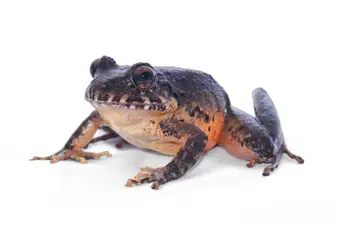
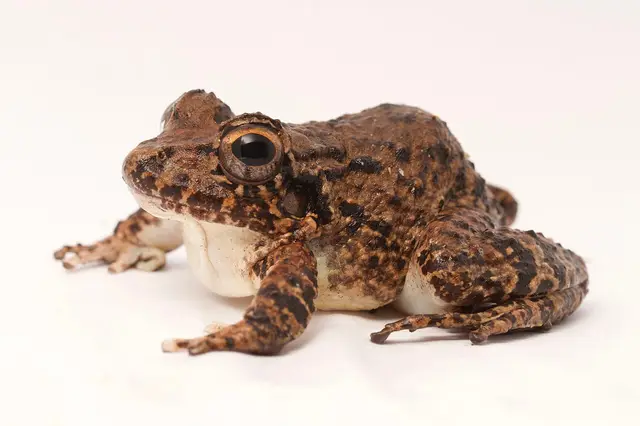
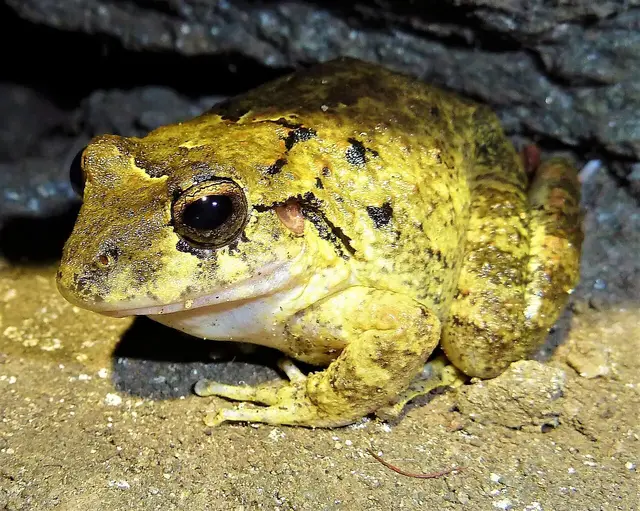
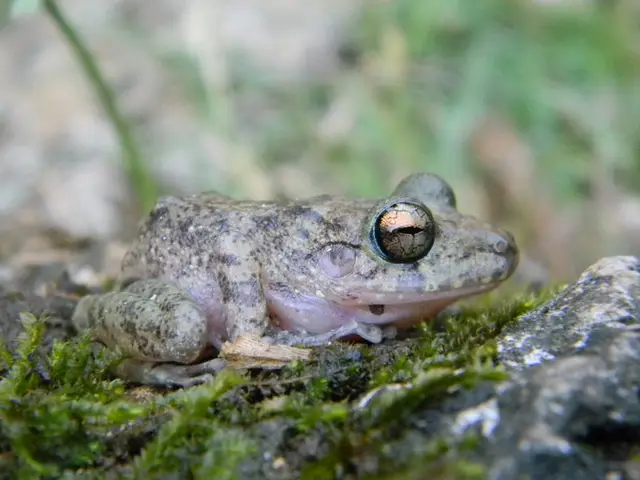
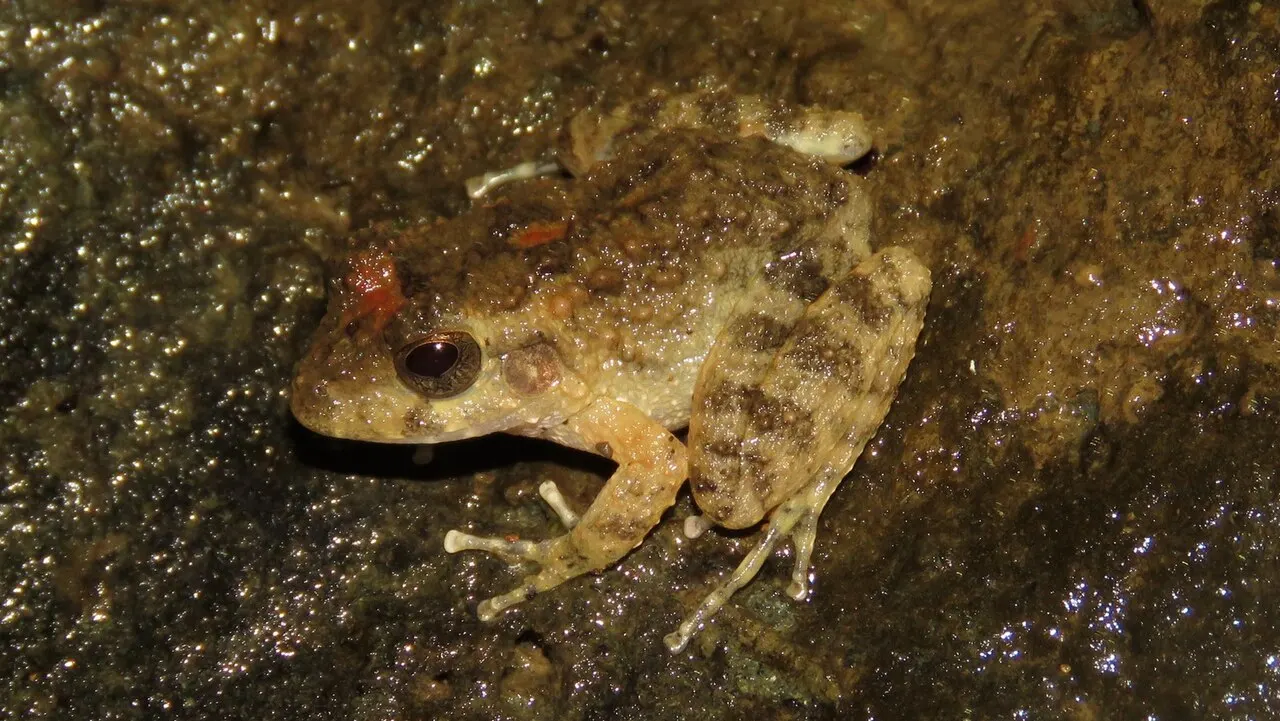
Golfito robber frog, the Golfito robber frog (also called the South Pacific streamside frog), is a big, warty, webbed-footed frog of rocky lowland streams in southern Costa Rica and western Panama. The IUCN Red List rated it Endangered in 2020. After years without a sighting, it turned up again in 2014.
How to recognise it
This is a heavy, somewhat toad-like frog, and the sexes differ a lot in size. Females reach about 80 mm from snout to vent, while males top out near 42 mm. The back is bumpy and grey or brown with darker blotches, the arms and legs carry dark bars, and the feet are extensively webbed. Males have a vocal sac and a relatively larger eardrum than females.
Taylor described it in 1958 as Eleutherodactylus taurus. The species name is Latin for bull.
Where it lives
The frog belongs to the Golfo Dulce region of southern Costa Rica and the adjacent edge of western Panama. It lives along rocky streams in humid lowland forest between about 25 and 525 m above sea level. At night it sits on rocks or in debris, roots and plants along the banks.
The IUCN counts one to three locations and an extent of occurrence of about 915 square kilometres, and records that the frog is not known from any protected area.
Pins are Wikidata “endemic to” fields. Orange dots, when present, are GBIF occurrence tiles — survey bias included.
Why it is in trouble
Museum records place the species in 34 Costa Rican streams between 1963 and 1990. Then it vanished. Researchers sampled 47 streams and tributaries between 2000 and 2012. A 2014 paper in Tropical Conservation Science described the later find as the first sighting after fifteen years of searching, and a news report on the work gave 1997 as the date of the previous one.
What caused the loss is not known. In 1987 a mass die-off linked to the chytrid fungus (Batrachochytrium dendrobatidis) hit at least 17 Costa Rican amphibian species. This frog belongs to the Craugastor punctariolus group, which has lost 26 of its 33 species across Mesoamerica. Chytrid disease is a suspect, although some Costa Rican declines happened at low elevations where the fungus was not thought to be a major threat.
The IUCN assessment also lists farming, grazing, agro-industry, tourism development and water abstraction as threats, and describes the population as decreasing.
What is being done
In 2014 a team found two previously unknown populations at Punta Banco, in the driest part of the historic range. That area makes up only about 4 percent of the old distribution. Swabs from 15 frogs showed chytrid infection in 12, yet the frogs were still there, which suggests they can live alongside the fungus. One idea is that the drier climate at Punta Banco makes outbreaks less likely, but that remains a guess.
The researchers called for continued surveys within the old range, since more populations may exist, and for monitoring and long-term management plans. The IUCN assessment names habitat and site protection, awareness work and captive breeding among the conservation measures for the species.
Sources
Written for this catalog in our own words from the sources below, checked against them on 12 November 2026. Population figures are estimates and carry the year they were made. Status and assessment year: IUCN. 2026. The IUCN Red List of Threatened Species. Version 2026-1. iucnredlist.org.