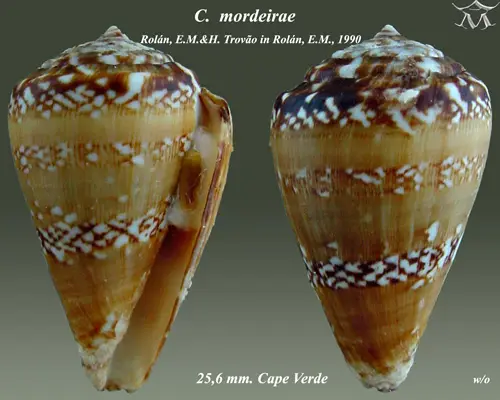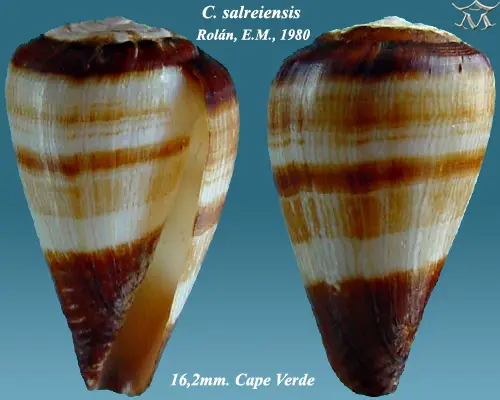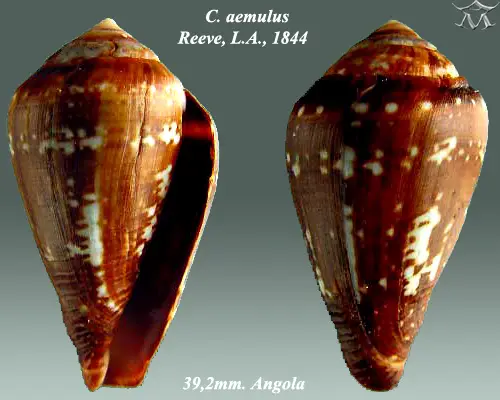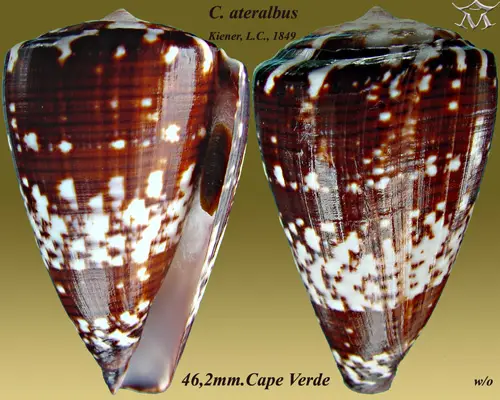
Endangered
Conus richardbinghami
Conus richardbinghami
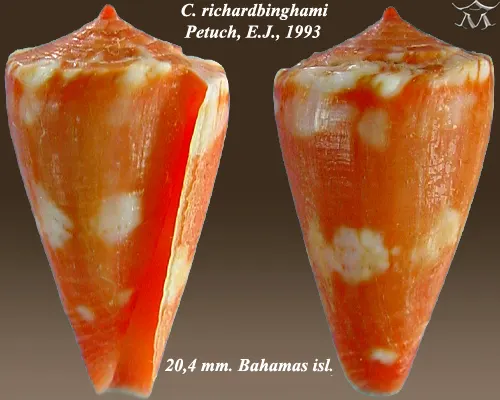
Conus richardbinghami is a small marine cone snail known only from the shallow seabed of the Bahamas. The IUCN Red List assessed it as Endangered in 2025 because it occupies a tiny area, and its numbers are falling. Like all cone snails, it hunts with venom.
How to recognise it
This is a sea snail in the cone snail family, Conidae. Its shell is reported to reach about 35 mm long, so it's a small species even by cone snail standards. It was described scientifically by Edward Petuch in 1993, and the name honours a person named Richard Bingham.
Cone snails are predators that use venom, and some species can sting people. Live ones should be handled with great care or left alone.
Where it lives
The species is endemic to the Bahamas, found nowhere else. The Red List records it from one to five locations, with an estimated extent of occurrence of 315 square kilometres and an area of occupancy of 152 square kilometres. That's a very small footprint for a marine animal.
It lives in shallow water, roughly 10 to 20 m deep in the Red List record, and one encyclopedia entry gives a range of 1 to 20 m. The habitats listed are loose rock and gravel, rocky reefs, coral reef and sandy bottom, all in the shallow marine zone. A specimen in the World Register of Marine Species is credited to the southwest Bahama Bank.
Pins are Wikidata “endemic to” fields. Orange dots, when present, are GBIF occurrence tiles — survey bias included.
How it lives
Published detail on its diet, breeding and lifespan is scant. It belongs to a genus of venomous predatory snails, and the Red List classes it as a non-migratory resident of its small patch of seabed.
Why it is in trouble
The Red List records a decreasing population and continuing decline. The two threats listed are small-scale harvesting for use, which the assessment notes involves international trade, and unintentional effects of small-scale harvest. In plain terms, shells are likely taken on purpose or caught up in other collecting, though the scale of this isn't measured.
There's no population estimate, and whether its population is fragmented is unknown.
What is being done
No conservation actions are recorded for the species, and no systematic monitoring scheme is in place. The Endangered listing rests on its small range and ongoing decline.
Sources
Written for this catalog in our own words from the sources below, checked against them on 12 November 2026. Population figures are estimates and carry the year they were made. Status and assessment year: IUCN. 2026. The IUCN Red List of Threatened Species. Version 2026-1. iucnredlist.org.