Endangered
Conus rawaiensis
Conus rawaiensis
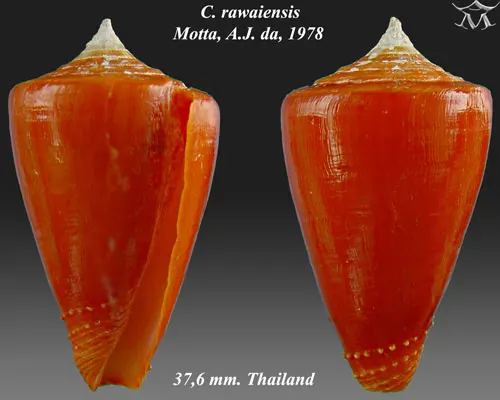
The Rawai cone (Conus rawaiensis) is a small, venomous sea snail of the Andaman Sea off western Thailand. The IUCN Red List classed it as Endangered in 2025 and records a decreasing population. Harvesting of the shells for collectors and crafts is the main listed threat.
How to recognise it
It is a cone snail, a predatory marine mollusc in the family Conidae. Shells are small. Published lengths run from 19 to 48 millimetres, and a Thai government biodiversity database gives a maximum of about 3 centimetres.
Like every cone snail, it hunts with venom. Live cones can sting people, so they should be handled with great care or not at all.
Where it lives
The species was described by da Motta in 1978. It is a marine snail of shallow water, recorded on sandy seabed at roughly 10 to 30 metres deep. The Red List treats it as restricted to Thai waters and counts just two locations.
Some references also list Sri Lanka in its range, which conflicts with the Red List. Thailand's own database records it only from the Andaman Sea, where it goes by the common name Rawai cone.
Pins are Wikidata “endemic to” fields. Orange dots, when present, are GBIF occurrence tiles — survey bias included.
Why it is in trouble
The Red List assessment, completed in December 2023 and published in 2025, rates the main threat as small-scale harvesting. It describes that collecting as affecting more than 90 percent of the population, with very rapid declines. Cone shells are used by specimen collectors and for handicrafts and jewellery.
Tourism and recreation areas are listed as a further, ongoing pressure, though its scale is unknown. The assessment also records a continuing decline in the area the species occupies.
What is being done
Very little is on record. The assessment says no systematic monitoring scheme is in place, and it lists no conservation actions. Research priorities include population size and trends, life history and ecology, harvest and livelihoods, and threats.
Thailand's national assessment rated the species Near Threatened in 2025, a milder rating than the global one.
Sources
Written for this catalog in our own words from the sources below, checked against them on 12 November 2026. Population figures are estimates and carry the year they were made. Status and assessment year: IUCN. 2026. The IUCN Red List of Threatened Species. Version 2026-1. iucnredlist.org.