Endangered
Conus madagascariensis
Conus madagascariensis
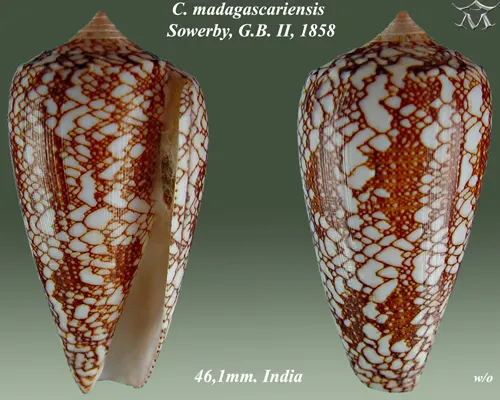
Conus madagascariensis is a venomous cone snail that lives on sandy seabed, rubble and reefs off southern India, and some references also list Madagascar. The IUCN Red List assessed it as Endangered in 2025, after estimating that numbers have fallen by about half.
How to recognise it
This is a marine gastropod in the cone snail family, Conidae, described by G. B. Sowerby II in 1858. Its shell measures roughly 44 to 81 mm. Like other cone snails it is a predator that hunts with venom, and it is reported to be able to sting people, so live ones are best left alone.
It is sometimes listed under the name Darioconus madagascariensis. The name Conus madagascariensis is the one the Red List uses.
Where it lives
The Red List records it in the Indian states of Andhra Pradesh, Tamil Nadu, Karnataka and Kerala. Some references also give Madagascar, though the assessment's list of places names only India.
It lives at depths from about 9 to 50 m. The habitats named are sandy bottom below the tide line, rubble between reefs, and coral reef itself. The assessment estimates its extent of occurrence at about 345,000 square kilometres, a wide area, so the concern here is decline rather than a tiny range.
Pins are Wikidata “endemic to” fields. Orange dots, when present, are GBIF occurrence tiles — survey bias included.
Why it is in trouble
The 2025 assessment estimates a population reduction of about 50 percent over the period considered, and the assessment takes a generation to be about 10 years. The estimate rests on actual or potential levels of exploitation, together with a loss in how much of its habitat is occupied and in habitat quality. The causes of the past decline are not well understood, and it is not known whether they have stopped.
Pollution is listed among the pressures on its habitat: sewage, run-off, nutrient loads, herbicides and pesticides, and oil spills. The population is still declining. The only use recorded in the assessment is specimen collecting. More broadly, a 2024 survey of cone snails in the Andaman Islands in Frontiers in Marine Science pointed to overexploitation and unregulated trade for shell collecting as risks for cone snails in India, where around 93 species have been recorded. That study did not cover this species.
What is being done
Nothing specific is recorded. The assessment notes there is no systematic monitoring scheme for the species, and it lists no conservation actions in place.
Sources
Written for this catalog in our own words from the sources below, checked against them on 12 November 2026. Population figures are estimates and carry the year they were made. Status and assessment year: IUCN. 2026. The IUCN Red List of Threatened Species. Version 2026-1. iucnredlist.org.